Apr 22, 2013

Poultry on the Prowl


During a recent trip to Hawaii I found out some interesting things about chickens. When we were on a tour of Oahu we saw many chickens that seemed to run wild. Would they be “feral” chickens?   When we reached a lookout point high in the mountains of Oahu the area seemed to be inundated with chickens.  I believe they were what are normally referred to as “game fowl”: the type most often seen competing in cockfights. We asked the guide about why there were so many wild chickens, and his response was that during a hurricane in 1992 many chicken coops had been destroyed, and the chickens had been set free. There were some very young chickens there as well.  They were between  “bitty” and “pullet” stages. I tried to get close enough to catch one but had to settle for a picture. The small ones would make a good meal for a fox or snake, but the chickens have few natural predators, perhaps, only hawks and other raptors. There are no foxes, and the mongoose, “Iole manakuke”, does not inhabit all the islands and usually eats only the eggs. There are no snakes in the Hawaiian Islands.  
Kauai probably has the greatest population of feral chickens. While there I learned something which could have helped me a lot when I was a farm boy. When Saturday came and there would be fried chicken for Sunday dinner, it was my job to catch and kill the unfortunate Rhode Island Red for said Sunday dinner.  I would chase and catch the unfortunate creature before performing the decapitation with my trusty axe. But, while on that mini-bus tour of Kauai our guide told of a different, and albeit more humane, method of execution. (I’m not sure “humane” can be used in reference to animals.) As we, the tourists, gathered around the middle-aged woman in Hawaiian dress she explained catching chickens for the pot in her youth.  She said, ” First you have to catch the chicken. Then you tuck the chicken under your arm, and you stroke the feathers on his back gently. Then you take your forefinger and tap ‘em in the forehead above the eyes.  The chicken will go limp in your hands ‘cause he’s dead.”

If I had known that as a kid there would not have been blood spurting everywhere, and I wouldn’t have had to have been so accurate with the axe. And never would I have heard the phrase, “Running around like a chicken with his head chopped off.”


Apr 14, 2013

Wait 'til September.

cellphone image
"I think we can," I said to my best friend, Jimbo.  We were two young boys in our twelfth year on the cusp of a great adventure.
"Aunt Helen would say that we're stealing," Jimbo said somewhat pleadingly.

"Not really.  We'd just be borrowing the boat." I countered.

We were on the edge of a farm pond in the red clay area of South Carolina.   School was out, and our shoes had come off for the summer. It was a beautiful day; the sun was shining, and a gentle breeze rippled the dark green water.   We had started our big adventure the night before.  The two of us had camped out in a big gully and cooked our breakfast eggs over a campfire. If Jimbo would go along with me we could have some real fun.

" I think we can get that padlock open if we hit it with that rock,"  says I.

"I don't know about this..." Jimbo's voice trailed off.

"Just hold the lock on that big rock and I'll bust it with this rock!"

"Well...alright," my best friend said begrudgingly. He gingerly placed the rusty padlock on the large rock and held it at arm's length. The fourteen food wooden boat was chained to a large pine tree near the water.

Bam!

"See.  I told you it'd be easy"

Jimbo helped me push the boat away from the bank and we climbed in. The water was warm.  We struggled a bit as we clamored aboard.

"Tony, how we gonna paddle?"

"We'll use our hands.  I seen it once in a Davy Crockett movie!"

And there we were, two best buddies floating out in the middle of a three acre farm pond on a beautiful summer day. A largemouth arced through the air in the shallows and made a big splash.
"I wish I'd brought my fishin' pole!" we exclaimed together. Visions of that fish on the end of my pole danced in my head!

"Shhh!" I warned Jimbo.  "Somebody's comin'," I whispered.

I heard the voice calling me. "Tony...Tony-boy!"  It was my grandmother.

"What we gonna do?"  Jimbo asked frantically.

Exhibiting my cleverness, I said, "We'll slip over the side of the boat and hold on.  The boat will be between us and Grandma, so she won't see us."  We were very quick and hardly made a splash in the water. My grandmother came to the edge of the pond opposite us and called again.  We were quiet as mice. But then we heard my grandmother hurrying away and screaming, "Gladys, them boys have done fell in that pond and drownded!" She repeatedly screamed until we couldn't hear her anymore. We knew it was time to get ashore and maybe hide somewhere, but we were not fast enough.  As we were securing the boat, my mother appeared. Her face was red.  She was disheveled and breathing hard from running.  And, there was a look on  her face that was not a loving motherly look.

"Your father will deal with you when he gets home, young man. And Jimbo, I'm sure yours will deal with you too,"  Mama said. When she called me "young man" I knew I was in trouble!

It was the end of our great adventure.  When Daddy got home from work he used a system of discipline that he said always worked on dogs and boys. "A stick on the behind sends a message to the mind!"

Can't wait 'til September.  I can sit down again then!

Apr 8, 2013

Shades of Gray

USS North Carolina BB-55
"I don't see how anyone could do it," she said.
"What?" I asked.
"This," she said, making a large circular motion with her arm.
"Oh, the battleship," I responded and added, "I think someone or some group decided what they wanted in a battleship and then hired a company to design and build it."
We were looking at a diagram of the BB 55, the USS North Carolina, while standing on the second deck of the ship.

All thirty-six thousand tons of the battleship North Carolina sits in the mud at low tide in Wilmington, NC.  It was a crisp April morning when we bought our discount tickets and boarded the iron and steel behemoth.  As soon as my feet set foot on the wooden deck I found myself behind a machine gun pointed skyward. I was in the footsteps of a man who had stood there almost seventy years ago. I could imagine how his eyes searched for a Japanese torpedo plane determined to sink his ship.

Claudette awakened me from my daydream and we walked aft under the enormous 16 inch guns.  Yes, the projectile was 16 inches in diameter.  Near the fantail is a Kingfisher floatplane.  It is perched on its center float much like some giant winged insect.  The North Carolina had two Vought OS2U Kingfishers, which were used for scouting the enemy.  Only one Kingfisher remains on the North Carolina, and both catapults used to launch the aircraft are no longer aboard. I tapped on the aircraft's float and heard that nice hollow ping of emptiness.

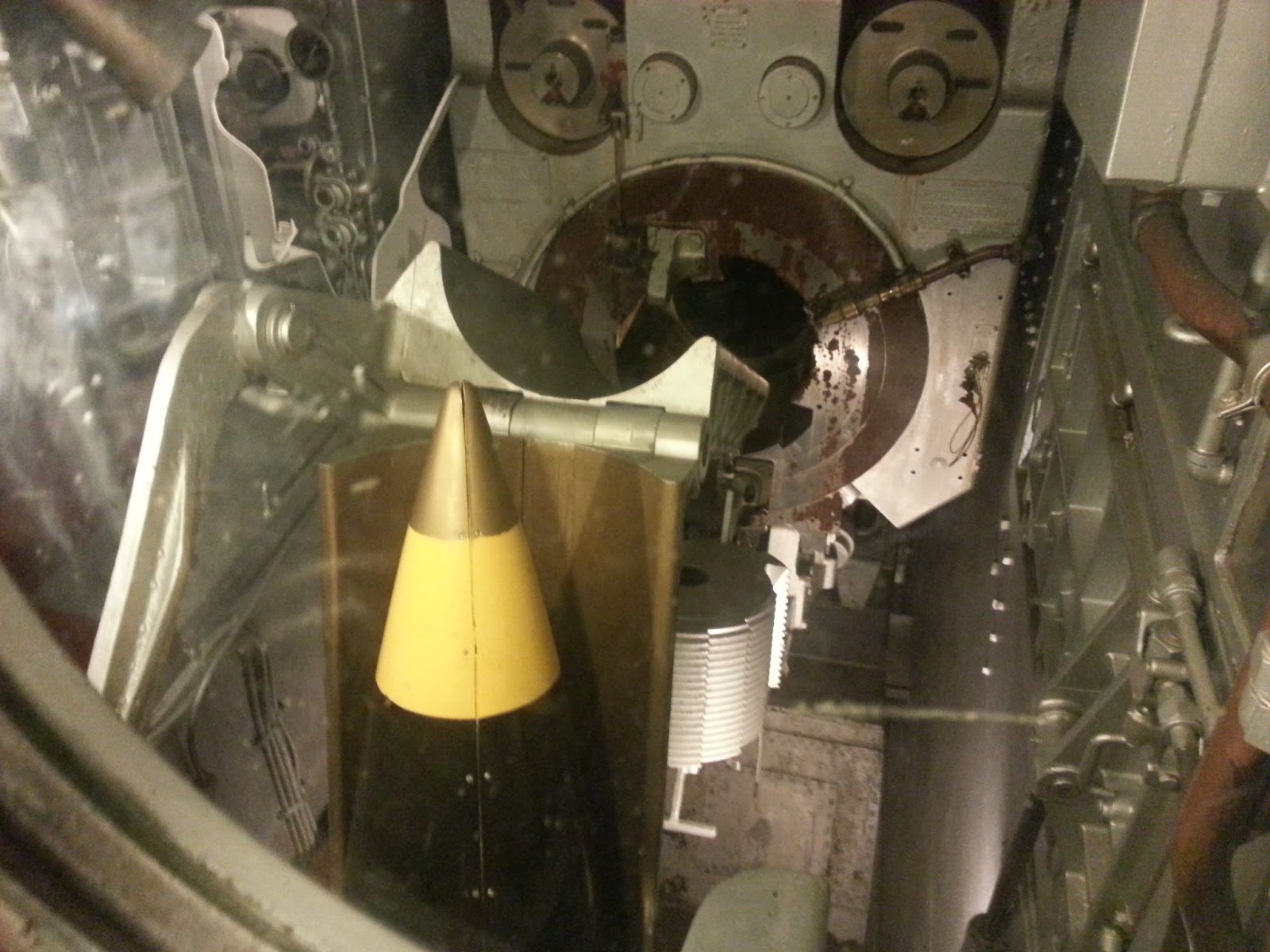
I really like airplanes, but what I really wanted to see were the big guns. We were near the aft (rear) gun turret. It's almost  as big as  a two car garage, with three big guns. There was a steel ladder extending from an open hatch.  I had to climb in. It was poorly illuminated inside.  Metal worn bare
Inside the aft gun Turret.
from usage shined in the darkness.  It was like being inside a machine. The mechanisms that moved the barrels of guns were visible as was the machinery which placed the projectiles and black powder into the breech of the guns.  The area was crowded but clean and smelled of machinery oil, and maybe a hint of burnt powder. Each gun is shown is various stages of being loaded. Cardboard cut-outs of men perform the work.

I needed to go below and see where the powder and projectiles were stored.    I extricated myslf from the gun turret and felt my feet firmly planted on the deck. "Here is a way to get down below," she said, standing beside a door marked, "Enter to go below decks." 
We found ourselves in the dining area or mess deck in navy speak.  There is a sameness about the naval ships I've been on. Their passageways, hatches, doors, decks, and compartments are the same.  They are reminiscent of the Millennium Falcon, Enterprise, Serenity and many other spaceships, or perhaps it's the other way around. Following the signs we found ourselves in the Fire Control Department.  Before I  joined the Navy I thought that fire control meant firemen.  Not so! Fire control refers to control of gun fire from the ships' giant guns. The compartment had plexiglas walls. This allowed the visitors to see the giant analog targeting devices used to calculate the targeting position for each of the nine 16 inch guns. These computers were the size of steamer trunks and were truly amazing mechanical devices. However, my cell phone has more computing power. The signs in the passageways pointed the way to the magazines.

There were more ladders before getting to where the munitions were stored.  We entered a circular room where bullet shaped projectiles taller than the man in front of me lined the walls. The projectiles are painted pale blue. Interesting. Could this be because pale blue is the school color of the University
Punch bowl USS North Carolina
of North Carolina?  Through a watertight door we went, and we were standing on the catwalk around a caverous circular room of about thirty-five feet in diameter and at least that depth below us. In the center is the shaft upon which the  gun turret rotates and the elevator for carrying the powder to the gun. We descended via a spiral ladder to the deck to see the powder magazine off to the side. Powder is neatly packaged in one hundred pound bags.
We climbed back to the upper deck to see the dining area again and visited the kitchen a.k.a. galley, the hospital, sick bay, as well as dental office, post office, and ships store.

Claudette raised her head up from the brochure and said, "Did you know there were 144 officers and 2,195 enlisted men including 100 Marines assigned to this ship?"
"No, not exactly, but I know battle wagons like this one had as many men as aircraft carriers," I answered. 
We continued to tour the ship, steering clear as much as possible of marauding teenagers. The crew's berthing area brought back memories.  I remember my rack as being 61 inches long and 21 inches wide. A piece of grommeted canvas was laced to the aluminum frame with a mattress on top. These were before the advent of foam rubber and instead probably used the usual mattress material. I once had the top rack.  There were three men underneath me. It was kind of like sleeping on a shelf. You slid your body in and out.

Continuing our walk Claudette noted, "The officers sure had better quarters," as we looked through the plexiglass wall of a junior officers shared stateroom."Yes, they did, and the senior officers had private staterooms.  Wait 'til you see the wardroom where the officers had their meals!"
But we did not see the wardroom on the USS North Carolina.  It had been converted into a hospitality area to be used for social or business events.  However, the silver punchbowl, cups, and silver tea set were on display. Examples of the ship's china and silverware were there too.
As we ascended the superstructure we were inundated by middleschoolers.  Some were extremely rude and had to be counseled with. The bridge housing  the ship's steering wheel, the helm in navy speak, was fairly crowded with tourists.  I failed to find the telegraph which sent the messages to the engineroom regarding the ship's speed. While in the superstructure we saw the captain's at sea cabin, the chartroom, and CIC, the Combat Information Center.  We found the ladders full of students as we descended to the main deck.  I took a close look at a twenty-five foot motor whaleboat with its small diesel engine.  After some kids stopped playing on one of the anti-aircraft gun tubs I was able to seat myself behind the gunsights and raise and lower the gun with the handcrank.  I blasted every Zero out of the Wilmington sky! 


Mar 26, 2013

They call it Gaudy


I banged my head on the ceiling. It was not the first time, but it was the first time I had banged my head on the ceiling of a first century church.  We were in Cappadocia, Turkey, visting an early Christian church. Carved into a volcanic rock mountain, there was a narrow nave leading to an alter. Above it were crude images of crosses carved into the stone, and, of course, the ever present fish symbol.  I was struck by the simplicity of the sanctuary, which was quite a contrast to the  Sagrada Famalia in Barcelona, Spain.

I had never been a big fan of Antoni Gaudi Cornet, the  Catalan architect of the great Spanish church. I remember him from Art Apre. 101, but his designs seemed a bit bizarre to me The shapes were too amorphous, almost organic, and his use of concrete and ironwork seemed crude. I could well understand how we created the English word, gaudy, as a not so glorious comment on his work. But then I traveled to Spain and learned to appreciate, nay enjoy, the work of Gaudi. My appreciation came from the many displays and exhibits at Casa Mila. There I learned that Gaudi based much of his designs on those designs in the plant and animal kingdoms. Also, his style is in some ways a reflection of his heritage.  Gaudi's ancestry was filled with ironworkers, stone masons, carpenters, and other craftsmen. You can see this influence in his work. Gaudi had a unique working method, in that he rarely drew plans of his designs.  He preferred to make three-dimensional models of them.

It was not my intent to visit Basilica y Templo Expiatorio de la Sagrada Famalia, more commonly known as Sagrada Familia.  However, due to the urging of the dear sweet lady to whom I am married, I visited one of the most popular World Heritage Sites. We got off the bus and walked a few blocks to the construction site. I say construction site, because the construction of the cathedral started in '82, that was 1882, and it isn't complete yet.  As you look skyward there are eight spires reaching over 500 feet into the brilliant Spanish sky with construction cranes beside them.  It doesn't really make for a "Kodak Moment". There are many people in line. I don't like lines. I think my dislike for lines stems from my time in military service. We wait in line.  After all, it is the Sagrada Familia.


When you enter Sagrada Familia one of the first things you notice is how different it is from other cathedrals. Of course there is the extremely high ceiling in which you envision a cloud. It seems to lack the classic cruciform shape. There seems to be a total lack of sharp edges. The structure seems to "flow" around you.  There is space for 9,000 people.  It is vast.  The giant columns reach for the vaulted ceiling, but before reaching it form branches like those of trees.  And then there is the light. Light beams into the sacred space through stained glass and unstained glass windows. The stained glass images are abstract, stylized like that of all sculpture in the cathedral. The floor and white interior walls are bathed in ever-changing color and interesting shadows. A time lapse video of this would be spectacular! We ventured outside after studying the alter and its crucifix bathed in color.

There are three facades to the Sagrada Familia. The Passion. The Glory. The Nativity.  The Nativity was completed first, while the Glory Facade is yet to be completed. The sculptures and relief carvings are very ornate. Gaudi's love of nature is expressed in the amount of vegetation created in stone and concrete. (I wonder if Gaudi's vegetarian eating habits contributed to his love of plants.) Looking up, we see the eight spires. There are to be eighteen of them depicting the twelve Apostles, the four Evangelists, the Virgin Mary, and Jesus Christ. Christ's spire is in the center and the tallest.  The structure is awesome. But somehow that descriptive term seems to be inadequate.

We enjoyed our visit to Sagrada Familia, and if per chance we visit Barcelona again it will be on our "must see" list.

Wikipedia Photo

Mar 20, 2013

New Stuphphffz

I like new stuff but I'm cheap.  I prefer getting the best value. As you know from these blog posts I like to travel.  And because much of it involves flying I am constantly trying to find ways to reduce the amount of baggage I carry. other than baggage, another thing I dislike, although I favor the reason for it, is airport security. I do not hurry well.  And it seems TSA is always hurrying me. My problem is that when I carry my laptop and CPAP machine.   I have to open both before they are scanned.  I don't like this. Both are necessary.  The CPAP for my health and my laptop for blogging, emailing, editing photos and video and so on. One way I have found to lighten the load is to leave my Macbook at home.  I've found that my cell phone, a Samsung Galaxy SIII, with the proper apps can perform all the functions I use my laptop for while traveling.   Wifi is not always available so it's necessary to store posts and other data occasionally. Since I am budget conscious, the hardware and software is the least expensive kind. Dare I call this additional hardware peripherals?

Hardware 

  • USB-on-the go  (4 ports to connect USB plugs to phone)
  • Roll-up keyboard
  • Micro-mouse
  • Memory card reader/writer ( I bought one that accepts 3 types of cards)
  • Flash drive
  • Memory cards
Software AKA Apps

  • file manager app

Wireless (Bluetooth) mice and keyboards are available. My archaic versions were about $10.
Since flashdrives and memory cards serve the same purpose you can use either.  I prefer to use my flash drive for such things as movies and the cards for storage.  Also a card reader allows you to down load images or video  from your camera if you don't used the camera in your phone.
The file managing app is a must.  You must have a method for moving files to your storage devices as well as having access to the information stored on cards or flash drives.

This set-up has reduced my carry-on weight considerably as well has presenting a more compact system.