Nov 26, 2013

Milano

When you take the subway from Milan's train station, Milano Centrale, to Piazza Duomo prepare yourself for an  architectural delight. Entering the piazza from the Metro you'll be looking directly at Duomo di Milano, Milan's cathedral.  Piazza Duomo is the center of the city; all streets radiate from this central location. It was drizzling rain when we emerged, but we had reached our destination: Italy.  We would be on the peninsula for seventeen days.  Why not begin in the industrialized north, in Milano, the symbol of that industry? It is the second largest city in the country, with a population of over eight million, and is the center of commerce and  industry.

We had directions to our hotel. Unfortunately, rarely is there any standardized street signage in Italy. Building numbers aren't necessarily sequential, and sometimes street names change when they pass through an intersection. Also, streets and plazas will have the same name but will be preceded by either "piazza" or "via". These factors, coupled with the usual language problems, made finding our hotel, which was "an easy walk from the Metro", less than simple. But, we found it on a narrow street probably twelve feet wide including the pedestrian lanes.  The hotel door was flush with the street so that from the door of the hotel you were only one step from oncoming traffic. (I'm not being critical of Italian cities.  If it works for them, so be it!) Our other misfortune was that we had left our itinerary at home, along with our hotel and train reservations, and our Eurail passes. Claudette had made a frantic call from New York for a neighbor to FedEx them to us. It was an angst creating event. We settled into our room and then went out for pizza and to explore.

The Duomo di Milano is the second largest church in Italy and the fifth largest in the European Union. The piazza was brimming with tourists; tourists taking pictures, tourists staring up at the facade, tourists gawking, tourists appearing lost, and we were a part of it all. It truly is an awesome structure, perhaps due to its French architects. With multiple spires, its dome is not obvious like most Italian cathedrals.  We entered the nave.  The church is cruciform. Many churches are cross-shaped. The huge columns are eighty feet tall. It is, as all cathedrals, filled with gilded statues and ornamental artwork. The body of some cardinal long since deceased lies in a glass enclosure, and candles lit by worshipers illuminate the darkness. In the apse we saw a small red light high on the wall.  According to the walking tour we were listening to on our smartphones the light marks the storage spot for one of the nails used  on the cross of Christ's crucifixion. This spectacular cathedral took six hundred years to complete.  The American writer, Mark Twain, was quite enamored with it.

Close by the Duomo is the Galleria Vittorio Emanuele II, a truly unique shopping mall.  It's cruciform as well, with walls over one hundred fifty feet tall and an iron and glass vaulted roof. Construction began in 1864.  The architect,  Giuseppe Mengoni, unfortunately fell to his death from the scaffolding a year prior to the completion of the galleria. It was virtually destroyed by bombing in WWII but now houses the creme de la creme of shops following its restoration. Here you will find Prada, Gucci, Armani, Versace, and many more. It is the land of big bucks shopping, or rather big euros shopping. The floor is of beautifully inlaid marble. After a little window shopping we noticed a crowd gathered in one part of the galleria. In the center of the crowd we saw a young man spinning around on his heel. Claudette grabbed my elbow as we navigated through the crowd for a closer look. "I know what it is," she said.

"Oh, yeah?" I answered.

"He is spinning around with his heel on the Bull of Turin for good luck," she said with that thrill she gets from telling me about something I don't know.

"So what's the Bull of Turin?" I asked.

"In this galleria are the coat of arms of four cities, and Turin is one," she said then added, "and the one with the bull is Turin! By the way, you must put your foot on the bull's testicles for luck!"

"I'll bet PETA hasn't heard about that!" I knew I had to take a spin. I waited my turn and placed my heel on that most sensitive part of the male anatomy and began to turn around. I took a couple of turns and started to walk away when an Italian woman yelled at me. 

"Si deve girare intomo tre volte! Si deve girare intomo tre volte!

Somebody in the crowd yelled, "She said you must turn around three times."
And so I did. And then Claudette did her spin also. We have been waiting for the good luck. 

The next morning, upon awakening, I looked out our window to see a FedEx truck in the street; yes, our itinerary,  Eurail passes, and travel documents had arrived from the Creek. So maybe there was something to that spinning around on the bull. After breakfast of brioche, yogurt, and cappuccino we were on our way to see more of the second largest city in Italy. 

The Museo della Scienza e della Tecnologia Leonardo da Vinci is not easy to find. We rode the Metro to get to that area of the city where the museum was located. Once again we were befuddled by the Italian system of numbering buildings. There was very little signage for this large museum. The lines were short. I knew once I saw the huge steam engine linked to an electric generator that I was in the right place.  We climbed a stairway to a second level where there were display scale models of many of Leonardo da Vinci's machines. They were large exquisite models.  Many had the inventor's drawing displayed nearby.  The most complicated piece was the powered loom.  Noticeably missing was the multi-barreled cannon and battle tank. Throughout this part of the museum there were many displays of scientific discovery and technological advancements from radio to computer.  There are classrooms for structured learning as well.

There are other buildings in this museum complex which was once a monastery. In the train building, which has a roof like a train station, there are steam engines and street and trolley cars.

Next door is and even larger building housing a ship. Yes, a ship, a schooner, with masts reaching the ceiling. There is a two-man submarine and airplanes and a helicopter. One particular airplane I had not seen before was an early British jet design built by the Italians in 1950.   The building also houses the bridge of an Italian ocean liner. Outside this building are three jet fighter planes, two built under U.S. license and the other Italian, a Fiat, from the 1950's. Also outside is an Italian submarine. Viewing the inside of the submarine requires an additional ticket. We've seen a number of submarines so not seeing the interior of this one was not a big deal. 

Or next attraction to visit was Milan's castle. We like castles. Castello Sforzesco is Milan's 14th century castle built for defense. Today it houses several museums and an armory. Entering the castle is free, but a ticket is required for the museums.  We chose to buy a ticket for the museums, with our primary objective being Michelangelo's last masterpiece. But, it was not to be.  That exhibit was closed.  However, such things are not uncommon. We were disappointed, but there are several good museums within the castle walls.  A musical instrument museum and a decorative arts museum are beautiful and informative. There is also a display of tapestries. It seems to have been a common practice to design the tapestry in Italy but have it manufactured in Flanders. Of course my favorite part of the castle was the armory.  There is a good collection of arms and armor from the spear to primitive firearms. I thought it was interesting to note that as weapons improved, body armor decreased. It is a good collection, not on par with the armory in the palace in Madrid, but still quite good. 
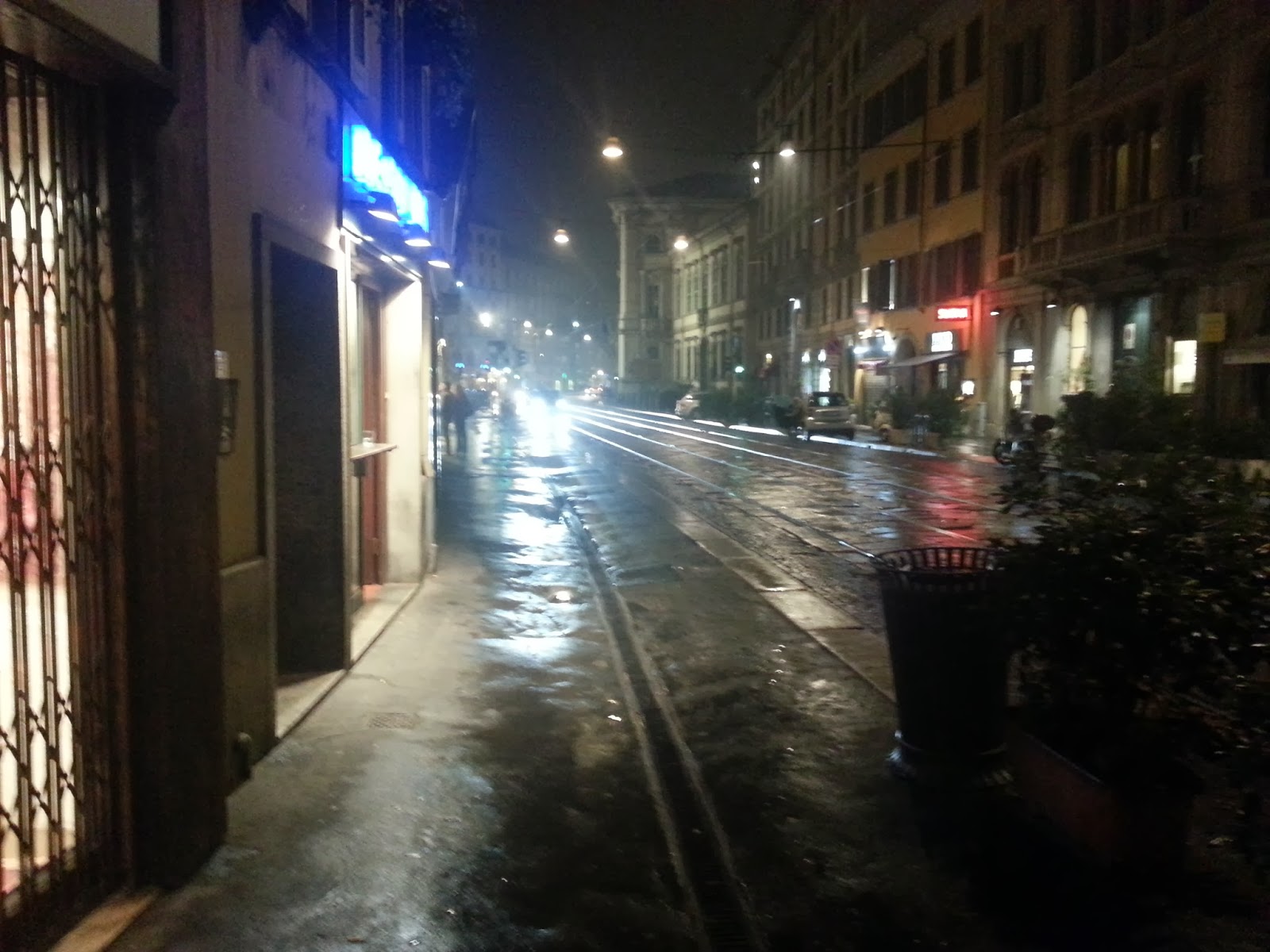
On our way back to our hotel we looked at some ruins  of the Romans. We had dinner our last night in a restaurant near the hotel. It was great. Food is expensive in Italy. You order by courses. Each course will be from eight euros up. But the food is outstanding.  After dinner we decided to get a gelato. I was pessimistic about gelato.  I had been told how great it was so many times, I had convinced myself that it could not be better than ice cream.  How could anything with less butter fat be better?  I don't know how they do it, but they do. It is better! We were only a few blocks from Piazza di Duomo. The streets were wet from a light rain, and lights presented a symphony of reflected color. It was great walking along, window shopping, people watching, and munching a caffe gelato with your best girl.  Life is good.

The next morning we caught our train to Venice. 


Nov 20, 2013

Escape from Lido

"Is it four o'clock already?" I asked groggily as the phone rang.

"Sure is," she said, removing the receiver from the phone, " We have an early train to catch."

I dragged myself out of bed and glanced out the open window noting the deserted street below.

We we in the Hotel Cristallo Venezia  on the Island of Lido, about fifteen minutes across the water from Venice's Grand Canal. Lido is a natural island, unlike Venice, and has a beach, airport, and wheeled vehicles. It also forms a barrier from the Adriatic Sea. We had spent a delightful few days in Venice, but we had a 6:15 train to catch for Rimini.

"Come on now! We don't have time to waste.  The first vaporetto comes at 4:56, and we have to be on it to get  our train!" She referred to the water bound bus which moved people around the city built on pine and oak pilings driven into the lagoon floor.

Twenty minutes later we had our backpacks on and were in the hotel lobby. There was no desk clerk, and we had checked out the night before to save time in departing. I placed the key on the counter as Claudette headed for the door. I was feeling proud of getting up on our own so quickly.

"I can't get the door open.  I think it's locked!" she said with a hint of concern in her voice.

I grabbed the handle and attempted to open the open the door without success. "Hit the bell on the counter," I said.  The bell rang loudly.  We expected to see a sheepish desk clerk appear.  "Ring it again!" I said.  She did, but the sound fell only on our ears.

"What are we going to do?" she asked.

"Call 'em!" I said, then added sheepishly, "That won't do any good.  The phone will just ring here, and there is nobody to answer it but  us.  Maybe there is another way out..."

"Where?"

"I don't know, but I think there is a patio on the other side of the dining room," I said as I walked through the doorway into the dining area where we had had breakfast. One wall had a ceiling to floor curtain. I opened the curtains to find sliding glass doors beyond through which I could see the outdoor dining area. I slid the doors open and entered the patio in the cool morning air. The dining area was surrounded by a vine covered fence two meters high.  No gate. I kicked one of the chairs against the fence in frustration. What next?

I went back into the lobby area. Claudette had found a key and was trying it in the door. No luck.

"We have to get out of here.  We can't wait for someone to come and open up.  We have reservations for that train with our Eurorail passes. We have to make it!" she said with desperation in her voice. "What about the burglar alarm? We've ransacked this place and no alarm goes off...why? Maybe someone would come..."

"Hey, don't think about it.  We don't need to be confronted by the Italian police now!" I added quickly.

I went behind the counter. The desk was a mess; she had already gone through everything on the desk and all the unlocked drawers. "There's gotta be a key here somewhere," I said.  I don't know if I believed there was a key or was trying to convince myself that there was. Behind a stack of papers and some magazines on a bookshelf I found a small metal cabinet mounted on the wall. The door was slightly ajar. The grey metal door swung open easily.  There was a row of hooks about seven inches long and upon them hung keys.  There were individual keys and several keys on keyrings. Keys!

"Hey, I've found some more keys! One of these has gotta work!" I said with new hope in my voice.  "Here try this one!" I said as I tossed a large key across the counter to Claudette at the door. I rounded the counter with a handful of keys as she tried to get the key into the door with shaky hands.

"Better let me try," I said as I elbowed her out of the way at the door. I methodically tried each key with no success. They were all either too big or too small or would enter the lock and not turn the tumblers. "Are there any more keys there?" I asked in desperation. Claudette was behind the counter now.

"I don't think...Oh, here's an old one," she said as she tossed it to me.

It fit the lock.  I turned it gently with anticipation. To my disbelief the door opened.

We wasted no time in congratulating ourselves.  We had a train to catch. At a rapid clip we walked nearly a kilometer to the vaporetto dock. My injury from a few days earlier in my right leg was throbbing as we passed the pizza parlor, gelato shop, and newsstand. We could hear the boat approaching as we bought our tickets from the vending machine.  Of the half dozen people boarding we were the only travelers. The other people were on their way to work. Water traffic was slight. Unlike the norm there were many seats available on the boat, so we settled in for the forty-five minute ride. It was like riding a commuter train with many stops on either side of the canal. The evening before we had taken this ride on the No. 2 boat to see the Grand Canal illuminated at night. Many of the lights were still on in the misty morning light. The ride was a bit smoother due to the lack of traffic. The crowds of tourists, that blemish on the cityscape, were missing as our boat continued toward the train station and the terminus of this voyage and our visit to Venice.

The dock at the train station was the last stop. We scrambled off the boat and ran for the train. Soon we were aboard the train for Rimini. We finally relaxed in the deeply upholstered seats and enjoyed some coffee and brioche. Soon we would be on a bus to the mountaintop country of San Marino.


Oct 14, 2013

Gone

USS Bon Homme Richard
Wikipedia Photo
  "We don't want no **##&##** boots in here!", said the bearded man in dungarees and chambray shirt, as he hurled the stool across the shop floor. It was my first day aboard the USS Bon Homme Richard, an aircraft carrier operating in the South China Sea in 1966. A  recent grad of the US Naval Training Center at Great Lakes, IL, I had flown to the Philippine Islands, and after a wild ride through the mountains on a bus from Manila to Subic Bay I boarded the Bonny Dick.  There were six of us "boots" assigned to the Electronics Division. The ships  berthing compartments were full, so-o-o, no racks or bunks for us to sleep in. We were given cots to set up in the forecastle of the ship for our berthing area. It wasn't so bad except for boatswain's mates waking you up in the middle of the night when coming back from liberty while under the influence.

Since we had no skills as electronic technicians we knew we would be performing menial tasks. The technicians onboard thought us to be useless. We were insulted by the term "boot". After seeing the action in the shop I maintained a low profile.  During this heavy buildup for the war effort in Vietnam the Navy could not train electronic technicians fast enough to fill the demand. Consequently, all the technicians had their enlistments extended. This made for some very unhappy sailors. Morale was at an all time low. I didn't speak unless spoken to. But, one of our group did keep a very low profile. He was a young man from the midwest; Jacob Swenson was his name. He was tall, slim, and blonde, a prime example of his Nordic ancestry. A rather likable fellow, Jake got along rather well with us "boots", although he tended to brag too much about his knowledge of electronics. He had an Associates degree from a technical college. The  "old salt" technicians seemed to take offense when he offered unsolicited technical advice.

After a few days aboard the time came for the "boots" to be assigned their duties. Some were assigned to the laundry and other tasks, but I, being fortunate to have a last name beginning with the letter "Y"  was told that I would be working in the shop. (I found that my name being near the end of an alphabetical list was always to my advantage in the Navy.) It was no surprise that Jake was assigned mess deck duty. Aboard ship, mess deck duty was probably the worse duty you could have. Usually it meant scrubbing pots in the scullery, peeling potatoes, or carrying  hundred pound boxes of frozen meat up from the refrigerated locker far below decks.  Jake complained to deaf ears and was told to move his gear to his berthing compartment on the mess deck. At least he
would have a rack and not be sleeping on a cot.

We were at sea and all seemed to be well.  The ship was underway for San Diego**, her nine month deployment coming to an end.  On those brilliant sunny days the ship's wake would appear as a straight line west to the horizon. We were going home.  Everyone seemed to be happy except
for those unhappy about Navy regulations requiring us to be clean shaven when entering port. I had been assigned the task of keeping the repair shop tidy. My most important duty was to keep the fifty cup coffee urn full and the coffee urn area clean. A standing order was never wash a coffee cup.  The WestPac OE Division scudzy coffee cup contest would not end until we tied up in San Diego. There were things growing in some of those cups!

I was in the shop when a Chief Petty Officer called from the mess decks asking when was Swenson was going to report to him. I thought Jake was already there.  I had helped him pack up his stuff three or four days previously. The shop watch relayed the message to our Division Officer, Lt. Robinson*, and he assured the chief that Swenson had been sent below to him. Our Division Officer called the Division to muster and asked us all to look in our area for Swenson. We did not find him. Soon we heard the message over the 1MC, the shipboard intercom, "Man overboard! Man overboard! All hands to your muster stations!" Over one thousand sailors and officers gathered in assigned spaces to be accounted for.  Helicopters were launched to search the sea near the ship. Everyone was accounted for... except Swenson. Designated crew members continued to search the ship but no one found Jacob Swenson.  Of course my mates and I discussed his disappearance.

Robbie said, " 'E ran off at the mouth too much!"

"Yes, he did.  He liked to tell everybody how smart he was," I added.

"The ship's investigator is looking into it. That's the scuttlebutt," added Jamison, trying to sound like an old salt.

"Yeah, I hear they questioned Celick," Okie chimed in.

"And the Eskimo, too!" Robbie said.

"You think they think somebody pushed him overboard?" I asked.

"Dunno, but cain't nobody swim cross no ocean," Okie added.

We heard the bosun's pipe over the 1MC " Lights out, Lights out, about the ship.  Maintain quiet about the decks!"

"'Night, guys," I said, as I wiped a drop of sweat from my brow and tried to go to sleep.

About a week later the Old Man, the Captain of the Bon Homme Richard, came on the 1MC and said, "Seaman Jacob Swenson, if you are aboard the ship, please make your presence known. I'm preparing a letter to inform your parents that you were lost at sea. That is all."  Swenson did not make his presence known to the captain, or anyone else for that matter.  A few days later I was in the shop in the early morning trying to organize some technical manuals on a shelf over the aft workbench when I found a curious thing. Amongst the books was an old black dial telephone. A most interesting note was attached to the handset. It read, "This phone is dead and so is Swenson." A chill ran down my spine.  A shipmate had left that note...

                            
All names are fictitious, but the incident is a true event which happened in January, 1966.
** the ship was home ported in San Diego and went into the shipyard in San Pedro where every part of the ship was given an overhaul before the next deployment--no sailor was found.


Oct 7, 2013

The Mill on the Bridge

"There's a covered bridge not far from here," Aaron said as I was finishing my second cup of coffee.  Claudette and I were at the Edenhouse Bed and Breakfast in Swainsboro, Georgia. This was our second day at Edenhouse, and we were planning our day. Swainsboro is about 70 miles from Savannah and not much of a tourist attraction, so we were surprised that there would an example of Americana nearby.

"Tell us more," I said.  Our rotund innkeeper was sitting at a nearby table. We had enjoyed conversation with Aaron since our arrival.  As a retiree of the U.S. Air Force he had many interesting stories.

"It's just a few miles from here, near Twin City.  It's at the George L. Smith State Park.  There's a grist mill, cotton gin, and sawmill too. And, you know what the best thing about it is?" he asked.

"Nope," I said.

"A four hundred acre lake," he replied.

"Wow," I said and turned to Claudete to say, "Let's get movin'".

Claudette knows all about my fondness for old grist mills and the like.

We left Swainsboro on Highway 80  for Twin City, and there we followed the sign pointing to the George L. Smith State Park, but we never saw the entrance to the park.  When we reached Metter, Georgia, we realized we had missed the entrance. We took an alternate route back to Highway 80 and found another sign indicating the direction to the park. There is not actually an entrance to the park. As you drive through a pine forest you see signage indicating the locations of campsites and cabins. Eventually we saw the lake and followed the road beside it until we found some buildings by the lake. The small one was labeled restrooms. My second cup of coffee was making itself known, so we stopped in the parking lot under trees which gave credence to the old expression, "higher than a Georgia pine".

Across the road was the lake, studded with cypress and tupelo trees. The waters of the lake were held back by an earthen dam with a covered bridge in the middle of it.

"Claudette, didn't Aaron say there was a sawmill, cotton gin, and grist mill here?"

"Yes, he did, but I don't see anything but a bridge," she responded, "and he said something about railroad tracks going over the bridge, too".

"Well, let's just look at this bridge then. Maybe those fellas fishing can tell us something," I said as I grabbed her hand and walked across the dam to the covered bridge.

About twenty feet inside the bridge, which seemed as wide as the northbound lanes of I-95, I realized that the bridge housed the mill. There were some odd looking wheels about two feet in
diameter over on the side toward the lake under one of the windows.  "They look a little like railroad car wheels," I mused aloud.

"I know what they are!" Claudette said.

"Oh, really," I said.

"Yes I do.  When the horses would  pull wagons onto the bridge they would sometimes get spooked and bolt. So they put those wheels on the wagons and the horses could not pull the wagons in any direction but straight ahead," she said as she gleefully shared her new found knowledge. "See, it says so right here on this plaque mounted on the wall."

"I'm not sure of exactly how that would work...but I guess it would," I said.

Along the wall there were windows so that you could see the interior workings of the grist mill. The history of the mill was told on the wall mounted plaques as well as the technical data about how the grist mill and the former sawmill and cotton gin had operated.  The sawmill had been used to saw some of the timber from which the bridge was built.  The grist mill had begun operation in the 1880's and continued to grind corn until 1973.
Actually, it could grind corn at the rate of two hundred pounds per
hour.  That's a lot of cornbread and hushpuppies!  The mill is currently operated on a limited basis.  I was particularly interested in how the water powered turbine operated.  The older one was on display.  It's about five feet in diameter.  The speed at which the turbine and subsequent mill stone turns is determined by the pitch (angle) of the turbine blades.  It must have been a busy place with everything operating.  We exited the other end of the bridge, and I thought I would see if the fishermen were having any luck.


I walked down the stairway about thirty feet to water level. There were about four fellows fishing there. Just as I walked down, a fisherman pulled out a fish that was black and about fifteen inches long.  The young man in the John Deere cap deftly took the fish off the hook and released it back into the foaming water.

"What's the matter? Was that one too big for the frying pan?" I asked.

"Naw," he said, "That's an old blackfish.  Ain't no good to eat.  Too many bones. Some people call 'em a freshwater shark 'cause they got so many teeth."

"What other kind of fish are in here?" I asked.

"That fella up there caught some bream and crappie," he answered.

"Yeah, a bream's a good eating fish," I said.

"Amen, to that.  Ain't nothin' better," an old timer added.

"Y'all don't catch 'em all now," I said in parting.

We had enjoyed our visit to George L. Smith State Park.  It was a good outing, and we learned a bit, but it was time to head north to our home in the lowcountry of South Carolina.


Sep 30, 2013

The Landing

We turned off the busy highway into another world and drove through a silent tunnel of overhanging live oak trees.
"What's that stuff hanging from the trees?" Nathan asked.

"Spanish moss," I answered, "and did you know it was once used to stuff the seats in Model T Fords?"

 Upon entering a clearing we parked in the lot designated for automobiles. Crossing a wooden bridge we entered the main exhibit structure. I looked for alligators in the pool under the bridge but saw none.  I would have loved to have shown one to our grandson visiting from New Jersey.  We entered the cool and  seemingly dimly lit building to buy our tickets.  As senior citizens, a.k.a. old people, Claudette and I received a discount. Instead of a single ticket discount we opted to buy a season pass to all South Carolina State park attractions. We frequently travel around the state and thought this would be a good companion to our Golden Eagle Passport to all National Parks.

Our grandson was anxious to get started on our tour of Charles Towne Landing in Charleston. There is a wonderful exhibit of artifacts and other items explaining this first English settlement in South Carolina.  One of the most interesting to me was the voyages to the new country, particularly the ships and methods of navigation. They really were iron men in wooden ships. There were other displays depicting colonial life and a scale model of the settlement complete with buildings. Some of the displays contain life-size figures of early settlers and Native Americans.  I noticed that our teenaged grandson had taken a great interest in the figure of a native American young woman who was topless. Having once been a teenage boy myself I could easily imagine the fantasies of his mind.  I suggested to him that it was time to go to the park outside although it would have been great to have read every word of descriptive text in the museum.

We left the cool of the museum to enter the hot, balmy Carolina afternoon. There was no movement of a breeze in the trees, just the stillness of the sun burning thick air. An occasional winged insect made its presence known.

The park has many informative signs, and we followed the one toward the animal forest. The display of wild animals is of those animals that would have been seen by the first settlers in 1670. The winding, well-marked trails carried us by bison, deer, bear, and cougar in their natural habitat.  There was also a caged area for birds such as pelicans and wading birds.  When I visited the park in the mid-seventies there were more animals, particularly smaller ones.  Also there had been elk.  In 1989 Hurricane Hugo destroyed the park, which was initially built to celebrate South Carolina's tricentennial. The reconstructed park did not have the same animals as before. The below ground exhibit space was not restored either.  The bear and cougar do not get close enough to the fence for good viewing, but the river otters always put on a good show.

After leaving the animal displays we walked toward the water. Along the way we passed a primitive building and palisade fortified with cannon.  These are the only seventeenth century cannon on the east coast that are fired with any regularity.  They are fired every third Saturday by volunteers in period costume. As we neared the waterfront we saw the skeleton of an early ship during construction.

"Hey, Nathan," I call out, "let's see how well we can tie knots." There is a panel with short lengths of rope attached for some "hands-on" experience. "I've never been able to tie a clove hitch," I announced.

"Let's do it," he responded, "I learned some knot tying in Boy Scouts." I felt a competition coming on. "I think the cowboys tied their horses to the hitching post with a clove hitch just like this!" I deftly tied the ropes into a perfect clove hitch! First time, ever!

'You said you had never tied a clove hitch!" he exclaimed.

"I haven't. And I know you won't believe me, but it's true," I exclaimed without success.

Next, we stepped gingerly aboard the replica coastal trading ship of the seventeenth century. The young man on board was well versed on period sailing ships and answered all our questions.  This replica ship was built in Maine and was sailed from the shipyard to its current berth. These small ships  could cross the oceans, but they were normally used for coastal cargo ships.  A typical crew for this ship was six to eight men.  The captain and first mate shared a cabin, but the rest of the crew had a common berthing area. It is easy to imagine the cramped quarters below deck when cargo and stores were aboard.


We had a great visit.  It is a great place for family fun. We will return of course; I must see the cannon firing.

My video of our visit.