Sep 28, 2015

The Burial of R. McKinney


It was a hot August day when my mama called to me as I was finishing up an oil change on my old Toyota. “Son,” she said, “get ready to go. Gene just called and said that Rascal was bad sick and she wants to take him to the doctor!”


Aunt Gene was my mama’s sister, and she was a widow woman whose life revolved around a Boston Terrier. Boy, did she dote on that dog, treated him just like a child.  She and Uncle Alvin never had no children.  Yep, that Rascal was the apple of her eye. I mean, when she sat down to eat she fixed the dog a plate just like hers, right down to desert. Sometimes I believe that dog ate better than I did.


When I heard Mama's call, I wiped the engine oil off my hands and cranked up the Toyota.  She was in the  passenger’s seat by the time the engine came to life. “You better hurry,” she  said, “you know how upset Gene can get!”


The little town of Bradley was disappearing in my rearview mirror as we gained speed. I drove frantically down the country road across Hard Labor Creek  and the branch called Cunning Ford. Mama held her handbag in her lap with white-knuckled hands. We made the usual 20 minute trip in about half the time. Aunt Gene was waiting for us by the road. She had the little Boston Terrier wrapped up in a blanket and her handbag hung on her arm.  She was carrying that dog the way a mother would carry her baby. She climbed in the car with tears streaming down her face and we lit out.


‘Bout halfway to town I heard a whimper from the back seat. "I believe he's gone," she said,  her voice cracking.


"Maybe not," I said, trying to reassure her. "We'll be at the vet's in a few minutes."


Upon arrival she carried the little dog into the doctor's office and, sure enough, he was pronounced DOA.


But that's not the end of the story.


"We have to get a casket!" she said, as she got back into the car. She still had the dead dog wrapped up in the blanket.


"What?" I said.


"Go by Walker's, they were good at Daddy's funeral."


I found myself driving to Walker's Funeral Home, one of the two in town. At the rear  were quite a few parking places, and I parked there. Mama had not said a word, but I could imagine what she was thinking. She had a dim view of Aunt Gene's relationship with her dog. “Get him a nice one,” she said, as she  pushed a roll of bills into my hand as I got out of the car. I entered the backdoor of the mortuary and found myself in a room of thick carpeting, dark wood paneling, and soft music. Almost like an apparition Jackson Walker appeared. We had been classmates in high school. Even then, Jackson had the manner of an undertaker; the sympathetic smile, the soft modulated voice, and radiating an eerie countenance.


"My, my! Is that you Tony Young? I haven't seen you since we put your grandpa away," he said.


"I've been kinda busy," I said, which was sort of the truth. I really do not move in undertaker circles. They kinda give me the heebie jeebies.


"So what can  I do you for?" he asked.


"I need as casket for a dog," I blurted out.


"Oh, okay, let me see what I can find," he said in his undertaker's voice.  "I may have something in the attic. Most people use an infant's casket. And what was the name of the deceased?"


"Rascal, and he was a Boston Terrier," I answered.


"That's a small dog, right? I don't care much for dogs myself. My oldest brother, the one in the Marine Corps; he had a dog. And you know what? It bit me! Never cared much for dogs after that.  I believe Rascal will look good in that little white casket I've got upstairs."


"Could you hurry it up a bit?  Mama and Aunt Gene are waiting for me out in the car with a dead dog, and the air conditioning’s busted on the Toyota."


"I'll be right back," he said, as he scurried up the stairway with his hand on the polished rail to steady his considerable bulk.


He returned quickly with a small white coffin on his shoulder. "That'll be $140," he said.


I peeled seven twenties off the roll Aunt Gene had given me and handed them to him.  He
gave me the casket.


"You give Mrs. Young and Mrs. McKinney my deepest sympathies, you hear," he said as I was almost out of earshot.


I took the casket out to the car, and we put little Rascal in it. By this time he had swollen up a bit and was stiff as a board. I must say he probably looked better than he ever did with his head on that little white lace pillow. It wasn’t easy, but I managed to get the casket into the trunk of the car. There was a piece of rope in the trunk I used to tie the trunk lid down. I would not hazard a guess as to what passersby might have thought they saw.


The drive back to Aunt Gene's house was uneventful. She was sitting in the back seat sobbing. Mama would look at me every now and again and roll her eyes. Seeing an eighty year old woman roll her eyes was kinda funny, but I could only smile because my aunt was broken hearted in the back seat.


Once home Aunt Gene picked a place near the muscadine vine beside the house for Rascal’s final resting place. I placed the small white casket on the ground and  went to find some digging tools.  It was about 2:30 or 3 in the afternoon and I’m sure the temperature was nearing triple digits. My Lynard Skynard tee shirt was wringing wet, and my Levis and BVDs would be next.  I scrounged up a mattock and a shovel and began to work. I pulled a bandanna from my pocket and wiped the sweat from my eyes.  As I looked to the sky, what did I see but rock birds.  When I was younger I had worked some with my Uncle Alvin digging water wells. Every time we would see those buzzards in the sky he would call them rock birds.  And sure enough we would almost always hit rock while digging. I sure hoped I wouldn’t hit rock digging this grave. But I’m sure that rock would not have been much harder than the red clay I was digging. It had not rained in two months.  In August, with no rain and the hot sun, even your tomatoes would get blisters. I sneaked around the house and brought two five gallon buckets of water to try to soften the clay.  I would’ve carried more but was afraid I would take too much water from a well that seemed to be going dry. Lot of folks’ wells went dry in the hot summer with little rain.


About two hours later I finished the job. I grabbed a bunch of bitter weeds with their bright yellow flowers and put them on the grave. I was tired, and about the only thing dry on my body was the tops of my socks. Thank goodness, she didn't want a tombstone!

Sep 21, 2015

Amber was not just for Dinosaur DNA

We boarded the bus on  a fairly cool Friday morning  to tour one of Russia's most famous palaces. Naturally it was from the years in which the czars ruled the country, but this palace was not named for one of the czars but rather for the wife of a czar. The palace is known as Catherine's Palace and is often thought to be the palace of Catherine the Great. Not true. Catherine the First was the wife of Peter the Great, and it is her name that is lent to the palace.
Catherine I was quite an interesting person.  Her time and place of birth is not known; only that it was not in Russia. She was a servant girl when she caught the eye of Peter the Great. There are very few "rags to riches" stories that can top this one; from servant girl to Empress of Russia.  


The palace itself follows the grand European style of palaces and was completed in 1756. The exterior is blue with gilded stucco. More than 220 pounds of gold were used in decorating the exterior and various statuary. That would be worth $3.6 million today.  It is rumored that even the roof is covered in gold. As we walked through the rooms of the palace which are open to visitors, we commented on the features it had in common with the abodes of other monarchs of the era. Ceilings were high and decorative. Windows were huge, primarily floor to ceiling in height. There was extensive use of mirrors, and there were huge paintings, some ten by twenty feet in height and width. There was a total lack of tapestries, which we had seen in most european palaces. Huge ceramic stoves were in many rooms. 

 The grandest feature of this palace is the Amber Room. Amber is fossilized tree resin. You may recall that in Michael Crichton's novel, Jurassic Park,  the dinosaur DNA was found in amber. Amber has been coveted for centuries as a semi-precious gemstone. In Catherine's Palace the world famous Amber Room has the walls covered
with thin layers  of amber. The beauty of the amber is enhanced by gold leaf and reflecting mirrors. The room literally glows. No photographs are allowed in the amber room. The room was first assembled in a palace in Prussia and then given to Peter the Great, Catherine's husband, as a gift to seal an alliance against the Swedes. Ordinary words cannot adequately  describe it. Like most palaces of the 18th century, Catherine's Place has beautiful gardens as well.  These are formal gardens beautifully designed and maintained.  There are blooming plants and statues galore.  There are small structures, garden houses to allow guests a bit of privacy for perhaps a tet-a-tet or rendezvous. As we wandered the gardens our guide, Natasha, filled our ears with facts about the palace. Our grandiose surroundings had been enjoyed by the eighteenth century Russian aristocracy, and the lady who built all that we saw began life as a servant!

Sep 14, 2015

Cosmonautica?

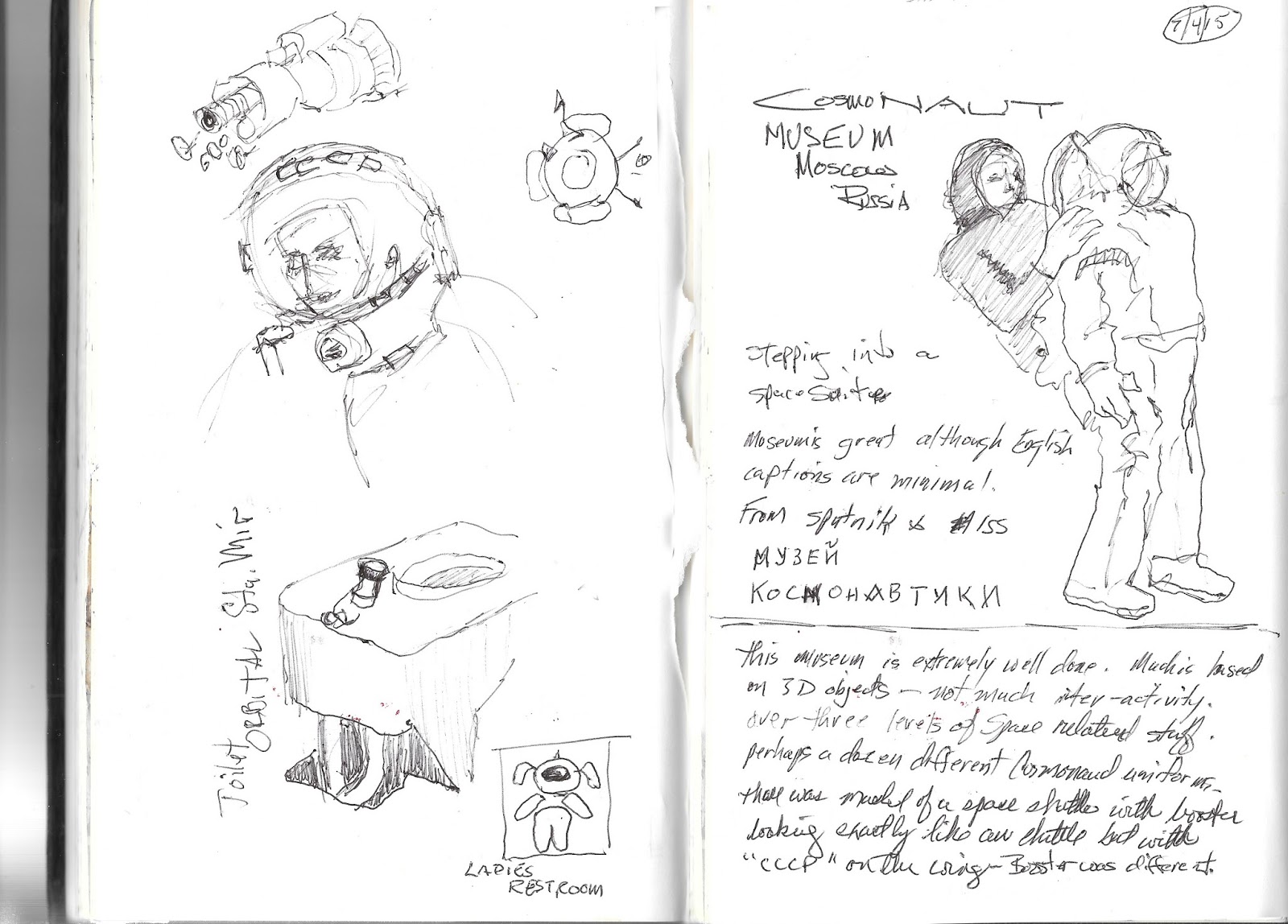
On our recent trip to Russia there was one place that interested me probably more than any other: The Museum of Cosmonautics. I'm sort of at techie at heart.  My wife, Claudette, can attest to this having visited many aircraft, railroad, automobile and naval museums with me.   What better to summarize Russian technology than a museum dedicated to space exploration? It was a "must see" for me in Moscow. The museum is located at 111 Prospekt Mira, VDNKh, and it was easy to find once you learned how to read the Russian metro maps. Like most subway maps the lines are numbered, named, and color coded. Moscow subways are world renowned for their uniqueness. Nearly seven million people a day ride the Moscow subway.  There are two ring lines with a male voice announcing on the clockwise train while the opposite is announced by a female voice.  875 direct current volts move the trains along the tracks at what seems to be extremely fast rate. Published rate of speed is only 25.9 miles per hour. I tend to believe that is an exercise in creative writing. The subway was opened in 1935 and has highly decorative Art Deco waiting platforms with arched ceilings decorated to celebrate the Russian worker. At the end of one of the platforms was a huge hammer and sickle. We queried our guide about it, but she said that was from the old Russia. Russian guides tend not to talk much of the communist ruled Russia or the days of the Union of Soviet Socialist Republics. The columns are connected by archways, many of which have decorative statues. The statues are painted black, but there is a statue of a dog whose nose is shiny bare metal. Thousands of Russians each day rub his nose for good luck.  Claudette and I did too. You can never have too much good luck.

We had to change trains twice to get to our destination.  If you turned left when you exited the train, you were at the museum, but you may not know it.  A man pointed toward a giant monument when I finally got him to understand what we were looking for. This was the Monument to the Conquerors of Space.  It was very impressive.  There is a titanium rocket atop its trail three hundred fifty feet in the air. The base was over fifty feet long and had steps all around. We could see no entrance. I sat on a bench while claudette reconnoitered. While  I sat a few Hare Krishnas came by chanting and beating a drum. The were followed by what appeared to be Russian college students. I guess some things are the same all over. When Claudette returned we decided we would go back to the street and venture further away from the train station.  Sure enough, in less than a block we found the entrance to the museum. We had not turned left when exiting the train.

The Museum of Cosmonautics is sub-terranean beneath the Conquerors of Space monument.We paid an  entrance fee  of 200 rubles, or $2.95.  They wanted an extra 200 for the right to take pictures, and even more if you wanted to shoot video. I thought this was ridiculous.  Instead, I did drawings. Fortunately, I had my Moleskine sketchbook with me. Don't get me wrong, I love to draw, but it An Astronaut's Guide to Life on Earth, all spacemen, whether astronauts or cosmonauts, must perform a specific act to insure a safe flight. When the vehicle which transports them to the spacecraft stops midway, they must get off the bus and urinate on the back tires to ensure good luck. This fact may or may not be listed on a caption in the museum.  My Russian is very poor.  
slows you down when visiting a large museum.   The museum is fascinating and had recently undergone a renovation. It traces Russian space exploration from its humble beginnings to the present day.  I remember when the Russians launched the first artificial satellite. It was called Sputnik.  It was only about the size of a volleyball with some antennae sticking out. People would go outside and look into the night sky and claim they saw it. In cartoons it always made a "beep-beep" sound. The U.S. was caught dreaming about space while the Russians were going there. As a result, American education systems placed renewed emphasis on science and mathematics. Soon the Americans caught up with the Russians and probably surpassed them in space exploration. Yuri Gagarin was the first man to orbit the earth, and his space capsule is on display.  Once he had entered the earth's atmosphere and was at a fairly low altitude he ejected from his capsule and parachuted to earth. The Russians, unlike Americans, always recovered their cosmonauts and their craft on land rather than sea. Gagarin, now deceased, started a pre-launch tradition the is still observed today. According to Chris Hadfield's book,
There are many space capsules and models of spacecraft to be seen. A model of a space shuttle very similar to ours as well as robotic moon rovers which were placed on the moon in 1971 were on display.  The moon rover was actual size.  All displays are extremely well executed. One diorama shows cosmonauts having landed in mountainous terrain during winter. It is a full size rendering of the event. Very realistic. There were two stuffed dogs representing the dogs that flew into space atop huge solid fueled rockets early in the space race. They looked like Jack Russell terriers. It was very interesting to walk through a mock-up of a section of the Mir space station.  It was a reminder of the space station at the Museum of Space and Aeronautics in Washington, D.C. My biggest criticism of the museum is the lack of English captions on displays. Unfortunately, I could not use the translator in my phone because it involves using the camera and I stupidly did not pay the extra 200 rubles for camera use. Also, there were very few direction signs in the multilevel facility.
Did I like it? You better believe it! Would I like to visit the Museum of Cosmonautics again?^ Absolutely!


Sep 7, 2015

Yaroslovl

Yaroslovl@tonyyoungartist.blogspot.com
After the ship docked at Yaroslavl it was time to explore the city.  Soon we were in the historical section of this World Heritage Site.  We began where the city began.  There is an overlook with a gazebo where you can see a park flanked by the Volga and  Kotorosl Rivers.  A notable feature in this treeless park is the bear, and it is a big bear. The bear, which is standing holding a battle axe, is on a white shield. This image is on the flag of the city. The shield and bear are over 100 feet long and are the center piece in a garden.  It is spectacular when viewed from above. Legend has it that Yaroslov, the city founder,  killed a bear on this spot and that is the reason for its use here.  It is a beautiful city with wide  boulevards and streets. Actually, it was once the capital of Russia, but for just a short while.

We walked around the historical part of the city and ventured into the city market. It was covered and sold primarily fruits and vegetables, but also included some sausages and cheeses.  The chef from the ship was there helping hand out samples. The bite-sized samples were delicious. We sought ice cream.  It was a warm day, in the eighties. We could find none, so we went outside. The tent-like booths were close together with narrow alleys between them.  It reminded us of Turkey and Morocco.  We found clothes and other non-food items, but no ice cream. We gave up on our search for that frozen dairy delight, because we had  to meet the tour group at the Church of Saint Elijah the Prophet.

The Church of St. Elijah the Prophet had green onion-shaped domes. The interior of this church is known for its murals. A team of fifteen artists did the painting. The most unusual fact about this mural is that it
depicts figures other than holy ones. Indeed, ordinary townpeople are shown. It is said that the priest responsible for paying the  artist withheld payment. In response, the artist depicted the priest in the mural in a very unflattering manner. The mural is beautiful and has only been cleaned since the seventeenth century. It is rare that a mural of this age has not been repainted. 

Our next stop was the Govermor's Mansion.  Near the entramce there were tables of  extraordinary crafts for sale. Tiny boxes from one inch to one foot were for sale, but these were no ordinary boxes.
They were made of papier mache and embellished with gold leaf and intricate paintings. They were some of the most expensive handicrafts we saw for sale in Russia, but they were objects of unusual beauty. 

The governor's mansion was actually built in the 19th century for a resting place for Emperor Alexander I. Royalty often built mansions throughout the country for restive stops during their travels about their country. This mansion was splendidly decorated and it houses a great art collection. Once we disembarked our motorcoaches we entered the large house and were met by a guide in period dress of the 19th century. She was young, hardly out of her teens, and was dressed in a flowing white gown. I had a momentary wish to become a young Russian male.  In an ornate room with paintings all around and devoid of furniture, she stood by a near waist-high vase of flowers. She gave each of us one to hold. She asked us to present it to someone close to us as she told us the significance of each flower. I'm not sure what this had to do with Russian culture, but it was interesting. Besides, I Iike interactive events. In the next room she told us about the governors who had lived in the mansion, and one tourist who answered a trivia question correctly was allowed to sit at the ornate governor's desk. These were minor treats compared to what was next.  The next room we visited was clearly the largest room in the mansion.  It was the grand ballroom. Claudette clutched my arm as we entered.  "I think that's Strauss," she said referring to the music we were hearing.  In the corner of the large room, which had windows along one side, was a trio of a violin, cello and piano, the source of the music. Along the walls from which hung ornately framed oil paintings were chairs. The tallest painting of a striking ffigure of a man in an 18th centrry military uniform was over ten feet tall.  Soon the ballroom was full of onlookers, and dancers in period dress began to perform.  The young ladies were in their long dresses and the young men in the militaristic outfiits of blue trimmed in white. It was very entertaining. After performing several dances  from earlier centuries the performers picked audience members for dance partners.  It was at that time that an old man's dream became reality. Yes, I, the rhythmically challenged, was on the ballroom floor with a beautiful young Russian girl in my arms attempting to move my body to the rhythms of  Johann Strauss.  Good dreams do come to an end.  The music stopped and Claudette reminded me of reality. 

We were rather tired by the time we were back aboard the Ingvar.  We did not attend the daily briefing, choosing instead to watch it on the closed circuit television. By dinner time we were quite hungry. We dined with Barry and Pamela.  They were a British couple.  He looked very patrician; tall, with well barbered but thinning hair and classic facial features. And she, well she was as prim and proper as could be. We had visited much of the area in England where they lived. Barry was quite a connoisseur of wine and ordered a bottle of Argentine cabernet sauvignon and shared it with us.  Barry liked it, and I thought it was good, although I could not extol its qualities the way he could.   Dinner with Barry and Pamela was the perfect ending for our first day on the Volga.  


Aug 31, 2015

Kizhi, Russia

It was a warm morning under a cloudless Russian skies as we walked onto the pier at Kizhi.  Actually, my problem with this place was like many others I had encountered since landing on the largest country on earth. HOW do you pronounce the names of some of these towns?  Even if you see it written that is not always helpful, because they use a different alphabet. So what was it?  How did you pronounce the name of the town? Fortunately the Russian guides came to my aid. I don't think I would have ever realized that it was "Ki-zee" or as they would have printed in Time magazine, rhymes with "Lizzy". There was a boardwalk across a marshy area  from the pier where the big white river cruise ship tied up. Our guide warned us about the possibility of snakes. I thought it was too cool for them to be out but watched my step anyway.

As we walked out from beneath the trees that border the lake the first thing we saw was the Church of Transfiguration.  Around this church with its twenty-two onion shaped domes was a high wall.  As we walked toward it I could hear a voice in my ear. (When we were touring a site with a guide she would transmit commentary to the small radio receivers we carried.) It was kind of like that little voice Magnum, P.I. heard, but not quite.  She was telling us why the church looked so strange. And indeed, it did look strange! That is if you can imagine a multi-level octagonal structure topped with domes appearing stranger than usual. What she was referring to was the fact that you could see
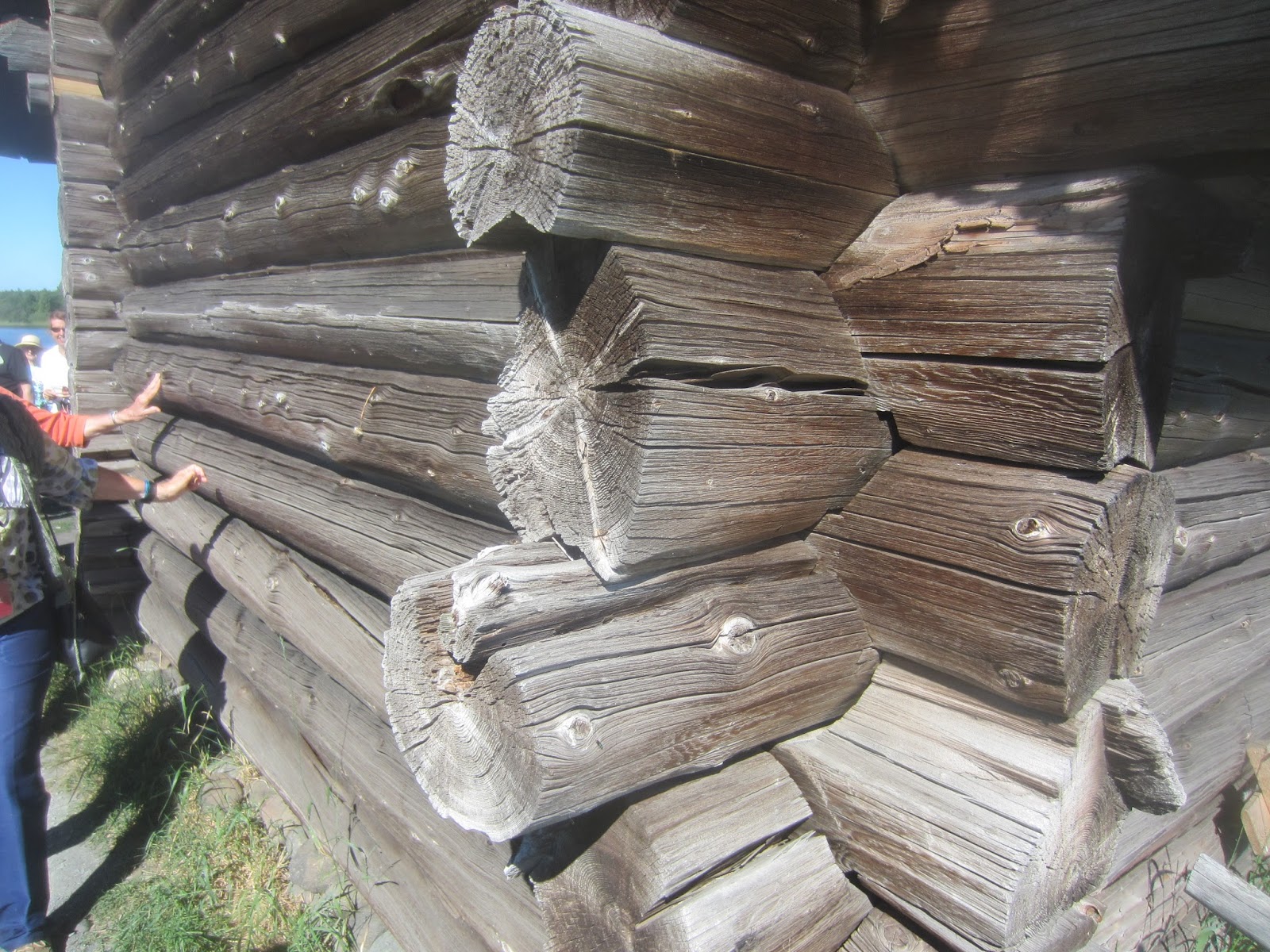
through the midsection of the church.  That was strange. The church was undergoing restoration. In doing so the conservators had built a steel frame inside the church to support it during restoration. This steel skeleton was visible where the midsection of the building was missing. As we entered through the gate in the surrounding wall we got a closeup view of the church.  I'm always fascinated by construction methods. The church is built of wood, scots pine logs actually. The notched logs are joined at the corners. There are eight corners in an octagonal building. However, the logs are joined in a crude tongue and groove fashion.  This eliminates a gap between the logs.  There was no "chinking" (mud between the logs) you see in American pioneer cabins. No nails are used in the construction of this 37 meter tall structure.  And the seventeenth century builder used only an axe.  Folklore says that when he finished the church he threw his axe into the lake, proclaiming that he could never build a more beautiful church. Next to it is a bell tower which is almost as tall. The Church of Transfiguration may be the tallest wooden church in the world.


Next we visited a typical house of 17th century Russia. It was a log house in a rectangular shape. The second floor was for people while the lower floor was for storage and animals in the winter. The living area was dominated by a huge ceramic stove. It was used for cooking as well as providing
heat. An interesting feature was the bed on the top of the stove for the elderly and children to sleep in during the cold Russian winters. Furniture was simple but  functional and there was a lady in peasant dress making lace. She had samples of her work for sale for a few rubles. Next to the living area for people was a huge loft with a ramp to allow livestock access.

There were several other structures on the tiny island in Lake Onega.  There was a sauna bathhouse, a wind powered mill, and another church. We saw a woman tending her vegetable garden near the bathhouse and a man making roofing shingles in the shade of a huge tree. He was fashioning the shingles from birch wood with a hatchet. It was similar to a teardrop shape like those covering the domes of the churches.  I recalled  how shingles were made by my great uncle with  mallet and fro. He could make a half dozen cedar shingles in a minute. This Russian craftsman could make one in about half an hour, but his were pretty. 

The last place we visited at Kizhi was the Church of Intercession. It was less grand than the Church of Transfiguration, with only nine domes, but was accessible.  The interior had icons on all walls. These are of the Byzantine style, showing biblical characters with elongated faces and bodies.
Russian Orthodox religion is similar to the Greek Orthodox faith. The main room is divided and only men are allowed behind the second wall. Women must cover their heads when entering the Russian Orthodox church. The rooms had high ceilings and a number of monks serenaded us with a cappella singing. It was beautiful, although I understood not a word. 

There was a leisurely walk back to the ship.  Upon leaving we felt we had seen a bit of Russian history. After all the palaces in Saint Petersburg it was good to see how the lower classes lived. That night we dined with Eli and Nina.  The retired couple was from San Francisco but had seen much of the world. He was a big man in his late seventies with thinning gray hair and a slight aquiline nose. He spoke in a low tone modulating each word that rolled off his tongue. Eli had previously owned a manufacturing company and was most interesting in discussing the United States policy toward Israel. The former businessman was from Israel and I believe he had relatives there. He told how the Israelis had built a hospital near its borders, which served the wounded children from either side. Nina, who was perhaps a bit younger but had added significant pounds during the aging process, spoke in accented English. She wore her make-up well with what I would consider "ultra red" lipstick. Born in the Ukraine, she had immigrated Israel and then to the Unite States as a young woman.  She, like her husband, was very pro-Israel. They were delightful conversationalists and we enjoyed our evening meal with them very much. 

There was hardly a hint of movement as the Ingvar sailed across Lake Onega. Kizhi
would be a place we would always remember.