Showing posts sorted by relevance for query art. Sort by date Show all posts

Jun 23, 2014

Little Jewel by the River

About an hour and a half from the Metropolitan Museum of Art in NYC, on the banks of the Raritan River in the rolling hills of New Jersey, sits the Hunterdon Museum of Art. Looking out through the windows set in two foot thick stone walls the river rushes by, turning the water wheel of the red mill across the way. This tiny Victorian town of 2600 residents has a terrific art museum.
Every year or so we have the opportunity to visit.

Current exhibits include Darren McManus’s work. The brilliant colored amorphous images were painted on uniquely shaped wood panels. Viewed through 3D glasses incredible effects are achieved. Also now showing is the work of Sky Paper :Traces of Places, whose images are all black and white in stark contrast to colorful works of McManus. She works with handmade kozo paper and black Sumi ink. Initially she
was a painter, but when her studio was burned she switched to drawing with ink and brush. I found many of her images brooding, haunting, and somewhat disturbing. Her work is in many national collections including the Museum of Modern Art and the Guggenheim. Joining the two solo exhibitions is a display by some thirty artists, experts in the ancient medium of encaustic painting. Pigments are added to melted beeswax before applying to a
surface. The exhibition includes paintings, collages, prints, and sculptural works. Simply fantastic!

I'm not one of the greatest fans of contemporary art, but exhibits at the Hunterdon always challenge the imagination. The presentations are always first rate.  There is something about the contrast between stonewalls and contemporary art that adds to the ambiance.


 Anytime we're in the area we will visit the Hunterdon Art Museum and make a donation.


Mar 17, 2014

The Center of the World

In our travels we have visited churches, mosques, temples, cathedrals and basilicas seemingly ad infinitum. They are always at the top of places of interest in various locales. Though many are opulent and some simplistic none quite compare to Saint Peter's Basilica of the Vatican City in Rome. We were there on a Sunday in October. There were also thousands of other tourists there as well. On this occasion we decided to take a guided tour which was unusual for us.  Our tour guide was a cute young Italian whose name was Gabriella.   She spoke very good english but used the term "ladies and gentlemen" so frequently it became annoying.

Taking a tour turned out to be a good decision. Without a guide we would have been lost in the crowds. Elbow to elbow we were. They issued us these small radio receivers with earbuds. We could hear Gabriella but  we could not respond. There was a large group of us tourists and we were divided among the tour guides.  We had signed up for a specific time also.  At the appointed time we were led by our guide across the street from Italy into the sovereign nation of the Vatican City of which the Pope is the absolute monarch. The 110 acres with 840 inhabitants is the smallest country in the world by area and population. Although actually formed in 1377, it became an official sovereign state in 1929.  It's major source of income is tourism and 1.1 billion Catholics worldwide. The walled city is quite interesting from an architectural standpoint and houses art treasures galore. And we were going elbow our way through the crowds led by a diminutive Italian.

Our first stop was a large room in which there was a three-dimension model of the city. The scale was probably a fraction of an inch per foot. Our tour guide pointed out our route on the model. Soon we entered the Vatican art galleries. It was like one lengthy ornately decorated tunnel. The vaulted ceiling seemed to have gold dripping from it. The walls are covered with paintings and sculptures. These are the longest art galleries in the world. As I looked at the great wealth I couldn't help but speculate on how many of the poor and sick could have been helped by such treasure. Millions, perhaps. We continued to the attraction which we had longed to see, the Sistine Chapel. Our tour guide was not allowed to lead us through the chapel and would meet us on our exit. Although the major art work was done by the sculptor Michelangelo many other painters are represented as well. According to our tour guide many of the poses of the figures in Michelangelo's work can be seen in his sculptures of figures.  I thought it interesting that characters from Greek and Roman mythology are also included. The artist also continued the practice of painting the faces of his enemies on the villains in the paintings. Actually they were frescoes, paintings created by the addition of pigment to wet plaster. It is an incredible work of art. The area was crowded with noisy tourists. The security personnel constantly requested silence in authoritative tones. But people talked. Photographs were strictly forbidden but electronic flashes lit up the dim interior. And teenagers do what comes natural when hormones go awry. I looked at those who offer no sense of reverence in a place of worship with disgust. I am respectful of their mosques and temples.  Why should they not respect my churches? By the way, there are two exits from the Sistine Chapel.  Don't take the one on the left. It does not lead directly to Saint Peter's Basilica. After a bit of discovery by wandering around we rejoined the tour group much to the delight of Gabriella.


I suppose Saint Peter's could be considered the church of churches. The apostle Peter was told by Jesus that his church would be built upon him. The bones of Peter are buried beneath the church. Are they the bones of the first century Christian? Archaeologists say that the bones are from the first century. The basilica is an incredible structure. The building is measured in acres not square feet. I think it's the only five acre church I've ever been in. The opulence is overwhelming.  The inlaid marble floor seems very smoothe. Normally, you can detect an unevenness where the stone  has worn down.  Since different colors of marble wear at different rates and normal wear introduces unevenness.
The shear size is over delusional. The center altar seems to be tall until you see a person nest to and you realise that it is four stories high!  There are many tombs and many more in the crypt underneath. Michelangelo's most famous Pieta is in one of the chapels behind bullet-proof glass. It seems it was once attacked by vandals. We ventured outside through the huge forty foot doors into Saint Peter's Square where the Pope normally holds his audience.

It was starting to rain.  A slow drizzle.  As we entered Italy we decided to duck under the canopy of a cafe for a cappuccino and to get out of the rain. We were of course accosted by a Pakistani selling ponchos. (I think they hid in the shadows waiting for rain and pounce on tourists when raindrops appeared!)  I got into some serious negotiations about the price. We purchased two for five euros and began to enjoy our coffee. There were two guys at the table next to us under the canopy. One asked it we were Americans and we responded that we were. A conversation ensued and we found that the larger man was creating some of the music for a Broadway show. It was based on a Disney film and produced by Bette Midler and Sarah Jessica Parker.  He said he came to Europe occasionally to get inspiration. We meet a lot of interesting people when traveling. The rain stopped  while we were at the cafe and our walk back to the hotel was sans ponchos. But I had made a great deal with the street vendor. Actually, I'm sure he had made a substantial profit..

The next day we would be leaving Rome for Milan and our flight home. Italy had been interesting. But I feel it is highly overrated as a travel destination. Or, perhaps, if we had rented a car or taken a guided tour things would have been different.  Paris is still my favorite city.


Jul 7, 2011

Once Upon A Time In The District

It was a great trip to the District, Washington, D.C. We did not see the Smithsonian, Jefferson Memorial, White House, the Wall, or many more attractions. But, then, after all, that was not the purpose for our trip. We had a nice drive from Goose Creek, SC, to Fairfax, VA. Traffic wasn’t extremely heavy considering that we were on the east coast Armageddon of super highway travel, Interstate 95. We had spoken to the oldest son via cell phone and knew he was in route from New Jersey and the daughter from Georgia had called to say she was in a diner near the hotel. We checked in and were soon talking with the Arizona and California folks via telephone. Yes, the children were getting together with Mom. And I, well, I was Mom’s husband.


This trip was about family fun. When people are on both coasts it’s difficult to get them altogether. This trip had been in the planning stages for at least a year. We stayed at the same extended stay hotel except for the NJ contingent who stayed at Crystal City. We were only a mile from the Metro station, and that would be our major mode of transport around the area. I was surprised to find that all day parking was only $4.50. I think that was the only inexpensive thing we found there in the city.

It had been decided that we would go to Pizzeria Paradiso in Georgetown for dinner. We used our car to drive from Fairfax to Georgetown; the Acura was a bit roomier than the rental Chevy. We parked underneath a shopping mall and walked about a block back to the restaurant. We walked down two or three levels to the dining room where we were seated. The rest of our party met us there, and we had a table for ten. It was good to see everyone together for the first time in at least five years. I thought the food was a bit pricey, and service left a bit to be desired, but we enjoyed each other’s company. The sweet tooth crowd wanted to find a cupcake shop, and so our navigatrix found one close by using her cell phone. The line was out onto the sidewalk, and waiting is not my finest suit. Everyone enjoyed their favorite exotic cupcake before returning to the hotel for a good night’s sleep.

We were up early the next day but the not rest of our party. We had breakfast burritos in our room. At the Metro station we bought our “one-day” passes, which are good for any time of day except rush hour. Washington’s Metro is clean and modern and bigger than London’s tube but, unfortunately, several of the escalators were out of service.

We rode to Union Station and had lunch at a nearby Irish pub. Lunch was good, and Mark and Nathan joined us for our tour of the Capitol. One of the attractive interns from Senator Jim DeMint’s office led our tour of the capitol building. There were quite a few tourists on a weekday but not overly crowded. It is very inspiring and big. I found out that if the Statue of Liberty is placed inside the capitol rotunda, it would not reach the top!

We next visited the Smithsonian Air and Space Museum. This is a great place for aerophiles like me. This was my second visit, so I was able to guide some of the newer visitors in our party around. I always learn something new at this museum. For example, the Airbus A380 is controlled by a joystick rather than the traditional yoke. Although this is a great museum, I find the Steven F. Udvar-Hazy Center at Chantilly better. The museum closes at 5:30, which seemed very early to me, but we did have time to get a soft serve ice cream which was a great treat for a hot day. Then, it was back to the sidewalk.

The group split up a bit as Nathan and Mark went to get Jen and meet us for dinner. According to one of the brochures we had, the American Art Museum was open until 7 p.m., so away we went. The George Ault show of 1940’s American paintings was very good. There is a good exhibit of folk art as well. I have mixed emotions about folk art. Much of the modern folk art is called outsider art. “Outsider” refers to the fact that the artists have no formal training.

Dinner was at a Mexican restaurant near all the Hispanic embassies. The food was great, and service was good, but it was extremely noisy. Dining was upstairs and open air. I thought the heat would be unbearable, but the overhead fans did their job. The place got a bad mark in my book for the life size cutouts of the President and First Lady by the entrance. Some members of our party even had their pictures taken with them. They are family. I still speak with them! By this time it was getting late and time to catch the Metro back to Fairfax. We got back to our room and watched some of the College World Series, and Carolina won. Although my blood runs orange I support those South Carolina teams in national competition.

The next day we did lunch in Crystal City: a hamburger restaurant in a mall. The brilliant designers had a clear glass roof over the dining area. It’s no fun to try to enjoy your food under intense heat. It was my least enjoyable meal.

We thought it would be a good day for a walk to the Lincoln Memorial. After a Metro ride, we exited at the station near George Washington University and began our walk. It took us by the Department of State, but I didn’t see Hillary Clinton anywhere. Kim, our navigatrix, kept us on track on this very warm walk. There was quite a crowd at the Memorial. Lincoln in his big chair is quite impressive up close. We had a good view of the Washington Monument without the benefit of a reflecting pool. The pool was empty for whatever reason.

After our visit to the memorial, which included a lot of walking, we were ready for the tearoom Kim had found, the Teasim Restaurant Penn Quarter. We had the afternoon tea menu: a selection of sandwiches, scones, tartlets, and other goodies with a pot of tea. There were a lot of Asian teas and menu items, but we stuck with Earl Grey and the traditional menu. We ate downstairs after getting our food. (No wait service here.) It was kind of cozy and quiet enough to carry on a good conversation. We spent about two hours in this place before saying good-bye to the New Jersey part of the family. They would not be joining us for dinner at Jaleo.

Jaleo, a Spanish restaurant, was a super treat. We had a reservation for 5:30 for an early dinner, because we had theater tickets for a 7:30 play. We had a good table for the seven of us by the window and the food and service were first class. The menu for the tapas style meal was in Spanish with English translations. My travelmate and I were excited about the Spanish food, since we will be visiting Spain in the fall. The arroz de pato, croquetas de pollo, dátiles con tocino ‘como hace todo el mundo’, butifarra casera con mongetes were all delicious, especially the dates wrapped in bacon and deep fried. We shared a carafe of sangria with Kim. It was the first sangria I had ever had with white wine.

The play was William Shakespeare’s Merchant of Venice at the Shakespeare Theater Company. The production was superb. This version was set in the early 20th century with period music. I found it quite interesting and the Shakespearaholic I’m married to was ecstatic. We watched the film version starring Al Pacino as Shylock before our visit to familiarize ourselves with the story. It was a late train we took back to Fairfax with the requisite homeless person sleeping on the train.

Morning came early and we decided we would have breakfast together before going our separate ways. There were only seven of us, since part of the family had left earlier in the day. It was a good breakfast at the diner, and we said our good-bys and planned to meet in Chicago in 2013.


Lincoln Memorial

Pizzaria Paradiso
Teasim Restaurant
Jaleo
Other Picasa Photos from the trip.

I did not see Craig T. Nelson of The District anywhere.

Jan 14, 2013

Looking Back

It was a very good year, the two thousand and twelfth year after the year of our Lord.

We began sipping cold Bahamian beer and eating conch fritters while watching a parade in beautiful downtown Nassau. A quick cruise from the Holy City in January had brought us there.  I'm not a big fan of cruise ships myself, but the price was right and "what the heck". It was fun, and our waistbands did not expand very much due to the excessive amount of food available on board.

In February we arrived in New Orleans for a look at the Crescent City the day after Mardi Gras ended. The trees were drooping with beads. We met an old friend and his wife there.  Don and I had been shipmates in the Navy during the war in southeast Asia. We met our youngest son and his significant other there as well. It was great fun walking the streets, dining at Cafe duMonde, and enjoying the art on the fence at Jackson Square. We encountered some dazed revelers on Bourbon as we walked to Royal Street to enjoy the street entertainers.  While there we used the city's famous streetcars for transportation. The National WWII Museum caught this history and technology nut's eye. The four days went by quickly with great friends in a charming city.  Then, it was time to fly home on a Delta BOGO ticket.

In April my dear wife had purchased Groupon tickets for lodging on a riverboat in Chattanooga, TN.
Grand entrance to the Delta Queen
Who wouldn't like to spend the night on a haunted riverboat? The trip to Chattanooga itself was quite eventful.  On this road trip our first stop was Augusta, GA, a city made famous by James Brown, the Godfather of Soul, or to some, the Masters Golf Tournament. We were interested in the great art collection in the Morris Museum of Art, which we enjoyed visiting after a lunch of barbecued pig meat. I would have loved to have visited the Confederate gunpowder works but, alas, the only thing left is the smokestack. Then, on to Athens and a visit with our daughter. While there we visited the High Museum of Art in Atlanta, the Atlanta Shakespeare Company, and the Bear on the Square Mountain Festival in Dahlonega. All these events were great fun, but we had to keep moving to honor our reservations on the Tennessee River.  The Acura's navigation system worked flawlessly, and we were aboard the Delta Queen for dinner.  Our cabin was on the second floor, or as hoteliers would say to sailors, the "02 level", and was quite small.  The last cabin to house a American president is on the deck above.  The Delta Queen is like an aging film star. She's a bit tarnished, has a few wrinkles, and isn't near as agile as she used to be. But, she still has charm and grace. We visited the Civil War battlefield, The Tennessee Aquarium, Ruby Falls, and we rode a train at the Tennessee Valley Railroad Museum.  Our most interesting point of interest, however, was the Station House Restaurant in the Chattanooga Choo Choo Hotel, with the singing wait staff.

Old Sacramento
May was a great month for us, as we ventured to the west to visit relatives.  We landed in San Francisco and picked up our rental Chevy at the airport.  Without a navigation system on the car we were relegated to using our cell phones which worked great. We spent the night in Castro Valley before doing some sight-seeing.  Our first stop was Sacramento,  capital of the state of California, where a part of the city is restored as "Old Sacramento".  Here we dined aboard the Delta King for dinner.  It's the sister, or brother, or sibling ship of the Delta Queen mentioned previously. I enjoyed the California Automobile Museum there.  However, I was not impressed with Gov. Jerry Brown's Plymouth Satellite. But, there were some very interesting automobiles and nostalgic ones like the shoebox Ford in which I learned to drive. We saw more family in Murphys, CA and had a nice dinner there. But the thing I remember most was the Calavaras County Fair at Angels Camp. This is where the jumping frog contests are held annually.  Mark Twain told us all about it. By the way, the record is now over twenty-one feet for a three hop jump. Castle Air Museum near Atwater was our next stop. As an aerophile*, I just couldn't pass it up. It was the first time I'd seen a B-29 Superfortress bomber inhabited by a ghost, but he didn't make an appearance during our visit. Yosemite National Park was great but crowded and the first place we paid over $100 for a room and had to walk downstairs to use a bathroom.  But it was an inn from the mid-nineteenth century. In Santa Barbara we saw more family who joined us from San Diego and enjoyed the Santa Barbara Art Museum. Interestingly enough it was market day, just as it was five years ago when we were there.  From there we traveled on to San Jose where we met more family, and some lovely nieces gave me a birthday cake. After that it was back to Castro Valley and then to Upper Lake to see more family before returning to San Francisco for our flight home.  We made a stop in the wine country to visit another niece and a stop in Alameda for dinner with a friend along the way.

We recuperated a bit through most of the summer until September when I realized a boyhood dream. I've always been a fan of stockcar racing.  And, wouldn't you know it, there was a Groupon coupon for the NASCAR Experience at a reduced price.  The famous Darlington Raceway is about a one hour drive from home, so we were on our way one warm Sunday afternoon. I had never been there but had watched or listened to broadcasts of races from there for over forty years. I went to the drivers' meeting and soon found myself behind the wheel of an 850 horsepower race car.  Needless to say it was the thrill of a lifetime.

Morning on Kauai.
For many years, Claudette and I have had the goal of visiting all fifty of the United States.  We have about seven that we haven't visited.  One of those was Hawaii. So when the opportunity to join a  tour group on a Hawaiian tour presented itself, we jumped (maybe not quite jumped) at the chance. We flew from Charleston to Atlanta and Atlanta to Honolulu.  Our tour guide presented us with necklaces of flowers which they call leis.  Much to my chagrin I did not get kissed by a pretty polynesian girl in a grass skirt. After we got to our hotel and were briefed by our guide some things became very apparent to us.  Hawaii is EXPENSIVE. Although several tours were included in the basic price of the tour package, many attractions were not. We could easily spend as much on additional tours as we had on the basic tour package. It was our first time on an organized tour.  I was surprised that all tour guides expected a tip for their services.  I suppose that the initial fee was to pay for the opportunity to give the guides a tip.  We did enjoy our trip to four of the Hawaiian Islands. Oahu, Kauai, Maui, and Hawaii are true jewels in the Pacific and an ideal place to spread your wealth. If you're there, walk the crater of a live volcano, drive the Hana highway, drink some Kona coffee, eat loco moco, and o.d. on sunsets and rainbows while listening to the surf sing the siren's song.  But paradise did not last forever, and soon we were home again with Sophie.

We made a quick trip to New Jersey to visit more family, and while there went to New Hope, PA. New Hope is a tourist town on the Delaware River.  If you were a fan of the Sopranos you'll remember that the artist that painted the portrait of Tony's racehorse lived in New Hope.  We left NJ the day before Sandy hit the coast.  Lucky us.

Belly dancer in Istanbul
Sandy did have some influence on our next trip though. We were in New York's JFK the first day it was open after the hurricane on our way to Turkey via Zurich.  Going to Turkey was my idea. I wanted to visit a Moslem country which I felt was  safe.  Turkey met our requirement. Although this was a guided tour, it was dramatically different from our experience in Hawaii. Everyone we met was exceedingly helpful. Vendors appeared very appreciative of your business.  We enjoyed the Grand Bazaar, Topkapi, Istanbul, Ephesus, Troy, Ankara, and Gallipoli.  Our tour covered over 1400 miles, and we saw the ruins of ancient cities, enjoyed extraordinary foods, and saw the manufacture of hand made pottery and hand-knotted rugs. Belly dancers and whirling dervishes thrilled us. Perhaps, the high point of our trip was the hot air balloon ride over the lunar-like landscape of Cappadocia.  Turkey is one of the places we would like to return to.

Upon returning home it was time to prepare for our annual Christmas party.  And we did. We delight in having our friends at our house for Christmas.   Also in December four children appeared.

It was probably our best year ever, made all the more special by seeing all six children in the same year.


* If a person who admires all things English is an anglophile then why can't a person who likes all things aviation be an aerophile?


Feb 10, 2015

In a Masculine Vein

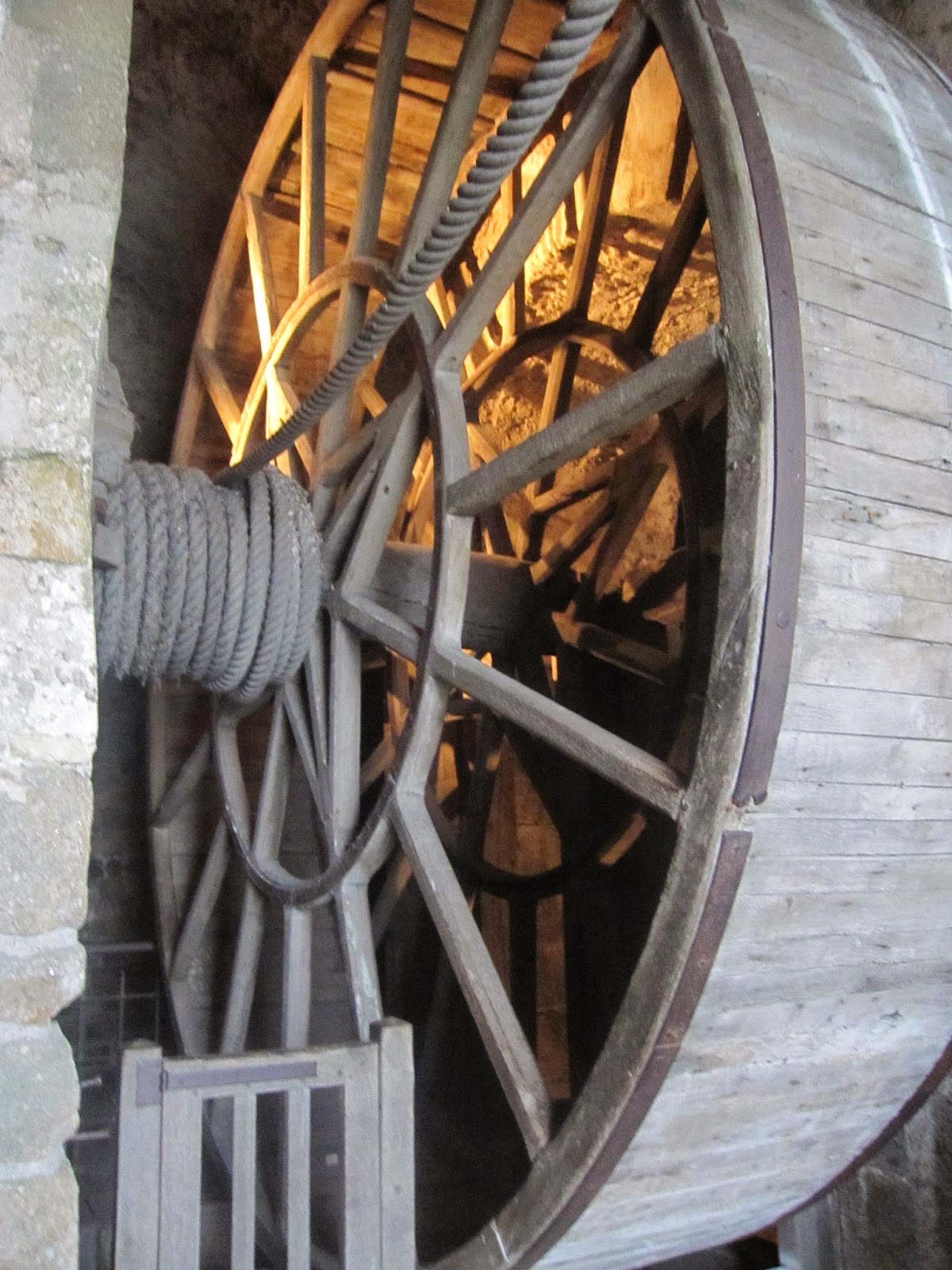
Winch at Mont St. Michel
As you've noticed from my posts about our travels we visit a number of different kinds of attractions. Typical of any travel brochure or other travel advertising art museums, churches and restaurants are featured. It seems to me that those things I consider masculine are usually left out.(The museums are usually art museums.) Now I don't have a problem with fancy restaurants or art museums or cathedrals in moderation. But as a fan of things that move and/or make noise I search for other venues.

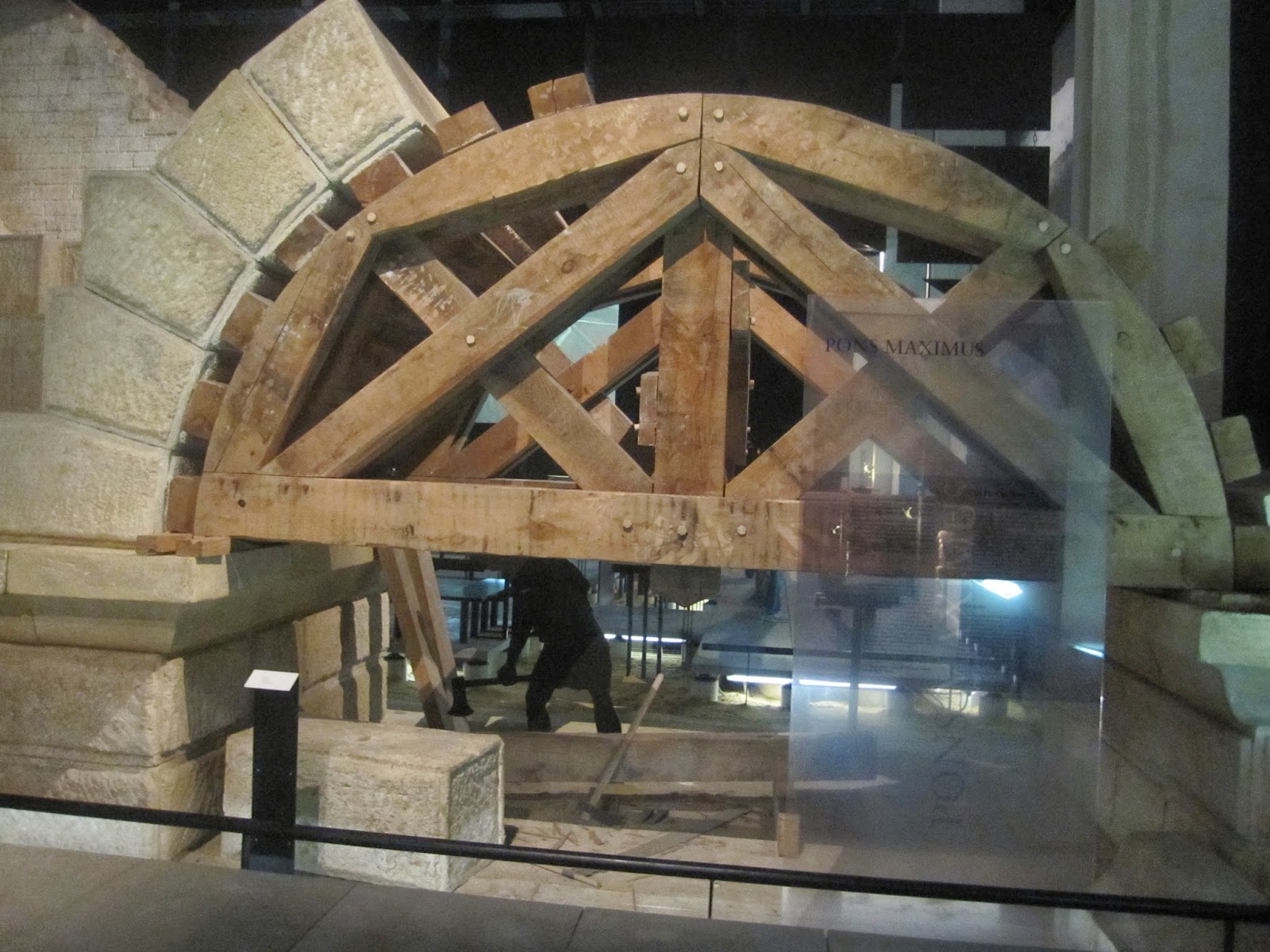
In our travels I've fed my masculine side with quite a few interesting attractions.  At the onset I would like to say in reference to cathedrals I am  in awe of the construction methods used to build these monumental structures. The builders moved tons of stone long before the invention of the giant machines used in modern day. At Mont Saint Michel in France we saw the winch used to raise building stones to the upper levels in this building.  It reminded me of a giant hamster wheel perhaps seventeen feet in diameter. Men would walk inside the wheel as a rope wound around the axle raising building stones to great heights. At El Escorial in Spain there was a great display of building tools used during the middle ages.   In the museum at Pont du Gard, France, you can see the building methods for the giant aqueducts. I never realized until visiting that museum that forms were used to construct
Template for arch at Pont du Gard
the giant arches that are a hallmark of Roman construction. The Romans were fantastic builders and great engineers. Their structures of 2000 years ago still stand today.

I have a fondness of mechanical things and the way they work. Cutaway engines have given me insight to the internal operation of the mechanics that produce the power. One  of the most notable of these is the 28 cylinder Pratt and Whitney 4360 aircraft engine. I saw an animated cutaway version of one of these in the Pima County Museum of Air and Space near Tucson, AZ. I posted a video I made about this engine on YouTube. It has received more than eighty thousand views thus far. The giant steam engine in the British Museum of Science was incredible to observe in operation.  In Nuremberg, Germany, there is a toy museum.  In it are those great mechanical toys of the early twentieth century. This was long before the advent of plastic and battery power. They were made of
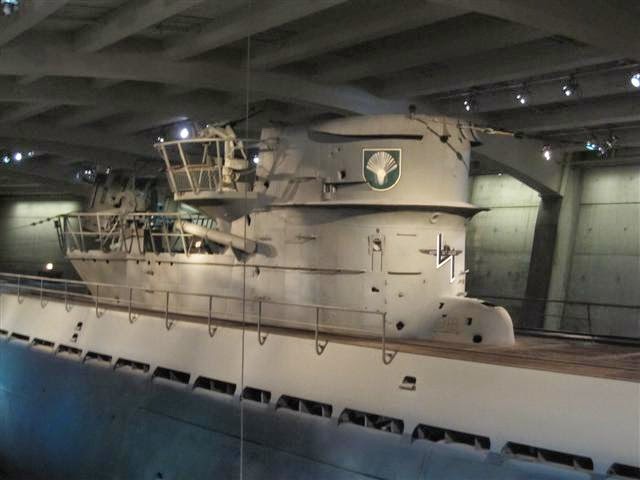
German submarine in Chicago
metal and powered by wound springs and there are videos to show them in operation.   During our travels I have visited submarines, aircraft carriers, battleships and destroyers.  I've enjoyed them all. However, there are times when I think that the exhibitors desire to make an attraction more tourist friendly has destroyed some of the ambiance. For example, on the aircraft carrier, Intrepid,  the "knee knockers" through the bulkheads have  cut down so the tourists won't hit their shins when going through a bulkhead.  And on the German submarine in the Museum of Science and Industry, Chicago, the subfloor has been removed so tourists
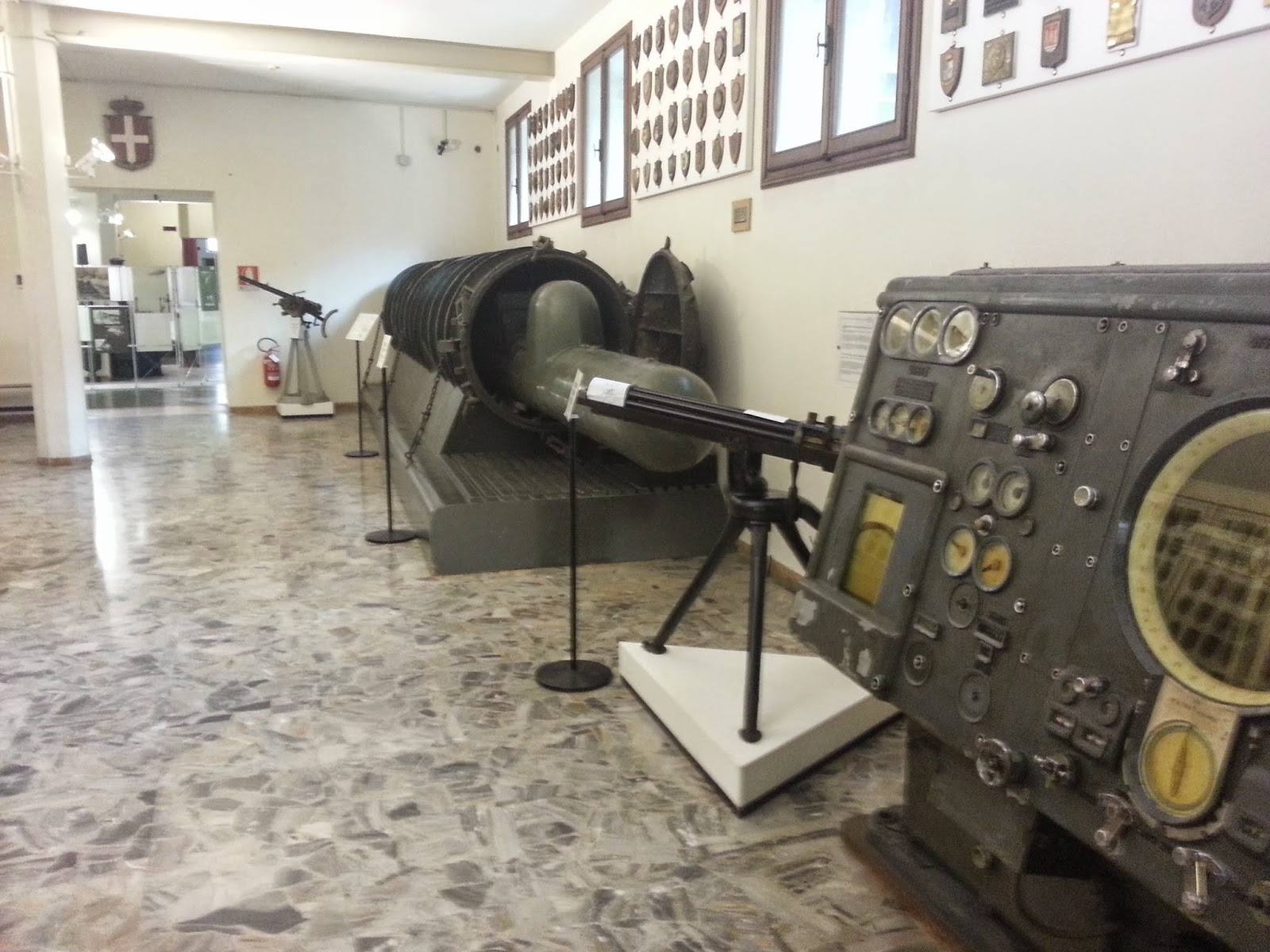
Midget Italian submarine in Venice
will be able to stand up straight when touring the relic. I believe that these modifications prevent a person from experiencing the true effect of being on the vessels. Arms and armor along with the aforementioned ways in which mankind seeks to destroy mankind I find interesting. The mechanical means of destruction is well documented in the Spanish Armory Museum in Segovia where examples of weapons from the spear to rifled cannon are on display. The engraved and ivory inlaid crossbow of a past king is a work of art. One of the most unusual instruments of warfare was the two-man miniature submarine used by the Italian navy during WWII. I'm sure I drooled over it in the Italian Naval Museum in Venice.

Perhaps the item I seek out most on our travels are aircraft displays.  There is just something about these machines that break the bonds of gravity that fascinate me. If I had to pick a favorite it would be the Pima County Museum of Air and Space. The displays are more accessible than the U.S. Air Force Museum or the Museum of Naval Aviation.  In Charleston, SC, the aircraft carrier, Yorktown has a great collection of naval aircraft. It has a much better display than that of the Intrepid in NYC. We've visited at least ten other aircraft museums over the years. When I have the opportunity sit in the cockpit of these flying machines I feel a connection with the men that flew them.  I also realized that the men that flew them were smaller than me.

fighter plane on the USS Yorktown

In the future I look forward to other great museums and attractions.  But without an understanding wife I would never had be able to see the things I have. Of this I am most grateful.

Nov 14, 2014

Musty Odors and Ancient Objects

"Lady, you need to get you son out of there!" the docent said to my mother. When I was a young boy
California Automotive Museum
(about five-years-old) my mom took me to the oldest museum in the United States, the Charleston Museum. Although only the classical Greek columns of the building remain today, I can still remember that musty smell of antiquity. I also remember being apprehended by museum personnel that day.  It seems I had managed to get inside some ancient piece of armor. Was this a detriment to my quest of old stuff? Not a bit!

Museums are of all kinds, and many specialize.  As an artist I find art museums extremely interesting. The Mona Lisa, Sunflowers, Guernica, or The Third of May.  Just to be so close to the genius of da Vinci, Van Gogh, Picasso or Goya is inspiring. The  photographs in art books don't do them justice.
The Tate Modern, London.
Reproductions of art somehow always miss something. Perhaps it's the dimensional aspect of the art. With oil paintings you can see the dimensional quality of brushstrokes better and just maybe smell the hint of oil in the air. There is something awe inspiring about seeing the actual works.

Aviation museums are no doubt my favorite.  There is something about these machines that break the bounds of gravity and join the realm of birds that have always fascinated me.  In our travels I
have seen many types of aircraft, some famous and some infamous. Of course the most common historic aircraft is the Wright Flyer, or rather a replica.  The original first American airplane to make controlled powered flight was destroyed. The Spirit of St. Louis, which first was flown solo across the Atlantic, and the huge NC4 flying boat of the U.S. Navy, which was the first to fly across the Atlantic, claim aviation fame. The Messerschmitt Me-262 was the first jet aircraft flown in combat and was a marvel of German technology.  The Glamorous Glynnis was the X-15 rocket plane which Chuck Yeager flew faster than the speed of sound. Actually, Gen. Yeager named all the planes he flew after his wife. The Enola Gay dropped the first atomic bomb, which ushered in the nuclear age, and the fastest airplane to ever fly was the SR-71, Blackbird. I've been fortunate enough to see these famous aircraft and many more.

The Chicago Museum of Science and Industry

To me, the British Museum is the creme de la creme of museums.  There you will find the Rosetta Stone. Discovered in 1801, this seventeen hundred pound piece of black granite has inscriptions in three languages.  These inscriptions in three languages allow linguists to translate the hieroglyphics of the ancient Egyptians. Also in this museum are many Egyptian mummies and the mummified remains of one of the first humans.  There are the ruins from Greek temples on display as well as Roman artifacts.  It was said that the sun never set on British soil.  During this period treasures of many civilizations were collected by the British Museum.
The Museum of Anatolian Civilizations, Ankara, Turkey

Once upon a time I was an enlisted man in the U. S. Navy and therefore have an affinity for things naval other than oranges. I must say that the Spanish Naval Museum in Madrid is another favorite of mine, although I've been aboard a number of the American warships which are now museums. The Spanish National Naval Museum houses a map produced by the cartographer who sailed with Christopher Columbus to the Americas. A map shows some of the coastline of the new world. The museum follows Spanish naval history from early colonial days through World War One.  It was interesting to see a scale model of the battleship U.S.S. Maine, the ship whose sinking started the Spanish-American War and whose capstan is in White Point Gardens in Charleston, South Carolina. Another Spanish museum I favor is the museum at the Spanish Artillery School in Segovia. Spanish weaponry is traced from the crossbow and spear to the rifled and breech loading cannon. Chicago's Museum of Science and Industry, The British Museum of Science, and the Museo della Scienza e della Tecnologia Leonardo da Vinci in Milan are great science and technology museums as well. One of the most popular exhibits in Chicago is the German submarine captured during WWII. The Milan museum does a great job tracing technology from Leonardo da Vinci's machines to modern computers. The mammoth steam engines are unforgettable in the British Science museum.
The National WWII Museum, New Orleans, 

As a childhood fan of B-Western movies, I would be remiss not to mention my fondness for cowboys. The one museum that depicts cowboy life well is the Buffalo Bill Historical Center in Cody, Wyoming. There is a reason your ticket will allow you entrance for two days.  It's that big! And, to appease the artist in me, it has Frederic Remington's studio reproduced. Remington is one of my all-time favorite painters and sculptors. Throughout this country museums abound on almost any subject.  Whether it is a museum about teapots or Winchester rifles I'm sure everyone can find one that suits their fancy. That includes the Crawford W. Long Museum in Jefferson, GA, which commemorates the birthplace of anesthesia.

Perhaps one of the greatest advantages of visiting museums is the opportunity to learn. Sometimes just to see an object as opposed to reading about it or seeing pictures of it can offer a completely
The Heard Museum, Phoenix, AZ
different explanation to its operation.  Nowhere is this more evident than in  science and industry museums. They show how stuff works. And musical instruments, which are machines of a different nature, are better understood when held in your hand. The Musical Instrument Museum in Phoenix, AZ, is great for this.  How do you play a gong anyway?

I will continue to immerse myself in the next museum I find, but I don't think I can get my torso into a piece of Greek armor anymore.


The Spanish Naval Museum, Madrid

Apr 18, 2011

James Gurney, the dinosaurs are coming!

On Sunday we were due our monthly Barnes and Noble fix. I have a prescribed route I take in the store. First, what's new in the cheap stuff in the lobby, then past the books in the main aisle. If it is the usual browsing mission then to the art books and finally to the magazine stand to peruse the newest periodicals. After scavenging knowledge on subjects from cinema  to Google hacks, I'm picking up a few and heading to the coffee shop where the odor of Starbucks blends with that of printers ink for that most intoxicating of aromas. With my decaf mocha I'll enjoy my latest  issue of my favorite publication with my mate. And there are always new discoveries. Enter James Gurney.
Gurney is most well known for his Dinotopia books which are illustrated stories from an imaginative land inhabited by dinosaurs and people. His work from concept to execution is fantastic. The style is like that of the twentieth century illustrators, Howard Pyle, N. C. Wyeth and Norman Rockwell. But I like to find out more about these people who introduce us to the fantastic. Where do they come from? What is their training? What inspires them?

from Fire and Ice
James Gurney was born in 1958 and grew up in Palo Alto, California. His father was a mechanical engineer and he was the youngest of five children. Much like me he liked to tinker and build things as a boy. He studied archaeology at the University of California, Berkeley, but received a BA in Anthropology in 1979. He then studied illustration at the Art Center College of Design in Pasadena, California for a couple of semesters. After a cross-country trip, he and Thomas Kinkade (aka, The Painter of Light) coauthored The Artist’s Guide to Sketching in 1982. Gurney and Kinkade also worked as painters of background scenes for the animated film Fire and Ice, co-produced by Ralph Bakshi and Frank Frazetta. Frezetta was a well know painter of fantasy magazine covers. Gurney produced many magazine covers for the science fiction and fantasy publications. National Geographic Magazine was a client, and he produced a series of illustrations of dinosaurs for U.S. postage stamps. In 1992 he published Dinotopia: A Land Apart from Time which became a best seller. Later he produced sequels to the book. His paintings have the quality of the classical illustrators with unerring accuracy to detail as seen in the video below. Notice that his medium is oil usually applied in transparent layers. The anatomical accuracy of the animals and the technical accuracies of mechanical objects is unbelievable. Although, I'm not quite sure how you would ascertain the accuracy of mythical beasts and fictional mechanical objects. He currently lives in Rhinebeck, New York, and continues to produce great art along with books on art instruction as well and maintains two websites and a blog.


Additional information:

Aug 28, 2019

A Short Trip Mid-Week

Coffee Underground
On Monday Claudette looked at our calendar and exclaimed, "We have nothing on the calendar after today! We need to go somewhere!"

"But where?" I countered.

"We can get a free room at a Marriott!"

"Really?"

"Yep, we've got enough points on our Visa card.  What about Greenville?"

"Fine by me. We haven't been there in a while. I wonder what is their current show at the art museum?"

"Okay.  Tomorrow we'll hit the road right after we get home from the gym"

"Why not skip the gym? We'll be walking all day after we get there."

According to plan, the next morning found us on I-26 west on our way to Greenville, South Carolina. The trip was uneventful with fairly light traffic. It was approaching eleven when we parked our car at the northern end of the tree-lined Main Street. Greenville is a hilly city at the base of the Blue Ridge Mountains. The temperature tends to be quite a few degrees cooler there than at our low country home and the humidity is considerably less. On our way down the tree lined sidewalk we passed a statue of Max Heller, an Austrian Jew who became one of the most popular mayors of the city. His family had escaped the Holocaust in Germany before making his fortune at the base of the Blue Ridge Mountains in South Carolina and becoming the first Jewish mayor of a major South Carolina city. Mayor Heller's leadership is seen throughout the area.  The shady streets we enjoyed as well attracting such multinational corporations as Michelin Tire to the area are attributed to his leadership.

A few blocks away we found our favorite Greenville coffee shop. We had visited Coffee Underground before and enjoyed the relaxed atmosphere.  The delicious  lattes with almond milk were enjoyable as we snuggled in the overstuffed sofa and planned our day.

Upon leaving the coffee shop we went our separate ways.  I would continue walking down Main Street toward the restaurant in West Greenville while Claudette would find a place near the restaurant to park the car.

I had a considerable wait for her at Pomegranate, the restaurant we had chosen. The hummus I ate while waiting for Claudette was quite "garlicky", the way I like it.  Upon her arrival we placed our order for Persian dishes. The Persian fare was quite good. A variety of roasted and marinated vegetables. Middle Eastern restaurants tend to have vegan dishes or those that are easily modified to fit our diets. Usually just a matter of leaving off the goat cheese.

We were in the neighborhood of the statue of another famous Greenvillian, "Shoeless" Joe Jackson. Interestingly enough, Joe Jackson of early baseball fame, got the moniker "Shoeless" after playing shoeless in only one game.

Did I mention that my walk had been down hill and I had crossed the Reedy River? The river provided for a natural landmark in the center of the city, the Reedy River Falls. The cascading waterfalls are the centerpiece of a lovely park filled with large shade trees and blooming flowers.  Stone stairways and walkways give access to river's edge and a semi-circular suspension bridge gives access to the other side.  We saw some folks enjoying walking in the shallow water.  We did not join them.  On our way back up to our car we stopped by a juciery for a cool wholesome beverage.  The area near the river is lined with interesting shops and galleries. And, of course, Canada Geese which seem to be required at any body of water larger than a mud puddle in South Carolina. One must walk carefully! We window shopped on our walk. It was a chamber of commerce kind of day, warm temperatures and puffy white clouds in a cerulean sky.
Reedy River Falls

There was a new museum in town since our last visit and we couldn't wait to visit it. It was on Heritage Green. This block in downtown Greenville has the Greenville County Library, the Greenville Little Theater, The Greenville County Art Museum an the Upcountry History Museum. The one we wanted to visit was the Upcountry History Museum.  As a native of the upstate, I was  very interested in seeing the museum. It was the newest structure  on Heritage Green at the very end of the Green with free parking behind. (a plus!) We paid our entry fee and got the maps of the floor plan on the building. The exhibits tell the story of the area from the early pioneer days to the present. Through hands-on exhibits as well as modern audio-video techniques the story of the upcountry is revealed. Also featured at the museum was a traveling exhibit which happened to be about the films of Alice In Wonderland. There were many props from the Tim Burton film.
The Upcountry History Museum
The Springhill Suites by Marriott was only one block off Main Street and easily accessible. We decided we would opt for valet parking since our room was free. After checking in we had some nachos in the bar.  Not good.  At six there was free wine and brats in the breakfast area. That was much better. We did not go out to dinner and satisfied ourselves with the free food. In our room which was upgraded had a small sitting area where we planned our next day activities.

After watching sunrise from our east facing window we checked out and went back to Heritage Green.  This time for the Greenville County Art Museum.  This museum has always been a favorite of mine.  The featured show was of water media paintings. Some Andrew Wyeth paintings were the centerpiece of that show. One of the largest collections of Wyeth paintings once graced the walls of the  museum before local textile magnet Arthur McGill sold it to the Japanese. Notable in the collection is a number of works by native South Carolina artist, Jasper Johns. The discovery I made while there was unique to the work of David Drake. I did not recognize the name but I did recognize the work.  He was known to me as Dave the Potter. I had always heard that this enslaved 
David Drake pottery
craftsman decorated his pots with Bible verses. 
Supposedly because his master had taught him to read from the Bible. I was surprised to find Dave's pots decorated with verses of his own poetry! This is a great art museum and I believe the only one without an admission fee in the state.


Later we had lunch at the Pita House on Pleasantburg Drive, formally known as the 291 Bypass.  The food was great at the restaurant/grocery store but only cash was accepted for payment. Styrofoam cups and plates with plastic utensils. It was a very popular eating spot totally lacking in any sort of ambiance.  But if you serve good food they will come!
from the Pita House

It was an uneventful, though picturesque, drive back to the Creek. We took the blue highways.

Aug 25, 2015

Mouth of the Neva.

After a good night's sleep aboard the Viking ship, Ingvar, we set out to explore Saint Petersburg, the second largest city in Russia. There are quite a few "must-be-seens" in this city, which is situated where the Neva River enters the Gulf of Finland. We were very excited to see the Hermitage, one of the greatest art museums in the world. The large fifty passenger motorcoaches were waiting on the pier for us. We each picked up a bottle of water as we left the ship. It was going to be a long day. On board the bus with us was Natalia,our Russian guide.  Unlike our other river cruise this one had on board guides. I must admit I liked this idea.  Natalia spoke excellent English and had visited the U.S.A. I found her quite knowledgeable, although I did not agree with some of her political views.

Our bus let us off in front of the eighteenth palace built by Catherine the Great. Natalia told us not to expect the bus to be in the same place after our tour because parking was not allowed
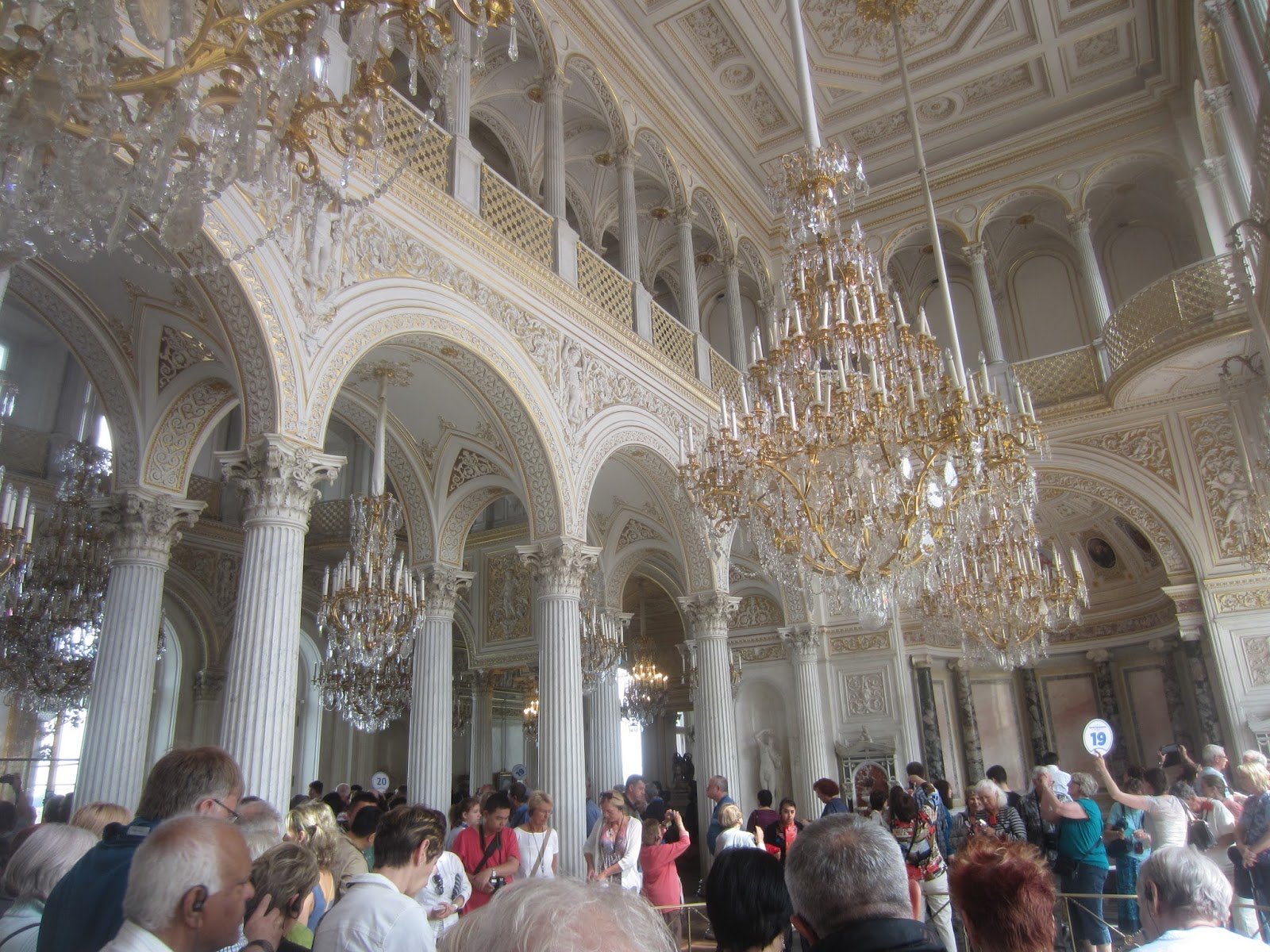
where we disembarked and to leave our bottles of water on the bus.  They would not be allowed in the museum. One thing we noticed immediately about Russian street traffic was the speed at which everyone drove, fast.  And how courteous they were to pedestrians.  If you put your foot in a pedestrian crosswalk the traffic comes to an quick halt,  According to our guide there are severe penalties to those who violate pedestrian rights.  There was not as much traffic as I would have expected for a city of almost five million people. There was a long line to enter the museum, but it moved quickly. Security at tourist sites in Russia is unusual.  I would prefer the term "quirky". Sometimes handbags are allowed and sometimes they aren't. Sometimes long coats are allowed and sometimes they aren't.  There seems to be no rhyme or reason for some of their rules.  It is easy to see why Saint Petersburg is called a very western city.  The czars liked France and sought to copy its architecture.  The interiors as well as the exteriors reflect this.  But I don't think I saw a blue building in Paris trimmed in white.


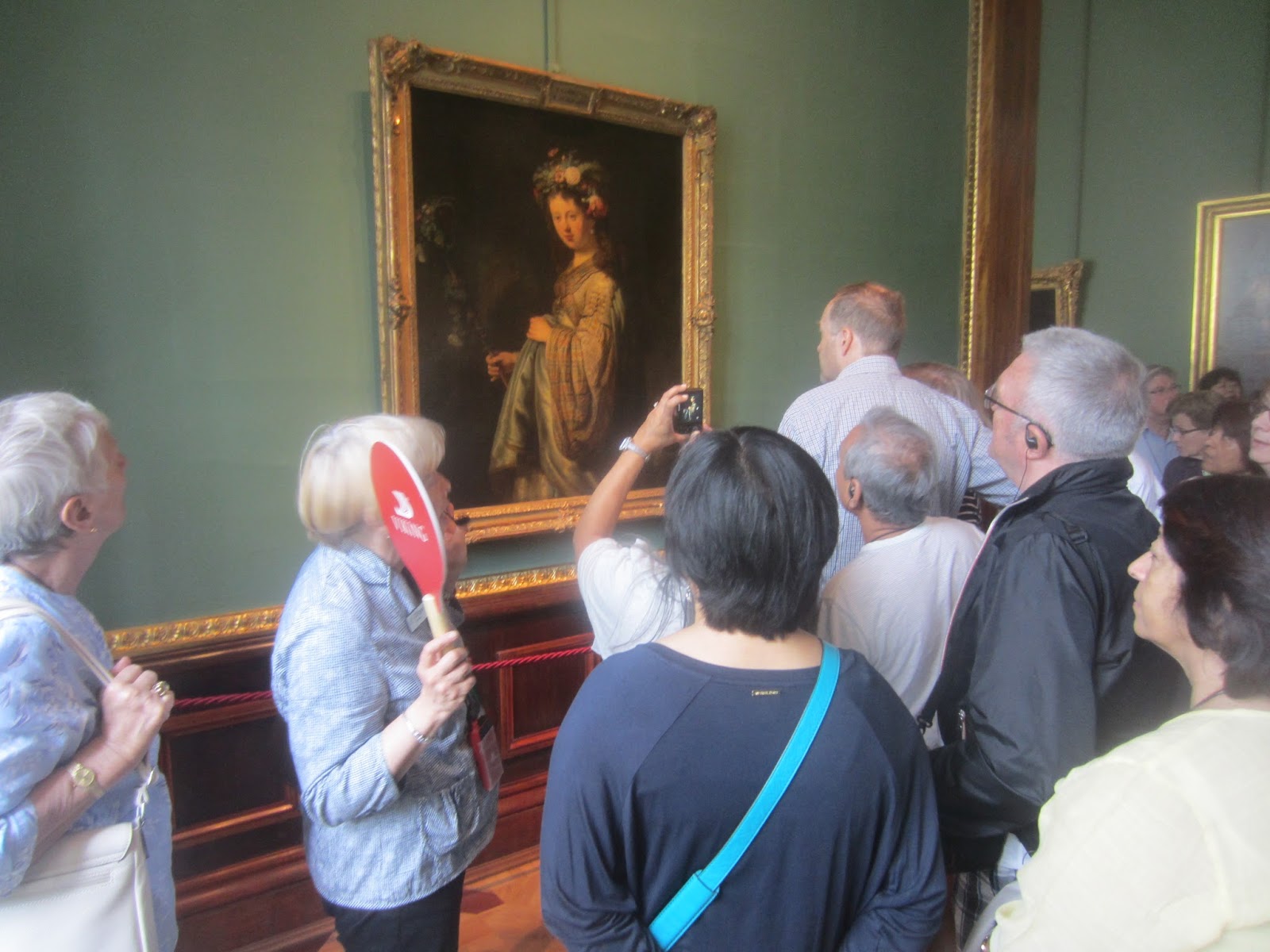
 Catherine the Great founded this museum in 1764 which, incidentally, was about the time my ancestors were  building their log cabins in the new world. There are three million pieces of art, antiquities, sculpture, and culture in the museum, which is comprised of six buildings.  When you visit one of the great palaces of Europe you become aware of what the wealth of the purveyors of
absolute power can buy.  All of the great masters are represented there. From Egyption art to the
present there are paintings and sculptures. I was fascinated by the collection of twenty-three Rembrandts, an incredible collection  of the Dutch master's work. The tour of this museum, which also included some palace rooms, was five hours long.  Although we did not see everything, we were ready to leave. It was crowded, although we had seen greater crowds at the Louvre in Paris and the Prado in Madrid. We found our motor coach a few blocks away from Palace Square, 2.

Back aboard the Ingvar we had an early dinner. We dined with a lovely couple from England. They lived near the Cotswolds, one of our favorite areas of the UK.  After a brief rest, a shower, and a change of clothes it was time to attend the ballet.  I am not a huge fan of the ballet, but I was in Russia and Russia is famous for ballet. Therefore, I put aside my prejudices and attended a performance of Swan Lake.  Once aboard the motorcoach we were told we were going back to one of the Hermitage  buildings. It seems one of the buildings was a theater. Many of us changed into some dressier clothes for the event. I put on a new pair of blue jeans. One fellow whom we would get to know better wore a Scottish outfit but with trousers instead of a kilt.  He said that he had heard that Mr. Putin did not care for men in skirts.The performance was great and was accompanied by an orchestra. The story was quite simple, and the dancing was fantastic.  Nevertheless, there is something about men in tights dancing on their toes that's not quite my cup of tea. But I do admire the athleticism required to dance the ballet. There was one ballerina that caught my attention. She was buxom! A rarity. After this performance, which we were not allowed to photograph, we returned to the ship slightly after ten o'clock.  There was plenty of daylight at ten o'clock, because St. Petersburg is at the same latitude as Anchorage, Alaska. A buffet awaited us.

We enjoyed our first full day in Russia and were anxious to see what tomorrow would bring.


Feb 7, 2017

A Walk Down Royal

The morning sun was quite warm, and the humidity was increasing as we walked toward Canal Street on Saint Charles. A streetcar rumbled by; the antique mechanical conveyance emanating  screeching, grinding sounds with bell ringing as it passed. The rest of the world may call them trolley cars, but in New Orleans they are always referred to as streetcars. I can hardly see one without thinking of Marlon Brando’s Kowalski screaming “Stella, Stella, Stella!” Could they call them streetcars in deference to Tennessee Williams play, Streetcar Named Desire?

There was light traffic as we crossed Canal Street. Canal has four lanes of traffic with a streetcar track between them. Unlike the majority of streetcars in the city, which are drab olive green, the ones on Canal Street are brightly painted red with yellow trim. But it sounded the same. We would find out the next day that senior citizens could ride the streetcar for only $.40.


After Saint Charles Avenue crosses Canal Street it becomes Royal Street.  Royal is narrow and has no streetcar tracks. We passed a few souvenir shops along the way. The light traffic moved slowly like that big river nearby.  Many of the trucks were those of food wholesalers delivering to the many restaurants in the city . And then I heard it...a different sound, not that of motorized vehicles, but the scream of an electric guitar blasting through the almost quiet street.  I peered between the passing trucks at the other side of the street. In the morning sun sat an old black man in a flop hat with an electric guitar cradled in his hands.  Thn the bottleneck slide on his ring finger caught the light of the morning sun. The sound of the delta blues filled the narrow street. We continued walking by antique shops and art galleries before reaching Cafe Beignet.

Like many restaurants in New Orleans, Cafe Beignet is open to the street. There are a few wrought iron tables clustered together in the front part of the eatery. Near the back is a counter and there were people in a queue. I saw a woman operating a cash register at the end of the counter and surmised that people were placing their orders for food. We surveyed the menu on the wall and decided that it was time to be a bit adventurous and order crayfish omelettes, one with hash brown potatoes and one with grits. The young man behind the counter gave us our coffee orders in styrofoam cups, and we went outside the small  courtyard to find a table. There was a tree in the corner next to the  street which was visible through the wrought iron fence. Our food arrived rather quickly, and we were pleasantly surprised at the the tastiness of the omelettes. The egg covered creek delicacies had the addition of bell peppers and tomatoes with a hint of onion.  Claudette’s hash browns had bits of andouille sausage for added flavor. My grits were course ground just the way I like them and to my delight the order with grits was referred to as the "regular". The dining area was rather crowded but not so crowded that a brown tabby cat could not attend. We delighted at the interaction between the tabby and a tiny Eurasian girl. It was a pleasant meal; warm weather, the smell of blooming flowers, and the diners' voices drowning out the sounds of light traffic. I brushed a few crumbs from my plate to the sparrows on the ground before depositing our plates and cups into the trash receptacle and taking our leave,

Most of the shops on Royal Street were now open.  We window shopped a bit before entering an art gallery. About a half a dozen artists were represented in virtually every medium. Some of the paintings were quite simplistic depending on bold color and simple shapes to convey their respective messages. There were realistic landscapes in watercolor and gouache. A young woman showed us quite a section of Salvador Dali hand colored lithographs. She was quite knowledgeable about art and had once attended a glassblowing workshop of Dale Chihuly. We said our farewells and continued our walk down the street.  A collection of periscopes in a shop window caught my attention. There were six of them.  Periscopes normally  make one think of submarines and naval warfare but not these. In
the days of trench warfare, such as WWI, periscopes were routinely used to survey areas beyond the trench without exposing one’s  self to enemy fire. These were real beauties, and I could not resist the opportunity to get a closer look. We entered the antique shop through a heavy wooden door. It was flush with antiquities of the household variety. Claudette immediately  was drawn to the tea sets. After a closer look at the periscopes, I found the hand cranked butter churns interesting. It was enjoyable but there were other things to see down the street.

Royal has all the prerequisites of NOLA streets. The buildings are old, most of the paint is faded, and wrought iron balconies are abundant.  But, the shops and restaurants are world class. The shops sell Rolex, Cartier and other exclusive brands. Royal Street is known as one of the most expensive places in the world to shop . We continued our walk by the New Orleans police station. A sign on a post advertised NOPD t-shirts for sale. I’m not quite sure who would want one.  

We approached the corner of St. Louis and Royal. A brightly painted carriage passed by loaded with tourists. We’ve seen these in many cities, Charleston, St. Augustine, Savannah, and others. There is something to be said for a horse drawn carriage ride, the slow ride and lively chatter of the driver add something to an historic city.
We last had a carriage ride in Charleston on our fifth anniversary. There was a barricade across the street making Royal Street, from St. Louis to St. Ann Street, pedestrian only. A pedestrian only street is just the place for street entertainers. It seems the newest form of street entertainers are poets. Yes, poets. The poets sit at tiny tables with old portable manual typewriters.  Like most street entertainers they are dressed in the best the Goodwill store has to offer. They offer personalized poems for every occasion. One poetess advertised erotic poems. I dared not query any details. One tall thin black man in white tie and white tails stood motionless on one leg with a stuffed doggie on a leash. A few yards further down the street a man in a Darth Vader helmet and robe danced to pop music.  There were other bands too, some playing dixieland jazz. New Orleans is known for music where the names of Marsalis, Armstrong, Connick, Neville, and others are
famous.  But the folks playing on the street aren’t that well known. One band in particular, dressed in tatters, of course, was playing some gypsy style music with a very slim male singer with a falsetto voice. At least I think he was a male with a mop of curly brown hair. But the eye makeup and pink lipstick made his gender questionable. We listened to the music a bit before ducking into the Court of Two Sisters for a late lunch.

Behind the double doors was about a thirty foot hallway to the courtyard. It was flanked by other buildings, and in the back was access to an alley with a street beyond. There was shade over the eating area with tables draped in white tablecloths. In the corner was a band of clarinet, banjo, and bass producing a cool jaźz sound. The food was served buffet style. There were over seventy dishes to partake of. The choices were almost overwhelming. It was my intent to sample as many local dishes as possible, and I enjoyed my attempt very much. I did have a crash course in the proper way to eat a crayfish. We enjoyed the meal at the Court of Two Sisters and would recommend it to everyone.


We continued our walk down Royal Street and then turned right on St. Peters Street toward Jackson Square. Every time I return to New Orleans I always walk down Royal.  Maybe it’s not as famous as Bourbon Street, but I like it.