Feb 10, 2015

In a Masculine Vein

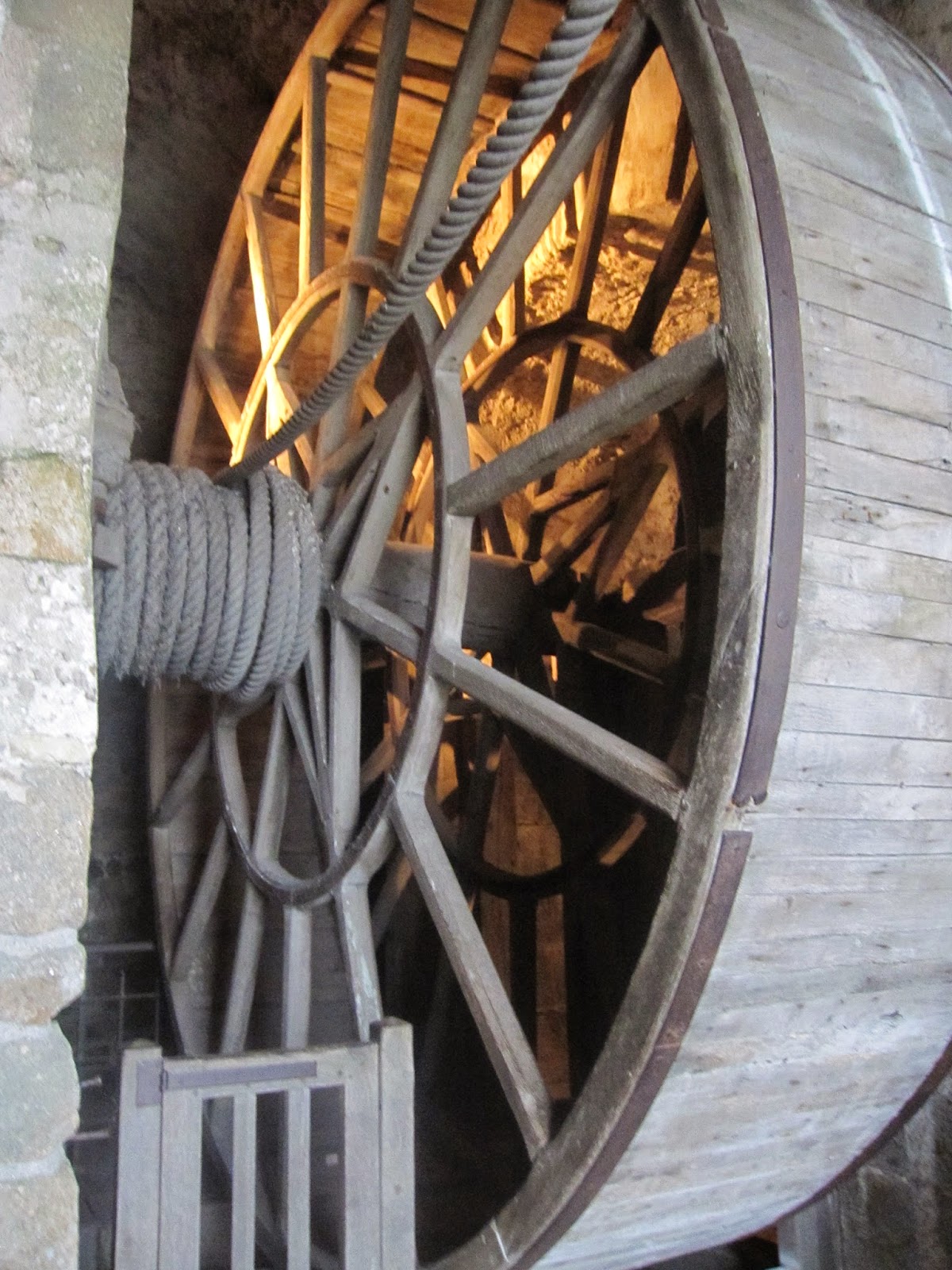
Winch at Mont St. Michel
As you've noticed from my posts about our travels we visit a number of different kinds of attractions. Typical of any travel brochure or other travel advertising art museums, churches and restaurants are featured. It seems to me that those things I consider masculine are usually left out.(The museums are usually art museums.) Now I don't have a problem with fancy restaurants or art museums or cathedrals in moderation. But as a fan of things that move and/or make noise I search for other venues.

In our travels I've fed my masculine side with quite a few interesting attractions.  At the onset I would like to say in reference to cathedrals I am  in awe of the construction methods used to build these monumental structures. The builders moved tons of stone long before the invention of the giant machines used in modern day. At Mont Saint Michel in France we saw the winch used to raise building stones to the upper levels in this building.  It reminded me of a giant hamster wheel perhaps seventeen feet in diameter. Men would walk inside the wheel as a rope wound around the axle raising building stones to great heights. At El Escorial in Spain there was a great display of building tools used during the middle ages.   In the museum at Pont du Gard, France, you can see the building methods for the giant aqueducts. I never realized until visiting that museum that forms were used to construct
Template for arch at Pont du Gard
the giant arches that are a hallmark of Roman construction. The Romans were fantastic builders and great engineers. Their structures of 2000 years ago still stand today.

I have a fondness of mechanical things and the way they work. Cutaway engines have given me insight to the internal operation of the mechanics that produce the power. One  of the most notable of these is the 28 cylinder Pratt and Whitney 4360 aircraft engine. I saw an animated cutaway version of one of these in the Pima County Museum of Air and Space near Tucson, AZ. I posted a video I made about this engine on YouTube. It has received more than eighty thousand views thus far. The giant steam engine in the British Museum of Science was incredible to observe in operation.  In Nuremberg, Germany, there is a toy museum.  In it are those great mechanical toys of the early twentieth century. This was long before the advent of plastic and battery power. They were made of
German submarine in Chicago
metal and powered by wound springs and there are videos to show them in operation.   During our travels I have visited submarines, aircraft carriers, battleships and destroyers.  I've enjoyed them all. However, there are times when I think that the exhibitors desire to make an attraction more tourist friendly has destroyed some of the ambiance. For example, on the aircraft carrier, Intrepid,  the "knee knockers" through the bulkheads have  cut down so the tourists won't hit their shins when going through a bulkhead.  And on the German submarine in the Museum of Science and Industry, Chicago, the subfloor has been removed so tourists
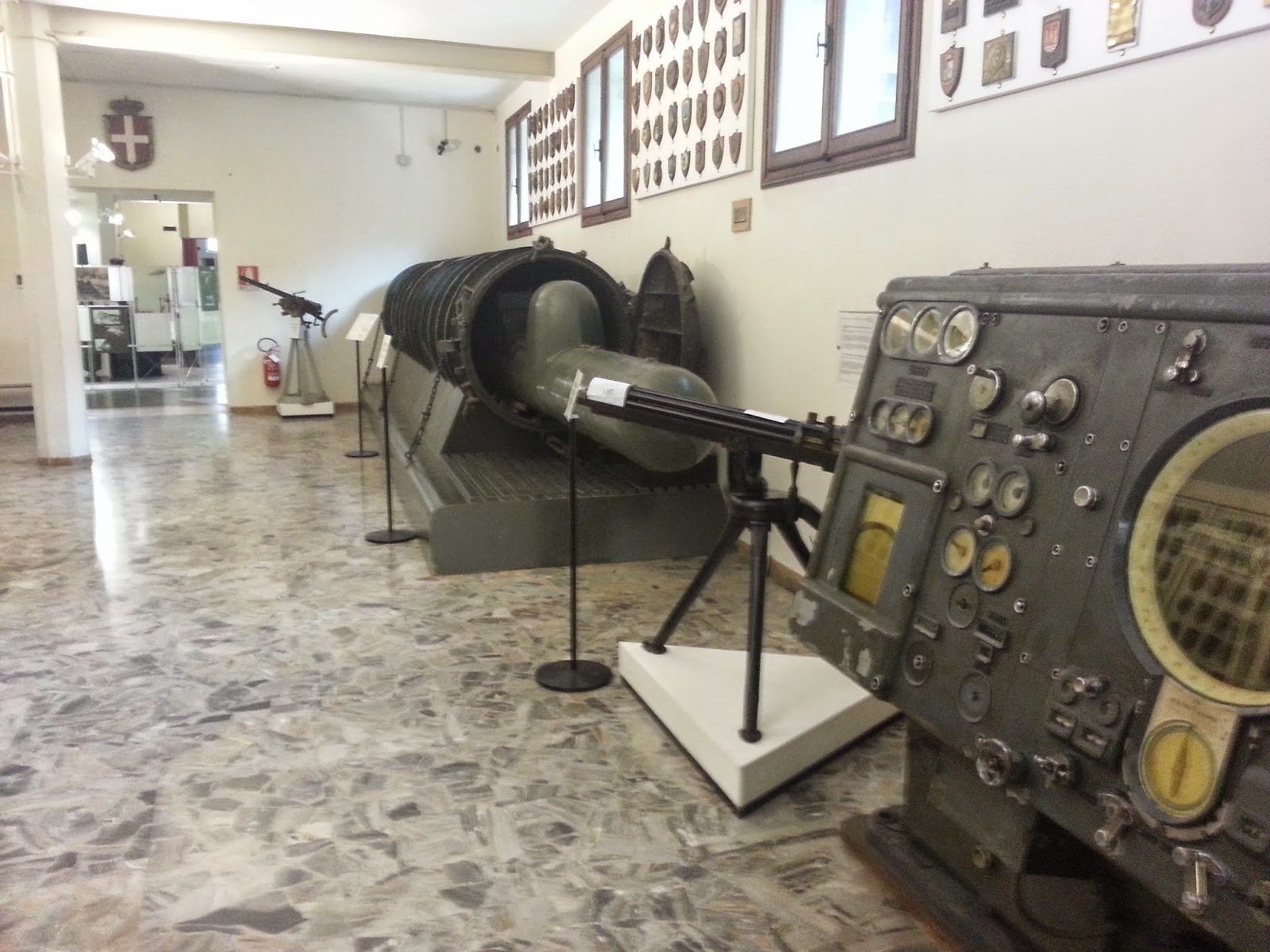
Midget Italian submarine in Venice
will be able to stand up straight when touring the relic. I believe that these modifications prevent a person from experiencing the true effect of being on the vessels. Arms and armor along with the aforementioned ways in which mankind seeks to destroy mankind I find interesting. The mechanical means of destruction is well documented in the Spanish Armory Museum in Segovia where examples of weapons from the spear to rifled cannon are on display. The engraved and ivory inlaid crossbow of a past king is a work of art. One of the most unusual instruments of warfare was the two-man miniature submarine used by the Italian navy during WWII. I'm sure I drooled over it in the Italian Naval Museum in Venice.

Perhaps the item I seek out most on our travels are aircraft displays.  There is just something about these machines that break the bonds of gravity that fascinate me. If I had to pick a favorite it would be the Pima County Museum of Air and Space. The displays are more accessible than the U.S. Air Force Museum or the Museum of Naval Aviation.  In Charleston, SC, the aircraft carrier, Yorktown has a great collection of naval aircraft. It has a much better display than that of the Intrepid in NYC. We've visited at least ten other aircraft museums over the years. When I have the opportunity sit in the cockpit of these flying machines I feel a connection with the men that flew them.  I also realized that the men that flew them were smaller than me.

fighter plane on the USS Yorktown

In the future I look forward to other great museums and attractions.  But without an understanding wife I would never had be able to see the things I have. Of this I am most grateful.

Feb 3, 2015

Yesterday

No, I'm not referring to the first word in a song but rather what I did yesterday
I woke up then some calisthenics before going to the gym to walk two miles. I would remiss if I did not mention the family cat laid on my stomach while I waited for my beloved to ready herself for the gym. Enroute we listen to a Harry Bosch novel and try to figure out whodunit. Of course going to the gym also means that I will meet old men there and reminisce about the old days and how the country is going down the crapper. However viewing young women in spandex will lift our spirits. I manage to read the morning national news on my phone while riding an exercise bike.

Then back home for a breakfast of cereal while reading the Post and Courier after that a daily Bible reading and then a short nap before getting to work. I check email, Facebook, and Instagram responding where necessary.  I updated the website and Facebook fan pages I'm responsible for. Then I finished up a short video on the B-29 Superfortress airplane. I love airplanes.

Time for lunch. In the kitchen I had a yearning for white bean soup.  I had to make some.  In my haste I did not look for or find a recipe so I made up my own.

First I sauteed a chopped medium onion with two cloves of chopped garlic in a tablespoonful of olive oil then I added a cup of water and brought it to a boil.  To the boiling water with onion and garlic I added one package of Herb-Ox chicken bouillon and stirred until dissolved. I added a can of white beans and one slice of fried bacon chopped into small pieces.
Then I seasoned the hot soup with one half teaspoon of ground coriander. Next I added about one half dozen spinach leaves.  After the spinach leaves had wilted I added fresh ground black pepper to taste. I served myself with soup and tortilla chips.

After lunch I tidied up the kitchen a bit and after a quick nap continued working on a painting.  The local artist guild of which I'm a member is having its annual show and I needed and entry. I painted prolifically for about ten years before tapering off and channeling my creative talents into social media and storytelling. The painting I was rendering was with acrylic and pallet knife was of balloons over Cappadocia. We had visited Turkey several years ago and gone on a hot air balloon ride. The painting would commemorate that event.

After my wife returned home we went to dinner at Ruby Tuesday's.  We enjoyed a beautiful sunset driving into town.  She had a free meal as a birthday gift.  I foraged at the salad bar.


Later at home we caught up on some old episodes of Arrow.


It was a good day!


Jan 23, 2015

All You Need...

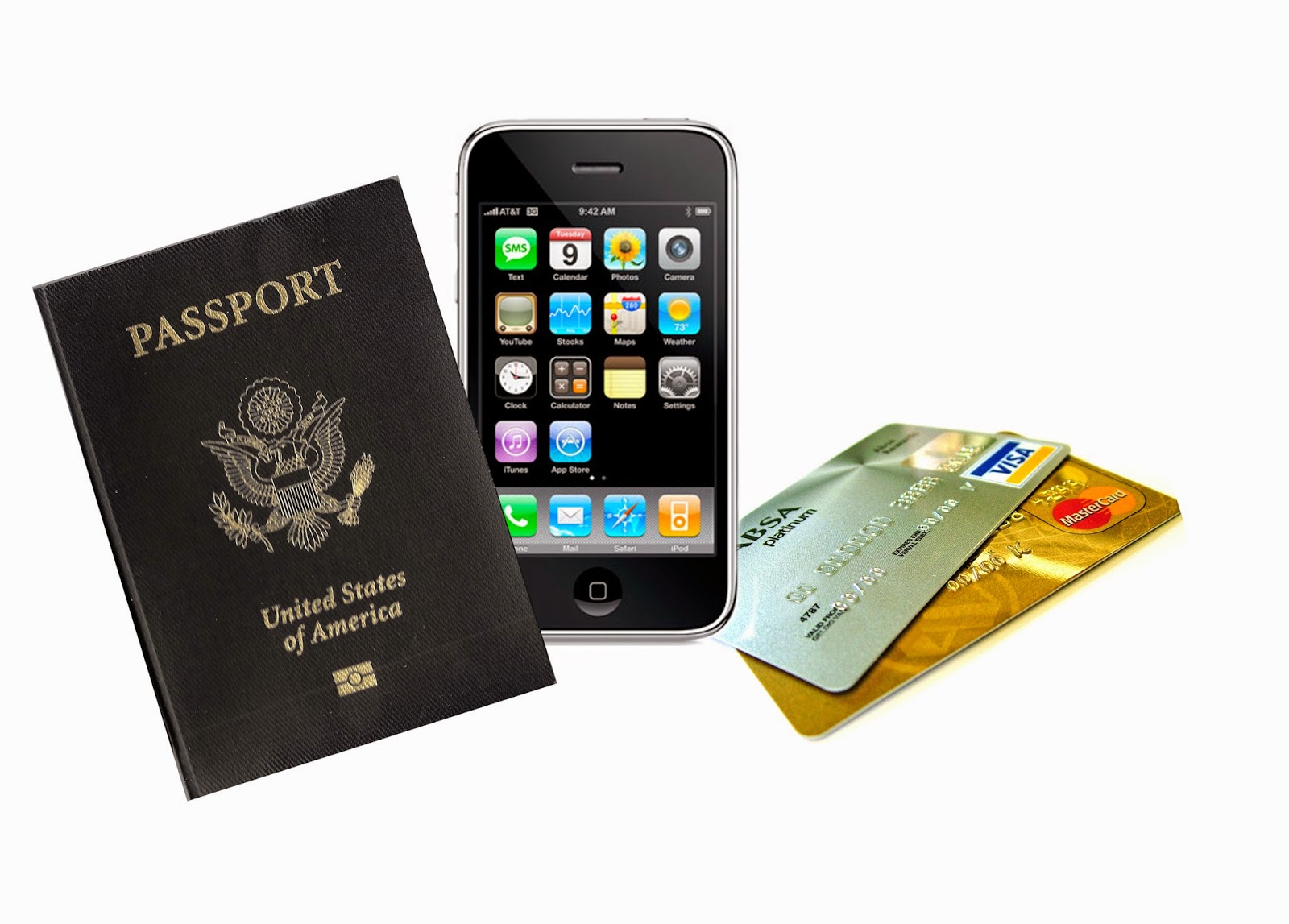
All you need to travel the world is a smart phone, a passport and a debit card. Could this be true?  I think that the passport is a given.  After all I can't imagine trying to enter a country without one. But why a smart phone?  I rarely need to talk to anyone in a foreign country, besides I probably wouldn't understand the language. Most phones will work in a foreign country if the proper card is installed. But it you're like me, talking is what I use my phone the least for. Now is the age of cell phone applications or what we once called programs. We have found many uses for our smartphones while traveling.  Once we used an audio guided tour of London we had down loaded from Rick Steves' website. Translate apps also work well to help you with the local language. At times you can use a number of apps together for a desired result. For example, while in a museum in Venice I found the descriptive labels on artifacts in Italian. I lack knowledge of the Italian except for "grazie".  But I used the scan to text application to get the Italian copy into my phone and the translate application to translate it into English. It's  a great way to translate restaurant menus too. Obviously, a currency converter application is always useful. You should be sure that you apps are downloaded to your phone and not on the cloud accessible only via WiFi.  Since most hotels in foreign countries now had WIFI it's easy to send email and catch up on social media. However, sometimes they can be unreliable and frequently require a user fee. I use my cellphone as a camera, currency converter, Google maps and a measure app.  With WiFi  I use it for editing photos for blog posts and social media. Needless to say we keep our friends at home updated via email.

Thirdly, a debit card or credit card is indispensable. Major cities around the world now have ATMs. As a general rule the exchange rates are better than airport rates and most banks.  Also most restaurants in major cities accept credit cards. We rarely carry much cash but have a debit card readily available.  However, there is one caveat. Be sure to notify your credit/debit card company that you will be traveling in a foreign country. If they notice that someone is making large withdrawals or charges in a foreign country they may freeze the account and not allow withdrawals or charges. This happened to us once with our debit card and we were forced to use a credit card instead. An interesting aside on credit cards. If you rent an automobile with a Visa card the credit card company insures the automobile. We had a minor fender bender is Nazare, Portugal, and the credit card company paid the claim.

As an afterthought, good old American greenbacks are recognized almost anywhere in the world.  Don't leave home without a few. And carry your smartphone, passport and debit card.

Jan 16, 2015

Two Men on a Fish

Venice is a marvelous city. Its canals are lined with exciting things to see and do. Like any city it has its "must see" attractions.  The Grand Canal, the Guggenheim Museum and Saint Mark's Cathedral are but a few. However, I find some of the lesser known places of interest very attractive. One such place is the Museo Storico Navale, the Italian Naval History Museum. It's easy to find, right off the lagoon beside the canal leading to the Venetian Arsenal  at Riva San Biagio 2148.  The building was a granary in the 15th century. The origin of the museum goes back to 1815 when the Austrians controlled the city.  They established the museum to house the tremendous collection of ship models produced by the Venetian Arsenal but officially established by the Italians in 1919. The collection was housed in its current location in 1958.  In its forty-two rooms the seafaring history of Venice comes alive.

Inside the building after paying our admission fee and receiving a brochure which had the layout of the museum we climbed the stairs and began our discovery of Italian naval history. Some of the first displays we saw were  that of a model ship collection which must have numbered well over one hundred. There were ships of all types, but predominantly those of the glory days of the Venetian navy when it ruled the waves.  The size of these models are from six inches to ten feet.  One of the most impressive needed 130 men to man the oars.  There are actual barges in excess of fifty feet long. The wealthy traveled by barge and those of lesser incomes traveled by watercraft as well.    Wheeled vehicles aren't allowed in Venice. These barges  used in the canals were extremely ornate. The decorative wood carvings were brightly painted or covered with gold-leaf. Gold leafing is the process of adhering extremely thin sheets of gold to a  surface such as wood.  These barges were floating works of art. One of the rooms in the museum is dedicated to the most famous of Venetian watercraft, the gondola.  With a gondola out of the water it is easy to notice the curved keel which allows the gondolier to propel the boat forward in a straight line with an oar on only one side. There were rooms with old cannon as well as modern machine guns. The bottom most floor had more modern naval displays. There were actual boats  used in the second world war for launching torpedoes and the control panel from a submarine.

As we wandered through these  modern machines of warfare, I suddenly grabbed Claudettes arm and shouted, "Hey, there's one!"


In one of the rooms was a large canister open on one end with a miniature submarine emerging from it. It can be debated whether it was a submarine or a manned torpedo. Italian scuba divers rode this underwater machine to an enemy ship and attached a warhead to the ship before escaping and detonating the warhead electrically. Although other Axis powers, mainly Japan, developed miniature submarines the Italians were the most successful in using them. Or at least according to the information posted at the display. Miniature submarines are almost a thing of fiction. But there right in front  of me was one. Claudette was not as excited as I was. After all it was a museum of naval history. I made a number of photographs of the little sub. Using my drawing application on my smartphone I drew two figures on the photo of the midget submarine. As we continued our discovery of the  Museo Storico Navale, we saw another miniature submarine.

As far as I'm concerned the Museo Storico Navale is a "must see" in Venice.

The operation of the miniature submarine.

Dec 31, 2014

Mystic Seaport

It was a chilly November morning when we entered the seventy-five acre museum. We were in Mystic, Connecticut, at the mouth of the Mystic River.  It had been  a long time since I had seen those gorgeous color photographs in National Geographic Magazine. That day we would see Mystic Seaport, the Museum of America and the Sea for real. We had parked our car and crossed the street and entered by the guardian tugboat.

Before buying our tickets we were looking out at the river when we starting chatting with a nattily dressed gentleman installing a banner advertising a gallery.  He told us quite a bit about what we were going to see. You can only access the museum though the ticketing building.  We managed to get senior citizen discounts as well as AAA. That was good. Our tickets came with wristbands to identify us as visitors and a map with a schedule of events. The crisp winter air smelled fresh and we immediately noticed the lack of the odor of pluff mud. There was not much of a smell of salt either. But the the salt content was probably quite low in the river. At first we looked at a couple of steel hulled boats one was a trawler and the other a ferry. Claudette snapped my photo sitting in a dory doing my best impression of the Gordons fisherman. There are over sixty buildings in the restored mid-nineteenth century seaport. Mystic Seaport was the largest shipyard on the east coast at one time during the period of wooden sailing ships.  As we walked the gravel streets among the quaint shops and houses there was almost an eerie feeling. There were few visitors on that early Sunday morning. Some of the buildings were locked and many of the demonstrators were absent they would be there later in the day.  In one building there was the remnants of a large sailing ship.   There were no masts on theAustralia.   It was like a skeleton. Claudette went into the hold, but I could see her since planking was missing between the ribs. It was easy to see how the ship was constructed.  I found that interesting. Later in a smaller building we saw a collection of catboats. Most of those exhibited the epitome of the boatbuilders craft.  From there we saw a most unusual building housing the cordage production machinery. Sailing ships used hundreds of feet of rope of various sizes and it was made in that building which was over three football fields long.  It was an interesting process.  Twisting hemp. The first ship we went aboard had once been a yatch. But that was after the Conrad had been built as a training vessel.  The docent was very knowledgable but there is something about sailing ships with steel hulls that I don't like.  Maybe it's because they don't creak. There are over twenty watercraft of various sizes at Mystic Seaport to explore. There is a lighthouse there as well. I found it rather amusing because it was not very tall. But then it was positioned on a river and not the ocean.  One of the buildings held a 1/128 scale model of the entire seaport. This recreated seaport in miniature was over fifty feet long. The detail was incredible.  Each tiny house had its own privy! Perhaps, the greatest and best known attraction of Mystic Seaport is the Charles W. Morgan. It is an original nineteenth century whaling ship. The ship was launched in 1841 and took her first whale in December of that year. When we first saw the ship which towers over everything they had launched a whaleboat and were moving toward the bow of the ship. We approached the ship from the stern and entered a small building nearby.  It housed harpoons and and other whaling artifacts as well as a whale boat. There was also a diagram of how to butcher a whale. After leaving this display we boarded the ship.  We walked toward the aft part of the ship and Claudette took my picture at the helm.  The helm is where the ship is steered. The ship's wheel was at least four feet in diameter. I was surprised to notice that while at the wheel I could not see the sea.  But I could see the compass. We went below deck by way of a narrow curving stairway. I was surprised that it was not a ladder. At one hundred thirteen feet long and three hundred thirteen tons the ship was big enough to have a stairway which led to the captain's quarters. On whaling ships like merchant ships of the era the captain's entire family followed him to sea. I found it interesting that the captain's double bed was mounted so that it remained level when the ship was not. As we walked forward in this ocean going whale processing plant of wood we went through the crews quarters. There was a compliment of thirty-three men at sea to kill and process the largest mammals on earth. And they had to sail the ship too. Whale oil was in big demand. Until the advent of kerosene whale oil was used in lamps for lighting. Another surprise for me was that I could stand up in most places and I'm almost six feet tall. We left the ship with a better understanding of whaling and the life of a seaman aboard a whaling ship.

We exited Mystic Seaport and began our trek further north.