Mar 16, 2015

Faded love

If you are like me some songs evoke certain memories. Just the other day I was listening to an old CD.  It was one of those with something scribbled on it with a Sharpie. I stuck it into the laptop and gave it a listen. One of the first songs was Faded Love as sung by Patsy Cline. I had never heard this version of the song being familiar with the Bob Wills version.  Actually, I am not a big fan of of Western Swing music but like some jazz I can take it in small doses. There was and is  something about the sound of those twin fiddles in the song that I really like. Incidentally, Texas or Western Swing music is dance music  Dancing is something I don't do. I've crashed and burned on all attempts. Yes, the song did evoke a memory.  It reminded me of a night we spent at Billy Bob's Texas, the largest honky tonk in the world. I don't remember exactly where I had heard of Billy Bob's but when I found out that we were going to Fort Worth, Texas, I knew I had to see the largest honky tonk in the world. And I did


I am big fan of what I call the "all alone at the end of the bar at closing time" songs.  These may be called "tear-jerkers". Many of those are country music songs of the old style country. Back when the lyric was more important than the beat. I guess some could be called "torch songs". I think the greatest torch song was  At Last by Etta James. If this song doesn't tug at the strings of your heart, go see  your doctor to get restrung! Some people associate a specific song with a particular event or events.  Don't Stop by Fleetwood Mack was the theme song of William Jefferson Clinton's quest for the White House. Many couples have "their" song. How many times have you seen it in a movie? She looks at him with dreamy eyes and says, "They're playing our song".  Once I was the part of one such couple. The song was Gentle On My Mind by Bobby Goldsboro. (I know Glen Campbell covered it too.) The song defined the relationship. When I lived in the Northeast a local radio station had a call in segment og Fridays for dedications. You could call in and dedicate the Johnny Paycheck song,Take this Job and Shove It, to the boss of your choosing. I never did,  But should have.  Songs often remind us of personal loss.  When I hear Bishop F.C. Barne's Rough Side of the MountainI'm reminded of Vincent, a fellow artist I sold art with on the streets of Charleston. It was sung at his funeral. 

Other songs bring back other memories too. Every time I hear  Need You Now by Lady Antebellum I think of hot croissants and night time on the Champs de Elysees. When we were driving around France several years ago it seemed that every other song played on the radio was I Need You Now. And in English!


Some songs remind us of films or television shows. The John Barry theme of the 007 movies is recognised worldwide.  Other well know music from the movies is from The Godfather, The Magnificent Seven  and South Pacific.  The Mash  and Cheers television themes are easily recognised. I like the gritty sound of the theme of Hell on Wheels.  I can't hear the theme from Star Wars without visualising "A long, long, time ago in a galaxy far, far away..." scrolling up the screen and a battle cruiser coming into view. Of course before the days of television there were the themes to the radio shows. I never the forget The William Tell Overture from The Lone Ranger.

And of course there are the commercial jingles. Is there a physiological reason why they can get stuck in our minds?  I've had some commercial jingles play for hours in my head. I think it was those cats advertising fat litter!


We are all touched by music...I think.

Mar 13, 2015

Tatts

I wanted one. My momma didn't like them. I thought they were cool, although I don't know if I would have used the word "cool" in that  way in the late fifties. Before I had seen a real one I had seen a picture of one in an advertisement for Marlboro cigarettes on the back of a Life magazine.

The first time I saw a real one was on a doffer named Jimmy.
I was probably about eighteen years old at the time and had my first full time job. The textile industry was the most common type of manufacturing where I lived. My job title was"material allocator".  I moved bobbins of yarn from one place to another.   One of the jobs in the manufacturing plant I worked in was that of a spinning frame doffer. A spinning frame doffer removed bobbins of yarn from the spinning frames. Doffers were usually relatively small thin men, but Jimmy was different.  He was short and muscular.  He looked sorta like "Mr. Clean" but was only partially bald. He had one, or rather several, tattoos. On one of his arms, which looked as though it had come from a box of Arm and Hammer baking soda, was tattooed "Mom".  The other arm was the most interesting, however.  At his shoulder was tattooed "Jimmy loves". Under that were three black rectangles.  Beneath the bottom most rectangle was tattooed "Kathie".  The three rectangles covered the girlfriends that preceded Kathie. There was another guy there with a tattoo, but I didn't know him very well. He worked on the loading dock and didn't have much to do with other folks. I was in the canteen once and happened to notice some crude writing and a skull and crossbones on his forearm.  I asked someone about it, and they said he was a tough guy and had been in Federal prison. They said they were called jailhouse tattoos.

When I was in the U.S. Navy during the Vietnam war I saw a lot of tattoos on sailors. Actually, the first Navy tattoo I saw was while I was in boot camp. We all showered together there, and I could not help but notice this one particular tattoo.  This sailor from North Carolina, whom some said had been a carnival worker, had this tattoo of a rabbit running up his back. I'll let you figure out where the rabbit hole was. Once aboard ship  I found out how sailors had spread tattooing throughout the world. Although there have been tattoos found on the remains of humans from 5,300 years ago, British sailors, some of Captain Cook's, brought the idea back to Europe after visiting the South Seas.  The process was simple. The skin was pierced or cut and ink was rubbed into the incision.*  After the wound healed the ink was visible through the skin.  The men of the sea are also responsible for myths and superstitions attached to certain images tattooed on their bodies. Here are a few of the betterknown ones.
  • Swallows--for good luck
  • Turtle--means the sailor has crossed the Equator
  • Pigs or roosters --to keep from drowning
  • Anchor--means the sailor has crossed the Atlantic Ocean
  • Golden Eagle--means a sailor has crossed the International Date Line
  • Christian crosses on the soles of feet --to ward off sharks
  • Five-pointed stars --to prevent getting lost at sea
When I was a sailor I saw a number of these and became familiar with the superstitions attached to some of them.  Sailors seemed to have an affinity for tattoos of the nude female form. I never found out what superstition was attached to these. I do remember one sailor getting his nude female tattoos removed in order for some young lady to accept his hand in marriage. However, I did see my first tattoo on a female form in the Philippine Islands. She had "sweet" and "sour" tattooed on her upper body. I'm sure you can figure out what parts of her anatomy had these labels My shipmates on the Bon Homme Richard preferred two rather unique tattoos.  They favored either "US PRIME", like the blue stamps on Bonnie Dick steak (roast beef), or lip prints. Either of these were visible through a sailor's white Cracker Jack pants. I was told these tatts were chick magnets. Of course to get a tattoo a person must be willing to withstand a certain amount of pain. But there are specific libations that have a dulling effect during the application of tattoos. Maybe that explains these lines in a Jimmy Buffett song.

"It's a real beauty,
     a Mexican cutie,
and how it got there
    I haven't a clue!"
The modern twin-coil electromagnetic tattoo needle was patented in 1891 by Samuel O'Riley, an Irish-American tattooist working out of a barber's shop in New York City. The tiny needles on a modern tattoo device puncture the skin over 150 times per second.  There can be as few as three or as many as 15 needles puncturing the skin simultaneously. 

Tattoos are extremely popular now. According to a 2008 survey 40% of those Americans aged 26-40 had tattoos.


Personally, I've never  gotten a tattoo. I'm quite surprised that I did not get one while in the service. Perhaps I dream too much of Ray Bradbury's Illustrated Man.


* The native people of New Zealand are said to use gunpowder instead of ink. I, however, find this difficult to believe, because the Maoris were tattooed when Cook first saw them, and he introduced them to gunpowder. 


Mar 12, 2015

Hoot Owls, Bacon, and Boats

Recently, I had the pleasure of relating this story at the Tea Ladies of the Saint James Goose Creek Parish Area Annual Tea.

It was one of those days in early summer. The sun was shining, the birds were singing and all was right with the world. It was the day of our big adventure. Jimbo Dillashaw and I were going on our great adventure. Of course, when you're ten years old, every adventure is a big one. Jimbo Dillashaw was my very best friend. We were about the same age, but he was a little shorter and I was a little rounder. His bright red hair was cut in a crew cut while my brown hair was cut short as well. Sometimes I would call him "Frenchy" and it would make him angry even though he was a descendant of the French Huguenots. His family name had been de la Shaw.


We had packed up our backpacks. We didn't have fancy backpacks like they have now, but ours were army surplus ones in o.d. green with U.S. stenciled on them. Jimbo's mama had dropped him off at our house on her way to town. So we ready to go. We would go through the barnyard on our way to the back side of the farm where we were going to camp. There  was a deep gully there. To us it was the Grand Canyon. We just had to get there.


We entered the barnyard. On the left was a small building which looked like a privy but was actually where we stored all the harness, which we called gears, for the mules.  Next to it was the hog pen. There were two storage buildings which we called cribs. One of those cribs held corn that we fed to the animals and where I would shell some for us.  We would take the shelled corn, about a half bushel, to Shiburg mill. There the miller would grind it into cornmeal for mama to make cornbread and hush puppies. Shinburg was also near Jimbo’s house.  On the back of the barnyard was a gap to the pasture beyond and fence to the right side. On the right side of the barnyard were stables for the mules. Nearer the front gate was a loading chute for loading cows on a truck to take them to the sale barn. In the middle of the barnyard was a big barn with stables for the milk cows.


Jimbo and I  had almost crossed the barnyard when he said to me, “Ain’t that that new bull y’all just got over there?”


“Yeah, it is,” I said, noting the young Black Angus bull my uncle had just bought. He weighed less than a thousand pounds but would grow up.


Jimbo says, “Tony, I’ll bet you could lasso that little ole bull just like the cowboys do!”


I thought about it a minute or so. We were big fans of cowboy movies.  We had seen the cowboys lasso cattle many times in the movies we had seen with Grandma at the Carolina Theater.
“Yep, I can do it,” I said, answering the challenge. “Tell you what to do. Go around the barn and get the bull to follow you around to the loading chute.  I’ll be sitting on the fence there with a rope ready to lasso that rascal!”


Jimbo popped to attention and gave me a right hand salute, “Yes, sir!”


I did not think Jimbo would have any trouble attracting the bull; after all, he had that red hair and was wearing a red shirt.


I went up to the gear house and found a brand new plow line, made a loop in it, and fed the long end through the loop.  That made my lasso. I felt just like a cowboy as I twirled it overhead. Back in the barnyard, I positioned myself on the fence and waited. I yelled, “Jimbo, where are you?”


Within  few moments I heard Jimbo yell and the thunder of running feet, and they weren’t Jimbo’s. Around the corner of the barn they came. Jimbo’s red shirt in the wind behind him. He was beatin’ feet! A few feet behind him was the bull, his head lowered, snorting and making that angry bull sound. As they passed by me, I slung my lasso.  The loop dropped over the bull’s head and around his neck. The rope tightened; I tightened my grip. I flew from the fence and nose dived into the ground. The bull did not slow but ran like a caffeinated jack rabbit. Jimbo had ducked into one of the barn stalls.  The bull drug me around the barn about three times before I realized he wasn’t going to stop. I’m not always the sharpest knife in the drawer.  I released the rope and brought my body to a screeching halt.  When I stood up and began to brush myself off Jimbo came out of the stable and walked up to me laughing his head off.


“Whew,” he said with his nose turned up, “You sure do stink!”


I looked at the front of my shirt and pants. I had old cow patties, new cow patties, big cow patties, and  little cow patties all over my clothes. I think I had hit every cow pattie in the barnyard.  If I did not get some clean clothes, Jimbo would complain about the smell and spoil our adventure.  But, it would take time away from our big adventure for me to change clothes. What is more important to a ten-year-old boy? Clean clothes or a big adventure? Against my better judgement I sneaked back into the house to change clothes. I had to be very quiet so Momma would not hear me. She, no doubt, would have some harsh words to say to me about the dirty clothes. Luckily I got changed and stuffed the dirty clothes in the corner beside the wardrobe. I would be long gone before she found the dirty clothes.


Soon I was back in the barnyard with Jimbo. We hiked to the far side of the farm to the Grand Canyon. We made our camp on the flat sandy bottom of the big gully. The sides were fairly steep, and we had slid to the bottom. Fortunately, when we looked for firewood, there was plenty supplied by a fallen pine tree. We found some rocks to make a fire ring and hung our food bag from a scraggly sapling which was jutting out from the wall of the canyon. It took about a half dozen kitchen matches to get the fire lite. soon the fire was burning brightly as I set the cast iron frying pan atop it. Jimbo dug a can of Star Fort hash out of the food bag and tossed it to me. "you gonna open it?" he asked.

"You better do it," I said, "My Hoppy knife doesn't have a can opener."


"Roy was always a better prepared cowboy!"


"No, just the Roy Rogers knife has a can opener. Roy ain't no better cowboy than Hopalong Cassidy. No way,  no how, Frenchy!"


Jimbo's face turned a little red and then he started dancing around and singing, "Tony's got a girlfriend, Tony's got a girlfriend!"


"Stop it! Stop it!" I yelled as I cocked back my fist to hit him.


"Okay, okay," he said, "You know why I'm saying that. At school Debbie Cochran peeled an apple and throwed the peeling over her shoulder and when she looked at it, it had made a great big 't'. My sister told me all about it. I'll stop but you better stop calling me Frenchy!"


"Okay. Blood brothers, right?" I said. We shook our hands. About three years ago we had each cut the palms of our right hands. Then we shook hands, our blood mixed and we were  blood brothers for life.


He handed me the pocket knife and I used it to open the can of hash. It sizzled as it hit the hot skillet. After I had stirred it a bit, I divided it between us and we ate it with some light bread. i don’t know why we called it light bread. It was white sandwich bread. I’m sure it was Merita bread, which sponsored the Lone Ranger on the radio. Jimbo got to clean up after supper; after all, I had cooked it. He was down on the floor of the canyon scrubbing out the frying pan.


“I’m scrubbing it out with sand,” he said.


“Sand?” I queried.


“Yep, that’s what the cowboys use. I seen it once in a movie,” Jimbo answered.


“Don’t believe I saw that one,” I said is resignation.


We began to lay out our bedrolls for the night when I had to move Jimbo’s backpack. It was heavy. ”Whatcha got in here, Jimbo?” I asked as I opened the backpack.


“Just stuff,” he said.


“It looks like you have a big Bible in here,” I said. “Why do you have this Bible on a camping trip?”


“Well,” he said, “Daddy said that back in the war he knew a soldier that carried a Bible into battle and it saved his life. If the Bible hadn’t stopped a bullet, he would have been dead!”


“I know, Jimbo! I’ve heard that story before. Nobody’s shooting at us here!


“Old man Jenson did!”


“Yes, but we were stealing his watermelons! Now, let’s get some sleep!”


By now the sun was set and twilight was upon us. The sounds of the night were soon around us.  The sound of the crickets seemed deafening, and the call of the whip-poor-will could be heard. In the distance we could hear the big bullfrogs on the pond over the hill. Not all were the sounds of nature. A freight train could be heard going through the town of Bradley, some ten miles away, and there was the sound of an eighteen-wheeler straining to get up Watson’s Hill. We spread out our bedrolls and were soon trying to go to sleep.  I had barely closed my eyes when I heard the Who-who-who… of the great hoot owl.  When I was a little boy my grandmother used to tell me that if I did not go to sleep the ole hoot owl would get me. I’m not sure how being afraid of the hoot owl is supposed to induce sleep, but it worked.  Through the night we were awakened by things seen, heard, or imagined.


Morning came with a heavy dew and sunshine. It took a while to get the fire started, because most of our wood was wet because of the heavy dew. I threw some strips of bacon into the pan followed by a couple of eggs. There is nothing like the smell of bacon frying over a campfire. I noticed my egg was sort of crunchy and gritty when I bit into it. Then I remembered how Jimbo had cleaned the frying pan. “I think I’ll clean the frying pan the next time, Jimbo.” I said.


“I was just doin’ what the cowboys done! I got something in my backpack that might help,” Jimbo said and he reached into his backpack and pulled out two of the biggest and prettiest Baby Ruth candy bars I had ever seen. Jimbo had redeemed himself.


After packing up our gear and cleaning up the campsite, I asked, “What are we going to do now?”


“I think we ought to go fishing! I’ll bet the fish are biting!” Jimbo was excited.


“We ain’t got no fish bait,” I said, “It’s been so dry lately that all the fishing worms have gone so deep in the ground they’re probably halfway to China”


“We’ll use wasps nests,” Jimbo said.


“Okay...but I don’t want to get stung,” I answered with some reservations.


“I bet there’s a big wasp nest up around the barn,” he said as he threw his pack on his shoulders.


We went back to the barnyard and got two bamboo fishing poles from one of the cribs and started looking for wasp nests. Almost immediately Jimbo said, pointing upward, “There’s on there right under the eve of the barn!”


“Better let me knock it down.  I’m a little bit taller than you,”  I said. I used the cane pole to knock down the nest and all the wasps in the world swarmed after us. We ran. As I was going around the corner of the barn I felt a wasp sting my arm. By the time I rounded the second corner I realized that the wasps weren’t chasing us anymore.  Jimbo did not get stung. He could run faster than me.  We sneaked back around the barn to get our prize.  It’s a funny thing about wasps.  They don’t go to the nest on the ground, they go to where it once was under the eve of the barn roof.   We retrieved our treasure and were on the way to the pond at the bottom of the hill.  In the 1950’s the federal government had subsidized the construction of farm ponds and this was one of those. As we walked through the hardwoods toward the pond, which was only a few hundred yards from the barnyard, Jimbo said, “That looks like a boat on the pond!”


“I believe it is.  Momma said she thought that Stiefle fellow put a boat in here.  She said he probably stole it.  She said all them Stiefles steal,”  I told him.


“Maybe we can use it to get out into the middle of the pond where the big fish are!”


We walked around the pond, which was about three acres, to where the boat was.  It was chained to a pine tree.


Jimbo said, “I bet if I look around I’ll find a key to that padlock around here on the ground”.


“You're crazy, Jimbo!” I said.  He never ceased to amaze me.


In a few minutes he returned carrying a rock.  It wasn’t real big; bigger than a softball but smaller than a basketball. Then He dropped it. The rock fell directly on the padlock, which magically opened.


“See, I told you I could find a key  Now let’s get to fishing,” he said.


We launched the boat and used our hands for paddles to get the boat into the middle of the pond.  We were about to bait our hooks when I saw movement on the top of the ridge.
“Jimbo,” I said in a low voice, “someone’s coming!”


“What we gonna do?”


“Let’s get in the water and hang onto the boat.  That way they will only see the boat!” I said hurriedly as I began to climb into the water. Jimbo followed me and soon we were hanging on the side of the boat. And then I heard it. A scream like I had never heard before.


“Yee-ee-eek...Helen, them boys fell out of that old bateaux and drowned!”


I recognized the voice. It was my grandmother.  And I recognized the next voice a few minutes later. That voice was my mother’s. She called me by my full name: Charlie Tony Young.  When your mama calls you by your full name, you’re in trouble.


If my memory serves me correctly, it was after labor Day and school had started before I could sit down comfortably again.


Feb 24, 2015

Walkin' in My Ancestor's Steps

It had been a long time since I had seen the old house, and this would be different.  Today I would be showing it to my wife as we drove around the countryside searching for dead ancestors in church graveyards.

We parked the Toyota at the bottom of the hill and began the walk up the old road. It had once been the main thoroughfare for at least two centuries, but no more.  Progress had abandoned it. If it could have had feelings, I think it would have been happy knowing that it had done its job well. There were brown pine needles between former wagon tracks of red clay. I remembered red clay from the days when I was a boy on a Carolina farm. I remembered how hard it was and how in late August it would sometimes be very dry and hard.  As boys we would throw chunks of it at at the side of a barn, and it would leave a red mark like chalk on a blackboard, but not today. It had rained in the last week or so. On one side of the road was a thicket of small pines, and on the other was a barbed wire fence. The rusty strands of wire were attached to red cedar posts gnarled and weathered with age. In their day they had held my great-grandfather's  cattle  Today what was once pasture land is now a forest of conifers and hardwoods. Cattle have been replaced with white-tailed deer, grey and red foxes, bobcats, raccoons, possums, rabbits, squirrels, and an occasional coyote. We saw no wildlife.  They could sense our presence.

Claudette and I had walked about one hundred and fifty yards when we came to a large clearing. The road made a gentle curve to the right and began downward. The old house was at the top of the hill just as the ground leveled off. It was at sort of at a right angle to the road. There was a huge oak tree at the front. My knowledge of botany had waned; I was unable to identify the variety.  I remembered that my father could identify trees by their bark.


The quietness was almost eerie.  The only sound was the crunching of leaves under my Reeboks. We began our walk around the house.  It was a two room cabin with an addition on the back. Some of the clapboards were missing, and the logs were visible underneath. The marks of the broadaxe were easily distinguished.  Could my ancestor have swung the axe that made those marks? No one in the family knows exactly when the house was built.  Some of the family members once thought it could be designated the oldest house in the county, but without knowing the date of construction, that was not possible. It was an old hand hewn log structure, though. Some believed that it could have been the house of an even earlier ancestor. Perhaps from the early eighteenth century. Maybe the old Scots-Irishman had built the house in what was then a British colony. The Cherokee Indians had dwelled there. Had he fought the Indians for this land, even though he received it as a and grant? We continued our inspection of the house, bushwhacking our way through brambles, small bushes, and tall broom straw. I related to Claudette how my grandmother made brooms from broomstraw. In my preschool years I had been her able helper.

There was an open porch that ran the width of the front of the house. In an old photo taken in the early 1900s, part of the porch was enclosed.  The porch floor was solid and did not give any under our weight. To the the left of the left front door a local historian had removed the clapboard from a two-foot square section of the exterior wall to reveal the logs underneath. We entered the room. There was a door across from us leading to the addition, which was a kitchen. To the right was the fireplace flanked by the door on its left. The floor felt solid.   I could see the earth through the crack between the boards of the floor. That would allow the cold in during the winter. I knew about cold floors.  As a boy I lived in a house with cracks in the floor. Many colonial frontier homes had  dirt floors.  I wasn't  sure how to determine if this house had had one.. The only place I saw floor joists was under the front porch, and that was a lap-jointed hand hewn beam. If the logs reached the ground, and I'm reasonably sure they did, the logs in contact  with the earth would have been cedar or locust wood. Those woods would have been used because of their durability. As I walked into the other room it mirrored the first one.The ceiling was low as well.  The sunlight streamed through an aged window, making the dust particles in the air sparkle like diamond dust. 

The house was very clean. I remembered visiting it with my father some twenty years prior and it was full of debris. Could it have
been the historian who had cleaned it out? There was access to the loft beside the fireplace. I did not investigate there.  At one time there was a two story addition on the right side of the house, but it had been demolished and removed. My great-grandfather had nine children.  He could have been the resident who added that addition. Just before leaving, I spied a small scrap of paper in the corner of the room. I walked over, bent down, and picked it up. When I smoothed the crumbled piece of newsprint out I was surprised to find a picture of me. It was a newspaper clipping with the headline:"Young Teaches Painting at MCI".  I had once given art lessons to some residents of the prison in McCormick county. There was a photograph of me and five inmates. The inmates were displaying their artwork. Why was this clipping here? I could hardly remember the last residents of this house. Was it saved because of who one of the inmates was? It was a mystery left unsolved. As I looked out the front door of the house I remembered that it once had a split rail fence around the front yard.  The lady of the house probably had flowers there once. There was once a big barn about one hundred feet in front of the house that housed livestock. Some of the ruins remained, providing shelter for smaller wildlife.  I felt Claudette behind me and her hand on my shoulder.

"What are you thinking about?" she asked.

"Samuel Oliver Young, my old great-granddad, would have walked beside that barn on his way to fight armies of the United States of America in the 1860s," I answered.

"He kissed his wife and kids 'Goodbye" right here on this porch," she finished my thought as her hand squeezed my shoulder.

"Yep," I said.

We walked from the darkness of the house into the bright November sunlight. The air was cool and fresh and scented with pine needles. It was going to be a great day.


Feb 10, 2015

In a Masculine Vein

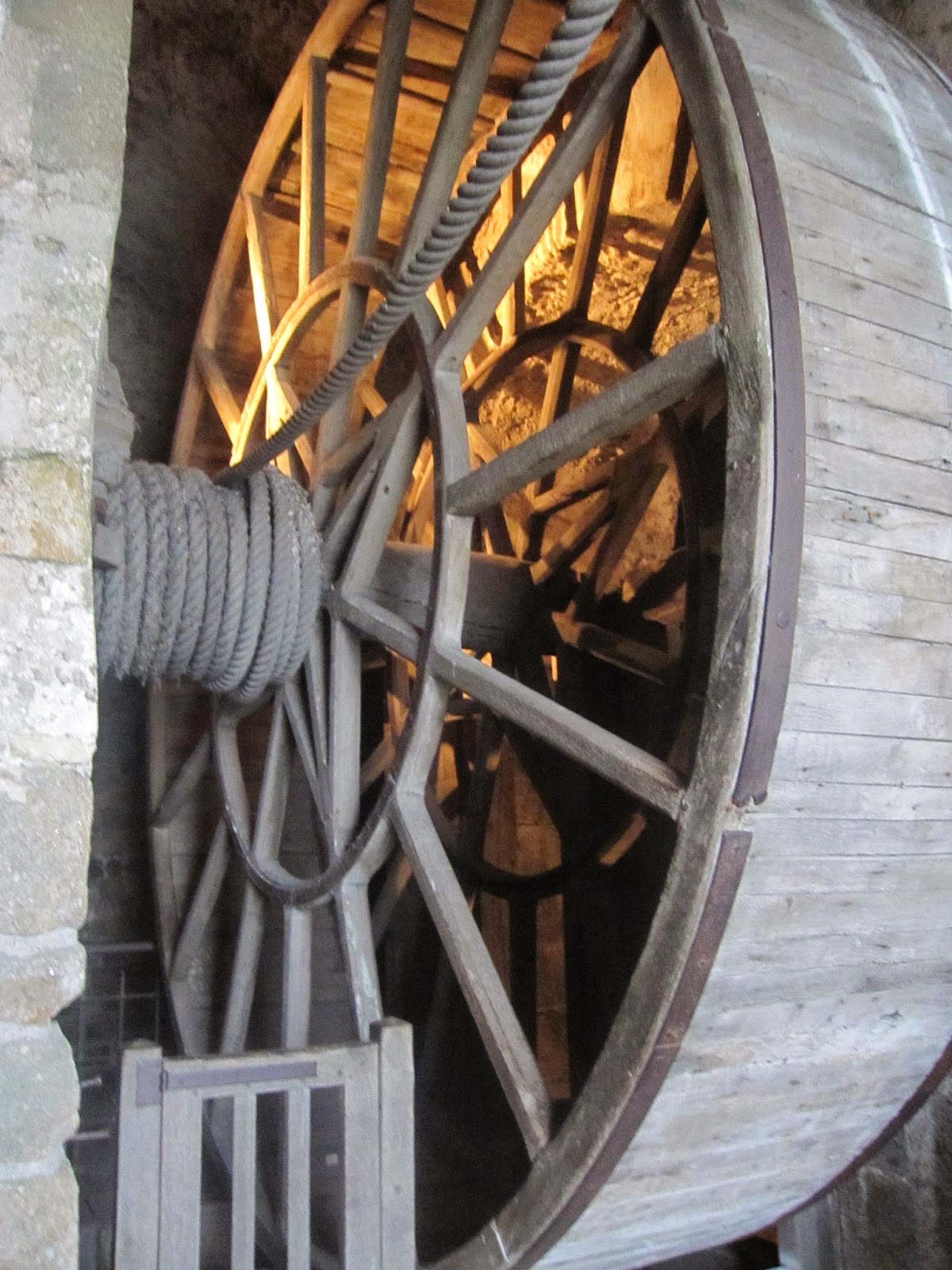
Winch at Mont St. Michel
As you've noticed from my posts about our travels we visit a number of different kinds of attractions. Typical of any travel brochure or other travel advertising art museums, churches and restaurants are featured. It seems to me that those things I consider masculine are usually left out.(The museums are usually art museums.) Now I don't have a problem with fancy restaurants or art museums or cathedrals in moderation. But as a fan of things that move and/or make noise I search for other venues.

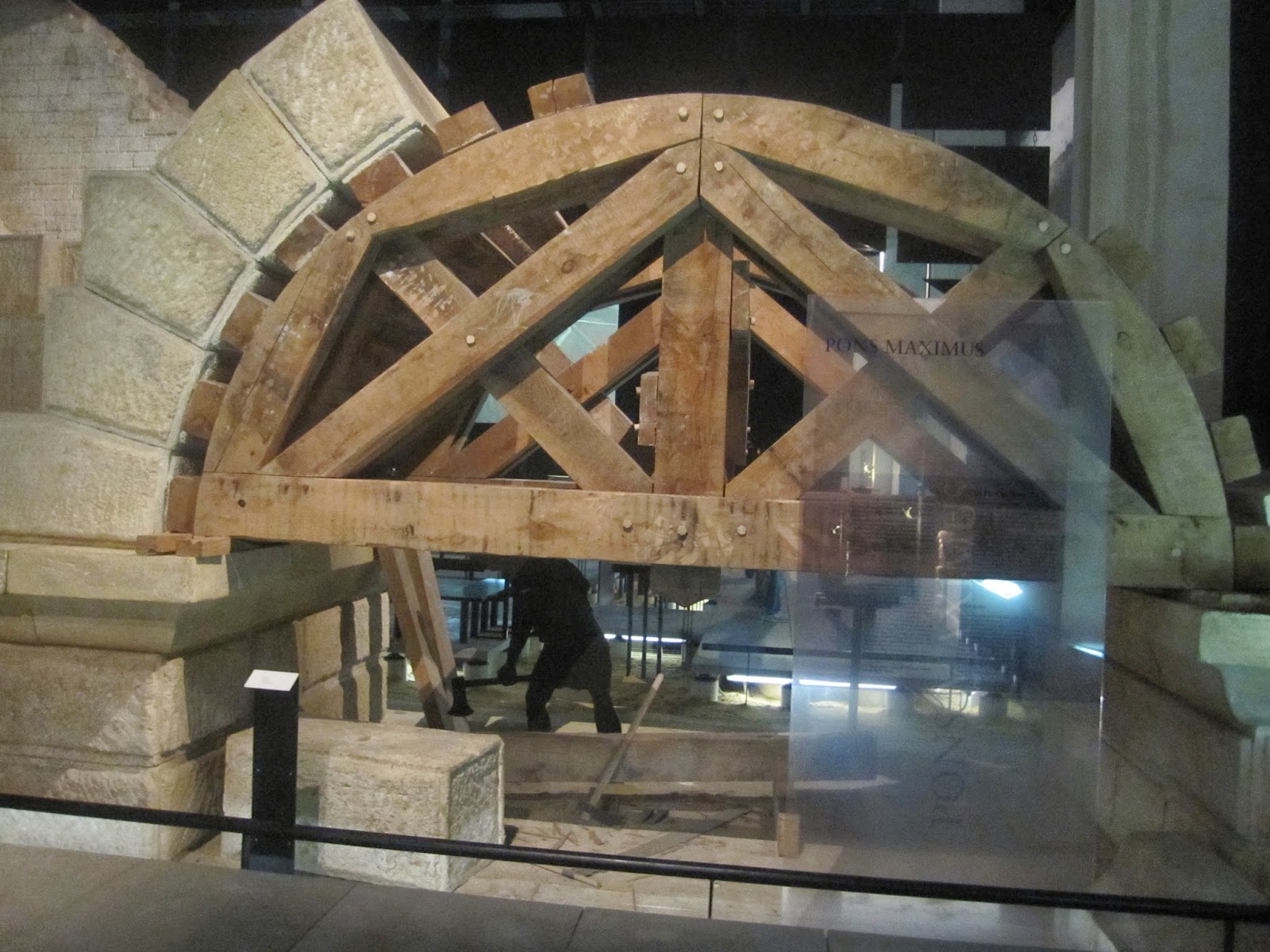
In our travels I've fed my masculine side with quite a few interesting attractions.  At the onset I would like to say in reference to cathedrals I am  in awe of the construction methods used to build these monumental structures. The builders moved tons of stone long before the invention of the giant machines used in modern day. At Mont Saint Michel in France we saw the winch used to raise building stones to the upper levels in this building.  It reminded me of a giant hamster wheel perhaps seventeen feet in diameter. Men would walk inside the wheel as a rope wound around the axle raising building stones to great heights. At El Escorial in Spain there was a great display of building tools used during the middle ages.   In the museum at Pont du Gard, France, you can see the building methods for the giant aqueducts. I never realized until visiting that museum that forms were used to construct
Template for arch at Pont du Gard
the giant arches that are a hallmark of Roman construction. The Romans were fantastic builders and great engineers. Their structures of 2000 years ago still stand today.

I have a fondness of mechanical things and the way they work. Cutaway engines have given me insight to the internal operation of the mechanics that produce the power. One  of the most notable of these is the 28 cylinder Pratt and Whitney 4360 aircraft engine. I saw an animated cutaway version of one of these in the Pima County Museum of Air and Space near Tucson, AZ. I posted a video I made about this engine on YouTube. It has received more than eighty thousand views thus far. The giant steam engine in the British Museum of Science was incredible to observe in operation.  In Nuremberg, Germany, there is a toy museum.  In it are those great mechanical toys of the early twentieth century. This was long before the advent of plastic and battery power. They were made of
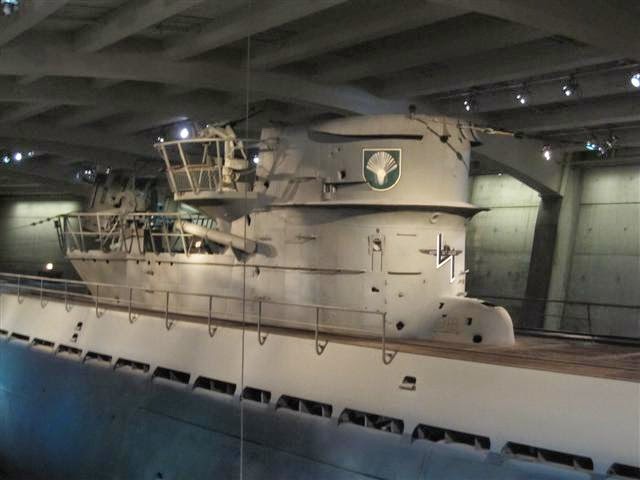
German submarine in Chicago
metal and powered by wound springs and there are videos to show them in operation.   During our travels I have visited submarines, aircraft carriers, battleships and destroyers.  I've enjoyed them all. However, there are times when I think that the exhibitors desire to make an attraction more tourist friendly has destroyed some of the ambiance. For example, on the aircraft carrier, Intrepid,  the "knee knockers" through the bulkheads have  cut down so the tourists won't hit their shins when going through a bulkhead.  And on the German submarine in the Museum of Science and Industry, Chicago, the subfloor has been removed so tourists
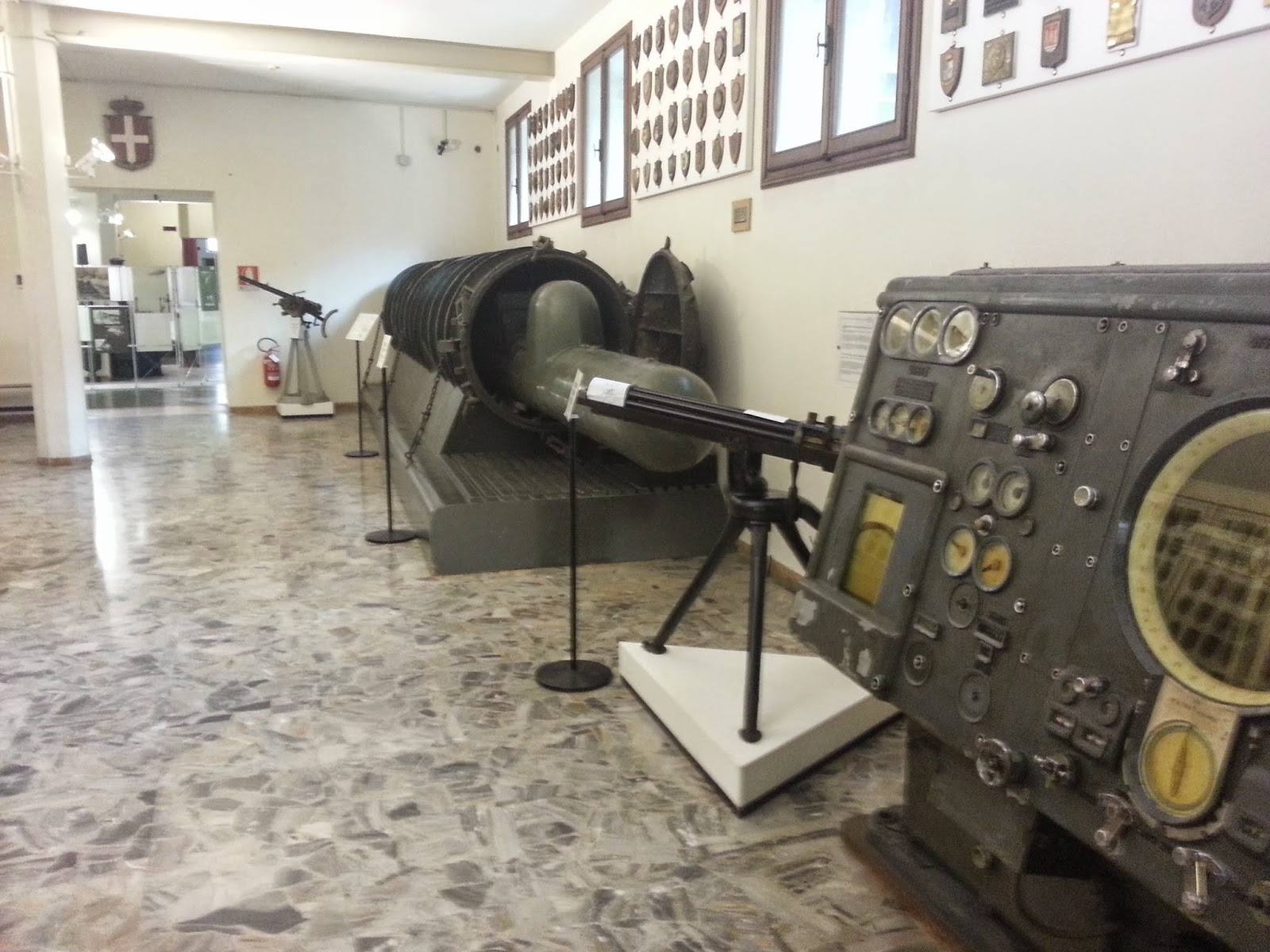
Midget Italian submarine in Venice
will be able to stand up straight when touring the relic. I believe that these modifications prevent a person from experiencing the true effect of being on the vessels. Arms and armor along with the aforementioned ways in which mankind seeks to destroy mankind I find interesting. The mechanical means of destruction is well documented in the Spanish Armory Museum in Segovia where examples of weapons from the spear to rifled cannon are on display. The engraved and ivory inlaid crossbow of a past king is a work of art. One of the most unusual instruments of warfare was the two-man miniature submarine used by the Italian navy during WWII. I'm sure I drooled over it in the Italian Naval Museum in Venice.

Perhaps the item I seek out most on our travels are aircraft displays.  There is just something about these machines that break the bonds of gravity that fascinate me. If I had to pick a favorite it would be the Pima County Museum of Air and Space. The displays are more accessible than the U.S. Air Force Museum or the Museum of Naval Aviation.  In Charleston, SC, the aircraft carrier, Yorktown has a great collection of naval aircraft. It has a much better display than that of the Intrepid in NYC. We've visited at least ten other aircraft museums over the years. When I have the opportunity sit in the cockpit of these flying machines I feel a connection with the men that flew them.  I also realized that the men that flew them were smaller than me.

fighter plane on the USS Yorktown

In the future I look forward to other great museums and attractions.  But without an understanding wife I would never had be able to see the things I have. Of this I am most grateful.