Showing posts sorted by date for query travel. Sort by relevance Show all posts

Jul 24, 2022

Friday Mornings, Old Men and Coffee


The discussion had been about cannon, particularly, a Civil War cannon a local resident had in their front yard in a neighborhood nearby. After a somewhat heated discussion of the cannon’s technical details, the conversation had reached a lull, but the silence was broken when the former city councilman spoke.


“We saw a cannon in an attic once,” Frank said, rescuing us from our momentary daydreams. 


“Oh, yeah?” I said taking another slurp of coffee.


It was the weekly meeting of out kitchen cabinet. Presidents had cabinets, why not us? There were five of us ranging in age from seventy-one to ninety-three. We have met at our senior member’s house since the unfortunate demise of his Lincoln automobile in a traffic accident. Conversation covered a myriad of topics, some of which were discussed quite intensely. 


The speaker took a drink of his coffee, cleared his throat, and continued, “It was several years ago now when my wife and I volunteered at the Charleston Annual Home Show to be, huh…what do you call it when you show people around?”


“Docent?”


“Tour guide?”


“Tour guides. That’s what we were? We would show people around when they visited the house. We thought we would go early and get a preview of what we were to show people, and maybe we could see the caretaker. The owner of this South Battery house, like quite a few of the others, lived out of town. Actually, he owned several houses,” the retired civil engineer continued his story. 


“When Joe Riley was mayor he sold rich Yankees on the idea they could own a historic antebellum house in Charleston if they would simply restore it. South of Broad Street went from a near slum to a destination for readers of Travel+Leisure  magazine,” I added.


He continued, slightly perturbed by my interruption, “We did arrive early and found the caretaker. He was very helpful and showed us around and described things in that distinct Charleston accent.  It was either a three or four story house. I don’t remember. It was years ago. I don’t remember if it was the top floor or the attic. But it was probably the top floor since most of the houses near White Point Gardens have relatively flat roofs… It was the top floor. I remember now, because the caretaker unlocked the door to enter a small room. It was obviously not lived-in and probably used for storage. The object in the middle of the room immediately caught my eye.” The speaker paused, took a bite of the pumpkin bread in front of him and followed it with a gulp of coffee. He deftly brushed the crumbs from the corners of his mouth before continuing. 


“Right in the middle of the room was a cannon. Just the barrel, mind you. It must have been seven or eight feet long. I couldn’t believe it. It must have weighed half a ton. I couldn’t imagine why anyone would have a cannon in their house. How would they have gotten it up the stairs?” the former member of the Army Corps of Engineers continued.


“How did they get it up the stairs?” our host wanted to know.


“What about the stairs?” the retired lineman from Boston asked. Occasionally Louie did not hear everything that was said, particularly when the battery was dying in his hearing aid. 


“They didn’t carry the cannon up the stairs,”.  Frank took a deep breath. He let it out slowly.  He took another sip of his coffee, then held the styrofoam cup up indicating to me that he need it refilled.


“Whaddya mean?” Roy, the most rotund of the older men, asked.


“Just a minute! Let Joe get back to the table with my coffee,” Frank said, forking another piece of the pumpkin bread. 


I returned to the table with a steaming cup of coffee for Frank. Frank took a swallow of the steaming hot coffee without flinching. 


“Thanks, Joe. No, it came through the roof!” the engineer said smacking, the table with his hand. 


“Through the roof?” The three said in unison. 


“I think it was about 1865 when Union forces were occupying Charleston. The Confederates by that time were pretty thoroughly beaten, but they were intent on sabotaging all cannons to insure that the North couldn’t use them.  It’s what is known as spiking. You fill the cannon with gunpowder to blow it apart. But, in the case of this cannon, something went wrong. The cannon was blown up in the air and fell through the roof of the house. It’s been there ever since.”


“Well, my Confederate ancestors were successful in one way,” I said.


“How’s that?” Frank wanted to know. 


I kind of smiled and said, “He did keep the Yankees from using that cannon!”


And then the conversation turned to local politics. 


__________________________________________________

photo courtesy of Google Maps

May 19, 2021

The Devil's Road


We had left Phoenix a bit after lunch and traveled east on Interstate 10 past Tucson  before leaving the four-lane. We didn’t know where we would spend the night because unlike our usual travel arrangements we did not make a reservation for the night's lodging. Claudette wanted to visit San Xavier del Bac Mission. We had visited it many years before and were anxious to visit this prime example of a Spanish mission in the southwest again. The mission was much as we remembered. I felt the same ambiance there as in St. Peter’s or St. Paul’s. But at this visit there were no Indians (Native Americans) selling fry bread on the grounds. 


Back on the interstate we traveled a bit further east  before turning south on a state road. Our destination was Tombstone, Arizona. It was my idea to visit the southwestern city so well known in western folklore and history. It was mid afternoon when we parked in the public parking lot to explore Tombstone afoot. It was good to stretch our legs after being confined to the SUV for several hours. Tombstone is a city of about 1200 people and no doubt survives on tourism. Founded in 1879, its greatest claim to fame occurred two years later. The shootout at the OK Corral was that event. The Earp brothers met the Clinton brothers there and engaged in gunplay on a Wednesday afternoon October 26, 1881. This was the culmination of a long standing feud. The gunfight actually lasted only about 30 seconds. When it was over three men were dead and others wounded. The battle is re-enacted today. We did not see the show. In our travels we’ve seen a number of western shootouts, including one in southern Spain on the former movie sets of the spaghetti westerns. I did manage to get us  disoriented (not lost) and find a number of places not on the tourist maps. Claudette had queried the internet earlier and found that Big Nose Kate’s Saloon served some vegan dishes. The saloon was big, busy and loud behind the swinging doors. A man with a white beard and black cowboy hat was singing some familiar western songs -  old and new. Old photographs and western memorabilia covered the walls. There was even a cigar store Indian! The food was good and the price was right. Service could have been faster but the waiter girl was very busy. One of the most memorable displays in Big Nose Kate’s was in the hallway to the restrooms. On a twenty-five foot wall was modern military memorabilia. Flags, shoulder patches, and photographs were too numerous to count. They called it "The Hall of Fame". It made us feel good to see our fighting men and women honored this way. 


The sun was getting low in the western sky when we saw Tombstone in the rear view mirror as we began our journey north, northeast. We would be on the blue highways as they were referred to by William Least Heat Moon in his book by the same name. As darkness fell we found ourselves in Morenci, Arizona. We were driving through or rather across the largest copper mine in Arizona if not the country. It was dark and we could only see the road ahead. But we were surrounded by hundreds if not thousands of lights. Had they been in straight lines I would have thought we were in the middle of a city. But the view was not unlike that seen from an airplane flying over a city at night. I believe we were on a bridge over part of the open pit mine.  As we left civilization there was a roadside sign stating “next services 90 miles”. I asked Claudette what that meant and she said she thought it meant it was 90 miles to a restroom. We were on Highway 191 which reaches the Canadian border after its origin in Mexico.


And so we began our drive through the Green Mountains and White Mountains of southeastern Arizona. Ninety miles did not seem very far, probably a two or three hour drive, or so we thought. After the lights of Morenci had faded behind us, Highway 191 became one of switchbacks and sharp curves. Speed was limited to thirty-five miles-per-hour. The road was either descending or ascending. It reaches the altitude of 9000 feet but my ears never did pop. There was no moon light, the darkness was so thick that our headlights penetrated the darkness only slightly. I could hear stones falling to the valleys below as our wheels pushed them out of the way. It reminded me of a road we had been on near Lake Tahoe where the white lines on the sides in the road fell away in chunks of asphalt as we drove down the road. The thick forest grew to the edges of the road and occasionally a jackrabbit would scamper across the road. We were in Apache territory, the San Carlos Reservation, which is a well known area for elk hunting. We saw no hunters but saw their quarry. Elk, the largest member of the deer family, would appear almost as mirages out of the night.  Approaching eight hundred pounds, they were animals to be avoided. Around midnight we were driving along the valley floor and spied a lodge. It was a log structure with several big motorcycles parked in front. I bounded up the front steps of the lodge as fast as an old man could and pounded on the entrance but without success. I tried another door with similar results. Frustrated we jumped back in the car and were on the road again and I might add that the need to relieve myself was becoming a dire necessity. Shortly after one o’clock in the morning we found civilization in the form of the town of Alpine, Arizona, population 146 at the intersection of Highways 180 and 191. On the other side of the intersection with the gas station was the Sportsman's Lodge. This little motel on the Coronado Trail appeared to be straight out of the 1950s. I knocked on the office door and to my relief it opened. There in front of me was a little old lady in flannel pajamas and a stocking cap. I blurted out that I needed a room and she said that number fifteen was available. Registration and payment was expedited quickly and soon we were in a cozy little room. It had cable TV and wifi too but was just a bit smaller than a Marriott room. Actually, a lot smaller. 


We had a good night’s sleep at the Sportsman’s Lodge in Alpine and I would recommend it to anyone. One day I would like to see the Coronado Trail in daylight. 

Highway 191 was first given the number 666. Since this number is considered the mark of the beast (the devil) and is a bad omen the number was changed. 

May 5, 2019

Flying

I have always loved airplanes.  When I was a toddler my mother would take me outside when she would hang the laundry to dry.  I would sit in my little chair looking up at the sky. At the sound of an airplane I would point my chubby finger skyward and scream, "airpane, airpane".  Later, after spending years building model airplanes, I would find that I was afraid of heights. I was not just afraid, I was flat out scared!  Yep! Terrified! If man had been meant to fly, God would have given him wings!

But, those Wright boys from Ohio didn't know that, so they built the airplane. And since then airplanes have become the way to get from one place to another place FAST.

When I was twenty-one-years-old, the federal government decided that I was needed in the United States Armed Forces - the Army. I was drafted. You see there was a bit of a scuffle going on in southeast Asia at that time, and they said my services were needed.  That meant that I had to fly. The cross-country flight was not so bad; we stopped a lot. My belt size went from a 38 to a 35 inch size from tightening my seat belt.

When we flew across the Pacific I saw the longest crap game in the world.  It lasted from San Francisco to Manila. I was very concerned when we stopped over in Guam.  The plane was descending and descending and I could see nothing below except water. I began reciting what the stewardess had said about landing in the water.  I was not sure that my seat cushion would support me; it did not look like a life jacket. I looked for someone to trade with, but it looked like everyone had the same size cushion.  After boot camp I was at my lowest weight since I was fourteen.  That would help. A few minutes later the plane made a funny noise, like metal scraping against metal, and I was thrown forward against my seat belt restraint as the plane slowed on the runway. Soon I was off the plane and inside that airport building. They call it a terminal.  I don't like the idea of something being terminal.  That kind of signifies the end of something. It could be me!

There was that one time while in the Navy when some of my shipmates and I had to wait for our plane to be retrieved from a snowbank before we could board it. The plane was an R4D, also know as a DC-3, a WWII vintage aircraft still in service. In those days you always faced aft on military aircraft. I don't like to ride in any vehicle faced toward where I've been, although faced forward I may not be able to see where I'm going. It was a rough ride back to Norfolk, cold, drafty, and noisy. Years later I was taking a very small airliner out of Albany, NY.  That flight was kind of dicey.  The plane had a late departure due to mechanical problems. Naturally you always wonder if they got it repaired properly. It was a small twin-engined plane with a pod underneath for luggage.  I think it was a Piper or Cessna. When we finally were taking off, the safety instructions came from a tiny speaker sounding an old eight-track tape from the sixties. Then the Captain spoke over the speaker with the "Welcome aboard"speech. That's when I found out we had a woman pilot.  I don't have a problem with women. (I married two of 'em and my mother was a woman.)  But I was not ready for a woman pilot. A soon as the plane lifted off the runway, all the snow in the world descended on us. 

I have flown many more times since then, and some flights have been quite memorable.  Once in Alaska I was in a Turbo Otter float plane flying through the mountains. Yes, I said through the mountains.  The plane did not fly over the mountains but between the mountain peaks. They were craggy peaks with a smattering of snow. They were like giant hands with claws reaching up to grab us.  I decided that I would look up front to see how the pilot was driving. He was a wiry looking fellow with salt and pepper hair stuffed under a battered New York Yankees baseball cap. There was a grin under his huge handlebar mustache and his eyes were fixed on an attractive blonde in the co-pilot's seat. His demeanor did not instill confidence, but both of his hands were on the control yoke. Back in my seat I tightened my seatbelt, pulled my earphones back on and closed my eyes. The landing was my smoothest ever on water. Actually it was my only landing on water.

Frequently, when flying, an adult must restrain one's self from committing the crimes of infanticide plus.   I added the plus to include the killing of older children also. In air travel the length of time a child can cry is measured in miles or destinations.  I overheard a young mother say rather nonchalantly, "Oh yes, he cried from Chicago to Cleveland".  THEY ARE USED TO THE CHILDREN CRYING!  WE ARE NOT! Don't they know our malice can spread to include them AND their children.

I have my own list of caveats while flying.

  1. Always get an aisle seat. (You can stretch one leg out.)
  2. Sit next to a small person. (I don't like to have flesh spillage from the next seat.)
  3. Sit near the lavatory.
  4. If  "Airplane" is among the selection of inflight movies, DON'T WATCH IT!
  5. This is the most important rule. If there is a small child in the section of the plane you are in, disregard previous rules and MOVE AS FAR AWAY FROM IT AS POSSIBLE
Just one more note on my air travel adventures. We, my dear wife and I, were on a flight from JFK (the worst airport in the world) to Charleston, South Carolina, late one evening on a small airliner. There were not very many passengers.  There was a very rotund man sitting in front of us. Had he been, and I don't think he was, a pro wrestler, he would have been called a man mountain. The flight attendant asked him to move to the other side of the aisle.  I think this was to balance the load on the airplane. The skies were not friendly to Delta that night and I don't think they would have been friendly to United either. Yep, rough air! It has been said that the air is smoother over thirty thousand feet, but he who said  that wasn't on the plane we were on. About a half hour into the flight things did smooth out though, and we were served coffee and a cookie. Soon after I felt the call to nature and made my way to the rear of the plane. The "Vacancy" sign was illuminated, so I walked right in and sat right down. Did I say this was a very small lavatory, maybe a little smaller that a Porta-John. It was the full width of the rear of the plane. As I was about to reach for the toilet paper, the solitude of my confines was broken by the crackling of the loudspeaker. "This is the captain speaking.  Please refrain from walking about the aircraft. Please remain in you seats and fasten your seatbelts!" So there I am, an old man with his pants around his ankles, precariously trying to maintain his balance while trying to reach a roll of toilet paper which is hell bent on not losing any of its sheets. As luck would have it, the next movement of the aircraft hurled me into the opposite wall and I was able to grab the objects of my desire. An opposite movement allowed me to complete the operation I had begun seemingly eons ago and escape from the tiny lavatory.

I wrote a letter to Delta Airlines requesting seatbelts in the lavatories of their airliners. 

I have found a way to overcome many of these issues I have with air travel though. I fly first class.  Snuggled in my cocoon in first class I am  oblivious to my surroundings.

Jul 28, 2018

The Ghost and the Thunder


It was back when we lived in the little house. It was a sharecropper’s house on a large farm in the red clay area of South Carolina. A strange thing happened on that late summer afternoon. I was eleven years old and attending Bradley Elementary School.  It was the time in my life when I could have been considered the “boy scientist”. I was intrigued by the possibility of space travel, no doubt fostered by devouring issues of Collier’s Magazine and its stories of space travel as predicted by Werner von Braun. I had been trying to make black powder for a rocket that day. 
The day of the week was Thursday.  I remember it was Thursday because Daddy had been to the grocery store that day on the way home.  Thursday was also the day he got paid.  It was a warm day with a temperature in the nineties. (I had started recording daily weather conditions in my scientific journal.) The late afternoon thunder clouds were beginning to form in the previously cloudless sky. Mama, my younger sister, and me, were sitting down for supper when Daddy came into the kitchen carrying a bag, a small brown grocery bag. It did not seem to be very heavy, but then Daddy was a big strong man. At over two hundred pounds and over six feet tall he earned the nickname,” Big Jack”. He set the bag on the table and announced, “I brought a special surprise  today!”

I elbowed my way past my sister to get closer to the bag. “What could it be?” I thought.

Daddy’s big calloused hand reached into the bag and pulled out the biggest Coca-Cola I had ever seen! It was the twenty-six ounce size. 

“Put some ice in some glasses, Mama, and we’ll enjoy this surprise”, he said.

Mama went to the Frigidaire, got a tray of ice, and put some cubes in each of the four glasses. All
the glasses were different, having come from different kinds of store-bought pickles and jellies.  Daddy, of course, had the biggest glass and got the most ice. He opened up the big Coke just as we heard the first clap of thunder close by.  He gave everybody some of the soft drink and replaced the cap, leaving the bottle about one quarter full. 

That Coca-Cola sure tasted good as we stood around in that little kitchen.  I always liked the way the foam on top of the Coke tickled my nose.  Mama had been cooking supper, and It was really hot in there.  

Before we could finish our treat a bolt of lightning struck the big cottonwood tree beside the back porch, and the lights went out in the kitchen.  (We had the lights on because it had been almost dark when Daddy got home.)  Now we were in total darkness. As it often is before a deluge of rain, it was very quiet.  For some reason, in our family, you were expected to remain seated and very quiet during a thunderstorm, almost reverent.

“I hear something,”  my sister whispered to me.

“Yeah, me too.  It’s called thunder,” I responded.

“No, something else. It’s like someone whispering. Like Sh…sh…sh,” she said.

I listened intently for a few minutes. I heard it too!
But not to allow my fear to show, I said, “I think that might be the ghost!”

“A ghost?” I could hear the fear in my little sister’s voice…and I loved it!

“Yes, Grandma said that the old man that died here always spoke in a whisper. Like this:’ I see y-o-u…!’” I whispered.

From across the room I heard Mama say, “Stop scaring your sister!”

“But Mama…”

“Don’t ‘But’ me,” Mama said.  I knew that the next time she spoke to me she would use my full name and that would mean I was in real trouble. Daddy hadn’t said anything.  He was deaf in one ear and we never knew whether he didn’t hear us or just didn’t care to respond.

We continued to hear the noise as the storm raged outside. It seemed to rain forever, but it didn’t.

Then, suddenly, the lights flickered and came on.   I looked on the kitchen table at the remaining Coke.  My throat was dry.

“Mama, can we drink the rest of the coke?” I asked.

“Share it with your sister,”  she said.

 I grabbed the bottle and unscrewed the top. The mysterious noise stopped.

Proudly I announced, “I found the ghost!”, which really wasn’t a surprise since I was a budding scientist!

T

Jun 22, 2017

119 Gordon Row


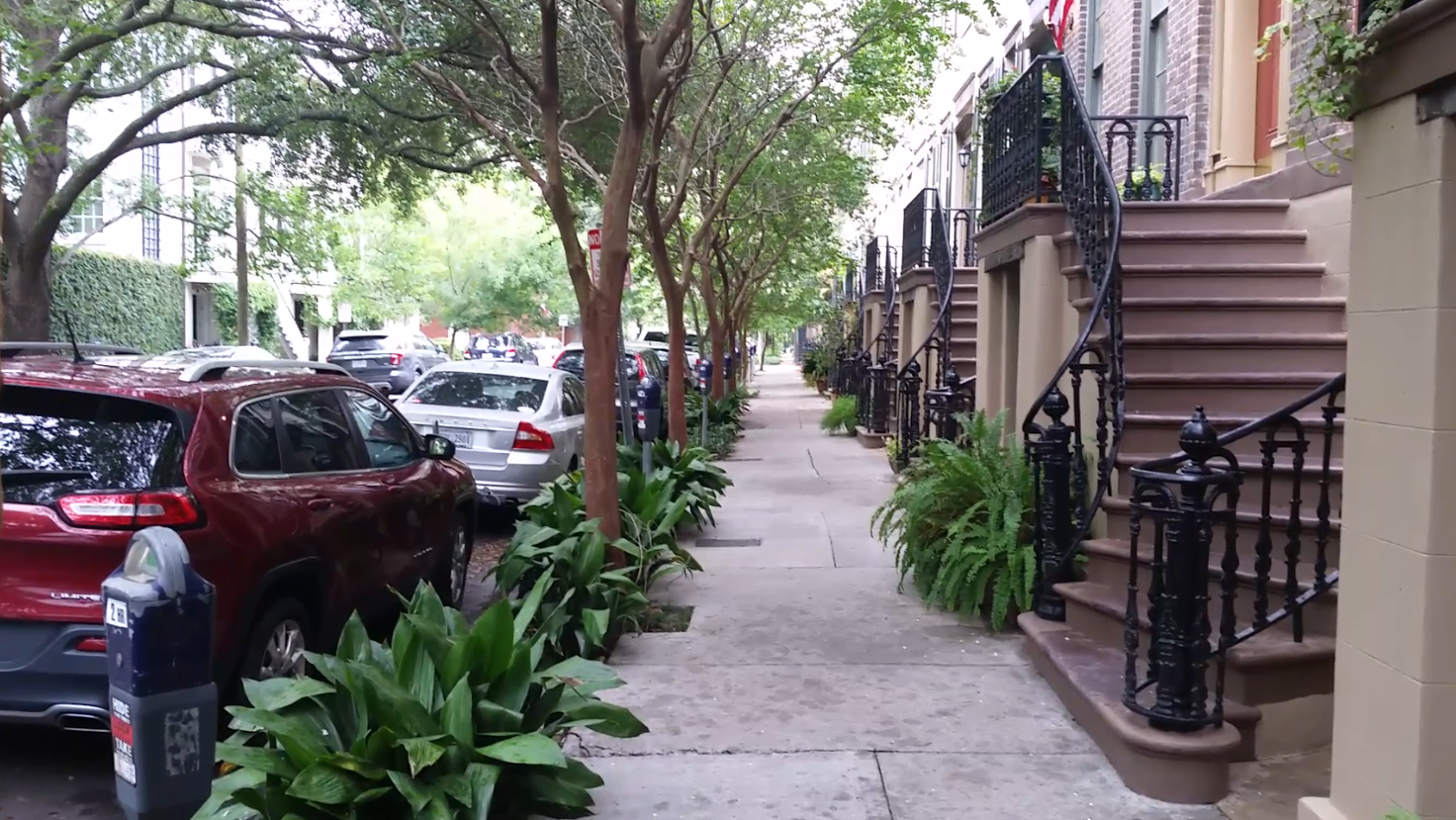
I was listening to the slow summer rain fall on the roof as I read the story.  It  was a warm afternoon in Savannah, and we had just checked into Savannah's Bed and Breakfast Inn. The Inn is housed in joined houses which form Gordon Row and was built 1853-54. It features wrought iron banisters leading to the parlor floor of the four story structure. On this shady street off Chatham Square, the inn exudes the charm of the old South with treelined streets, hanging Spanish moss, and blooming flowers. We had enjoyed lunch with friends soon after arriving in this city, on the banks of the river for which it was named, before checking into the Inn. The drumming of the rain on the roof gave more life to the story I was reading about the war in Afghanistan. It echoed the gunfire from the war zone. Claudette was catching up with her Facebook friends on her iPad at a nearby table. The overhead fans moved the warm humid air in a futile effort to cool things off. The story I was reading about American soldiers collecting the corpses of Afghani war victims was in stark contrast to my surroundings. A semi-calico cat brushed against my leg and brought me back to reality, as a young couple entered the porch from the parlor. Both were dressed in shorts and flip-flops. She wore the shorter shorts, but both had on long-sleeved shirts, untucked. Her dark hair spilled over her shoulders, and he had the fashionable facial stubble.  I would have put their age at mid to late twenties. They were very much engrossed in each other.  Newlyweds?  Perhaps. I finished reading the story

before Claudette was ready for tea, and I busied myself looking at the patio gardens below.  From my second story porch vantage point I got a good view. Several had fountains.  One particular fountain of note was an ugly creature spewing water from its mouth. Ceramic or stone stone animals were quite common too. I took a few photos including some of angels or "garden angels", as I referred to them. 
Soon she had finished catching up with her daily emails, and we ventured inside for tea. For some reason, after visiting the British Isles several times, afternoon tea has become a part or our daily lives. There was a variety of teas available, but I usually prefer a standard English breakfast tea with two lumps of sugar. I let others enjoy the various and sundry flavors. The necessary items for tea were on an elegantly carved sideboard with tiny pastries under glass. The parlor extended from the front to the back of the house and had matching carved black marble fireplaces along one side. Art framed in carved gilded frames hung on the walls. Some were botanical prints and others original oils or watercolors, and there were some reproductions on canvas also. All were very tastily hung on an off-white wall.  Of course everything was well illuminated by overhead chandeliers. 


We retired to our room to relax a bit before dinner. Our ground level room was spacious with private bath. There were two queen-size beds with matching carved headboards and were truly beautiful pieces of furniture. There was an upholstered chair by the window with end table. The flat screen TV was on a chest of drawers beside the fireplace. I kicked back on the bed and was going to watch television when I spied a stack of books on a shelf behind the room door. I selected a book reviewing a recent film festival in the city. 

We walked a few blocks to the Crystal Beer Parlor to dine. As you would imagine it had a storied past dating back to the early 1900s. I had the shrimp scampi pita pizza and it was delicious. It was a white pizza and the shrimp were surprisingly tender. Claudette had the bison burger which she enjoyed. 


Breakfast was all you could ask for. We had the classic breakfasts of eggs, bacon, toast and fresh fruit. I ordered strawberry jam for my toast. Yogurt parfaits, and waffles were also available. We had placed our orders for breakfast when we checked in. The parlor had spaces at the tables for 20 guests, but we did not see that many there at once. The waitress was very courteous and efficient.

But alas it was time to check out and leave to travel north to our home. I hope that the next time we visit Savannah it doesn't rain every day. We did find a nice place to stay even though it rained. 


Jan 23, 2017

The Rocket Scientist

When I was eleven years old  I was an avid reader of Collier’s magazine. The magazine had a lot of articles about space travel. The Allies had won WWII and captured some of the German V-2 rockets. The Americans had also captured or recruited some of their rocket scientists.  Werner von Braun was the most famous. The magazine had many color illustrations of what the rockets that would take Americans to the stars would look like. As an eleven-year-old country boy I was obsessed. I had to build a rocket.


I dug into the encyclopedia that Momma and Daddy had bought from the traveling salesman. When the bookmobile came to school I asked the librarian for all the books on rocketry.  There was very little about solid fuel rockets on the 1950 Ford pickup truck which had been converted into the bookmobile. It came very two weeks to Bradley school, which was much too infrequent for me. I had always been a voracious reader. Yes, I was one of those kids who would be reading by flashlight under the covers in my bed past bedtime. I eventually read the complete encyclopedia and held the record for the most books read in the school library when in the eighth grade, but that would happen in the future.

My big problem in rocket construction as an eleven year old rocket scientist was to find the proper fuel for my rocket. Finally, I determined that gunpowder would power the rocket. My research on primitive firearms provided a recipe for the fuel. Charcoal, saltpeter and sulfur were all that was required. By filling a coffee tin with wood chips,  putting on the lid, which had a small hole punched in it, and heating it on the kitchen stove, I could make my own charcoal. I found that dry pine wood chips made the best charcoal. I would grind it up with a mortar and pestle. But I never did get around to grinding it up, because I could not find one of the other ingredients.  The sulfur was not a problem, because I had some in the Chemcraft chemistry set I had gotten for my tenth birthday. Saltpeter, on the other hand, was a big problem. I could not find any anywhere.  As a teenager I would find out that we had potassium nitrate fertilizer on the farm that would have served me well as saltpeter.  But, not to be prevented from achieving my objective, I found another solution: modern gunpowder. Gunpowder such as found in shotgun shells. I had access to such, sort of. I had some for my own gun, a sixteen gauge Ior Johnson single shot shotgun.  Also, I knew that Daddy had some. I could borrow some of his, and he would not miss them. After all, hunting season was six months away. I managed to cut the shot shells apart with a bit of trepidation. A shotgun shell had a cap in the brass part of the shell which when struck by the firing pin of the gun ignites the gunpowder in the shell. If per chance I had caused one of the caps to fire I probably would not be writing this today. But some caution was thrown to the wind.  I had to build a rocket.


My plan was to make the fuselage of the rocket from a discarded toilet paper tube. I could not dispose of a complete roll of toilet paper for my cause. Would I be so brazen to use a complete roll of this treasured commodity for my efforts? No, I had to find a better way. So I made my own tube from poster board scavenged from an old wildlife poster I had made in the third grade. The tube was about one half the diameter of the toilet paper tube. A scrap of wood provided the material for the nose cone. My pocket knife sharp and I quickly
carved out the nose cone. Unfortunately, Mickey Spencer had stolen my Hopalong Cassidy a few years earlier.  I hoped he had cut his finger. The back of a Blue Horse tablet provided the cardboard for the rocket’s tail fins. Mom interrupted me for the noon meal.  I wolfed down the tomato sandwich and followed it with a glass of milk.  A man who had been without food in the desert would not have eaten faster. I was on a mission. The next part of the project was to fabricate the ignition system. My mind’s eye could see it clearly.  It would be an electrical system. In operation, I would count down 3...2...1...and push the button, sending my rocket skyward.  I would use nichrome wire attached between two nails and inserted into the tail of the rocket. There was an old lamp cord with a plug on it in my spare parts box that would carry electricity to the nichrome wire. The electric current would cause the nichrome wire to get hot and ignite the gunpowder.  I turned my cap around on my bicycle as I rode to this big ditch where we threw away our trash. When I was scrounging there before I had seen an old hot plate.  Hot plates used nichrome wire coils for heating elements.
On my way back to my room I picked up a scrap of wood from the wood pile in the back yard. With two nails and a hammer I had all I needed to build the rocket igniter. The igniter assembled quickly, and I was ready for the test flight.


I decided that it would not be a good Idea to fire the rocket in my room, so I carried it outside. But that did present a problem. We lived in an old farmhouse and electrical outlets were scarce. A number of extension cords would be necessary to get electrical power to the rocket’s igniter. I had to convince Mom I needed all the extension cords we had. It so happened that at that time I was working on an electricity project for the 4-H Club. Mom always supported my 4-H projects. She believed in the organization sponsored by the U. S. Department of Agriculture for rural youth. And she brought me every extension cord in the house. It took five extension cords to get power to the launch site. I decided not to include a launch button in the electric circuitry. There was not a push button switch anywhere on the farm! I would simply plug the rocket ignition power cord into an extension cord. I would countdown, of course. You can’t launch a rocket without a countdown! The time had come.


Ten...nine...eight...seven...six...five...four...three...two...one...I plugged the igniter into the extension cord. There was smoke! There was fire! There was a scream! There was not a rocket streaking toward the heavens. I wrote in my journal that it was a marginal success. Although the rocket did not lift off it was a tremendous learning experience. And the scream? That was from my mother, who was using an electric food mixer while making a cake at launch time. The launch put a strain on the electrical circuits of the house and blew every fuse. Mom was not angry with me. She appreciated the fact that I knew where the spare fuses were  and and how to replace the blown ones. I told her the problem was due to the very old wiring in the house.  If my Daddy had been home things would have been different.

I pursued my dream of becoming a rocket scientist until high school. Much to my chagrin the study of physics without skills in algebra and higher mathematics was impossible.

Aug 29, 2016

It's About Service...


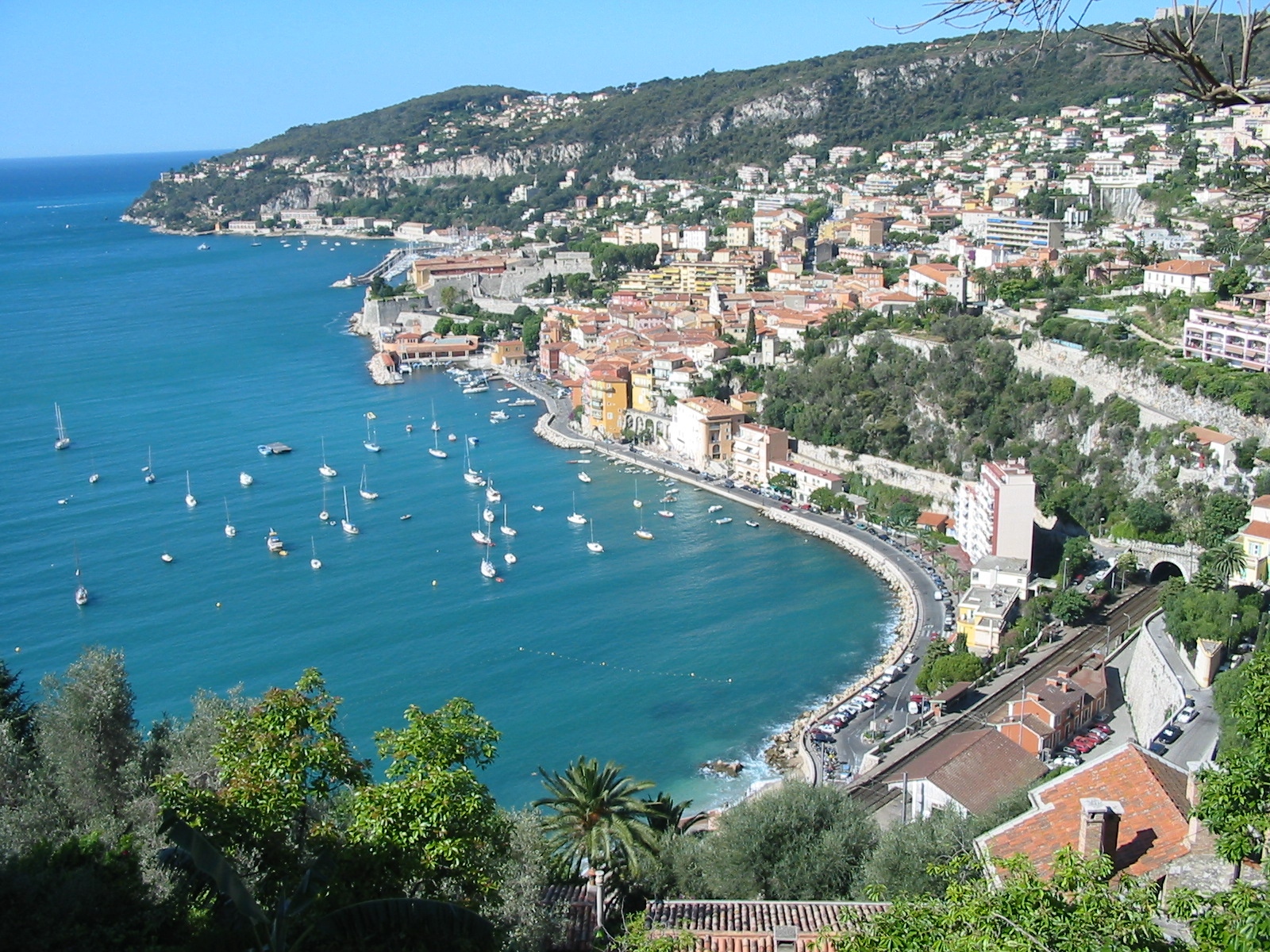
Villefranche-sur-Mer.jpg


In our travels we have had some interesting encounters with desk clerks. For the most part they have been positive encounters.  However...it was not always the case.


While visiting Venice we chose not to stay in Venice proper but rather to find lodging an a nearby island. A great idea. The cost was roughly one half that of a hotel in Venice proper. However, little did we know of the  adventure staying on Lido would hold for us.  When leaving Venice we had to catch first water taxi in the morning to get to the train station on time to board our train for Florence. Upon awakening we could find no desk clerk at the desk. We found ourselves locked in the hotel. After  trashing the front desk, we found a key to the door and were able to get to the train station on time. (read more about this in the blog post: Escape from Lido)


In Villefranche-sur-Mer the desk clerk was quite helpful. The French town is on the French Riviera and we had reserved a room on the third floor with a balcony overlooking the harbor on the Mediterranean Sea.  Due to my medical condition I prefer to use an elevator to reach higher levels rather than a stairway. The helpful clerk informed us that he elevator was not very dependable and may stop between floors. But he quickly added that he would get me out if needed! The next day we were going to catch a train for Nice to visit the Matisse museum and leave our rental car in the parking lot. It was one of those lots  where you deposit some coins in a machine that prints a ticket for you to place on the dash of your car showing that you’ve paid to park. Much to our chagrin the ticket dispensing machine was broken. When we spoke with Jacques, the desk clerk, he said he would take care of it. And he did.


Bed and Breakfast hosts have been quite helpful and offered interesting anecdotes during our travels. When in Alaska the hostess, Mrs. Walker, of a B & B encountered a bear while picking blueberries for our breakfast. Her husband entertained us with stories of hunting mountain goats in the mountain peaks. And in Scotland our host  entertained us with bluegrass music while showing us his collection of stringed instruments. We had a breakfast of kippers at the bed and breakfast on a loch.


One of our most interesting experiences was in Spain. My wife, Claudette, makes all our travel arrangements. Many times she communicates with hotels via the internet making reservations. She had spent considerable amount time communicating with a young Spaniard named Javier. Javier was a desk clerk in a Madrid hotel. He was extremely helpful with directions on which subway train to take from  the airport and exactly which streets to walk to get to his hotel. He was an extremely helpful young man. During our stay in Madrid, Claudette decided we needed to do some laundry.  Normally we would find a coin operated laundry and do it ourselves. But in this instance Claudette thought she would let Javier take care of the chore. “No problem,” he said and sure enough did deliver our clean clothes the next day. Much to my surprise, Javier washed my red shirt with my underwear. The rest of the trip I lived in fear of being admitted to a hospital in pink underwear!


We have found over the years that the most interesting things in travel isn’t the places, it’s the people.

Nov 24, 2015

Making a Documentary Video

I have made over one hundred YouTube videos in the past few years. However, I've never considered any of them that great. Perhaps it was because my methodology was backwards. Or maybe I'm just too much of a perfectionist. Probably 90% of my videos are about travel. I would shoot photographs or video on vacation and upon returning home make my YouTube video from these. 
Ken Burns


In my most recent video, the SO Young Story, I had began collecting data, still photos, documents, and video clips pre-production. That's moviemaking speak for: "getting your stuff together".  My normal process. I had an idea of what I wanted to do, and that was to tell the story of my great grandfather. As a part of my ongoing educational process, I watched a video about film editing featuring Richard Speziale. Then I realized I had no definite plan. I wrote a script, something I had never done before. Previously I added commentary after I completed the
Casey Neistat
video part of the project. Now I set to work using photos, video, etc. to illustrate that script. I found that one of the secrets is to get more material than you can possibly use. Part of the difficulty in making this video was that I had only three photos of the subject of the video. I had to come up with new and interesting methods to present information. In any work of art whether painting, film or book you must create interest and entertain the viewer/reader. For example, when I told of my ancestor buying property I showed the bill of sale of the property with money laid bill by bill on top of the bill of sale. The documentary filmmaker Ken Burns shows considerable creativity in his films. A procedure for filming still photographs is called the Ken burns Effect. On perhaps the opposite end of the spectrum Casey Neistat uses creative yet different techniques than Burns. I borrow from both.

The most important part of the process is to never forget that the purpose of the video is to tell a story.


This is my most recent video.  This was the first video I wrote a script for before beginning. The S O Young Story video is special and personal.


This video I made, which has no narration (it isn't necessary), was made after I found interest in paper engineering. The video is quite short  I had learned the importance of brevity.  Television commercials tell a complete story in 30 seconds. But it is hurts to discard footage ( to use film nomenclature). One must CUT, CUT, CUT and cut some more.

Aug 17, 2015

Boarding the Ingzar

Our flight from Amsterdam was uneventful.  I sort of felt strange going through Russian security though. Perhaps it was from growing up during the cold war and having seen too many spy movies. The uniformed personnel said little, merely stamped our documents and waived us through.  They were very efficient.   Polkova International Airport was not very crowded and as usual the Viking representative met us at the airport. This would be our second cruise with Viking Cruise Lines.  Our first had been a thoroughly delightful voyage from Amsterdam to Budapest. This cruise would be from St. Petersburg to Moscow. Many of our friends had openly questioned our wisdom about traveling to Russia, given the current Ukraine situation and Russian American relations. However, we paid them no heed.

About an hour and a half after landing we were aboard the Viking MV Ingvar. Our cabin was on the second deck almost directly above the dining room. On this ship we had opted for a room on the port side  with an accessible deck.  One of the things we like most about this mode of travel is the handling of the luggage. Once it was stored on the motorcoach which transported us from the airport, ships personnel carried it directly to our room. It's like moving into a hotel room that travels with you.

Dinner tends to be a welcome event for us on board.  Not only is is an opportunity to enjoy some great food and drink but open seating and a casual atmosphere is very conducive to making new friends.  The first night we had dinner with a couple of Mennonites and a woman from Maui with chronic wanderlust.  The lady Mennonite was the minister to a congregation in the midwest.We had the usual "welcome aboard" meeting in the lounge which also served as meeting room.  Crew introductions were made and we were informed about certain particulars of the cruise.  Who to see for what, mealtimes, safety regulations, et cetera.  There were 192 passengers and about one crewmember for each two passengers. One difference in this cruise from our previous was the inclusion of three onboard tour guides. After this informative gathering we went back to our room and continued settling in. This ship unlike the other ship had few 110 volt  outlets. But we had adapters with us to adapt the European style receptacles to our American plugs.  I had to check out the television remote.  (It has been said that I am addicted to television.) Shipboard television usually has local TV and maybe two English speaking stations. Normally, there are feeds from several onboard cameras as well. There are cameras on the bow and in the bar/meeting areas.  So if you don't get to the daily briefing, You can watch it on the television in your room. Staterooms are quite compact although we once stayed in a hotel room in the UK that was smaller. The bed was kingsize and flanked by an bedside table on either side.  There is a desk/vanity/whatever with a stool on which to sit. The wardrobe is built in  of course. The bath with shower is a model of efficiency.  There is a telephone and a smoke detector. Shipboard announcements are no longer made via the speakerphone in your cabin but announced in the passageways only.  It seems some passengers complained about hearing them in their cabins.  However, if you have your television on you may not hear the announcements at all. WIFI,which we have become accustomed to is "iffy".  It depends on where the ship is. We locked our passports in the safe and settled down to a good nights sleep.  It had been a long time since we left Goose Creek. Below is a look at our cabin.


(The bed had a duvet. I HATE duvets! The allow you to be either too cool (without) or too warm (covered).

Jun 23, 2015

Off We Go

Here we go again. Off to see the world, or at least a bit of it we've not seen before.

I hate long airplane rides. It's not that I'm claustrophobic...maybe a little bit.  For miles and miles you simply sit in a very small space with severe limitations on movement. I think any flight over 2 hours is cruel and unusual punishment. However, until we get one of the Enterprise's transporters it's all we have.  So, the best we can do is an eight hour flight. At least it is less than our longest flight to date: fourteen hours.  That flight was nonstop from Atlanta to Tokyo. I thought we were caught in a time warp and the flight would never end. 

There is packing, which I am not fond of. What to carry? I never know. What will the weather be like at our destination?  Who can tell? A television weatherman told me once that weather forecasters were right 85% of the time. Which means they are WRONG 15% of the time. Should I pack according to  what the weatherman says the weather "may be" or carry too much stuff to cover 100% of the possibilities? I do not pack, my wife is much better at it than I. What camera should I take? Or Just take my smartphone for capturing the images of breath taking vistas? How much cash will I need? Should I have gotten some Euros at the AAA?  It gets stressful. 

Have you noticed that lately that you can book a flight on a particular airline but when you get to the departing gate it is a completely different airline? Coufusing? It seems the airlines have partnerships with other airlines. When I book a flight on Delta I expect to get on a Delta plane not Air France.  But, then again, Air France has better food. Once upon a time you could use seat layout diagrams of various planes and airlines to pick a seat with a little bit more leg room.  But no more! The airlines have become wise to this procedure and now charge a premium for this little bit of extra legroom. Thinking about it is stressful.

And then there are the government agencies you must deal with in air travel. They operate in the name of security. I for one believe in airline security. I don't believe you can be too safe flying through the air at 30,000 feet at 400 miles per hour. But that does not mean I like to go through security checks. Kinda like going to the dentist. You hate the pain and suffering but you love the results. TSA, the Transportation Security Administration, is the biggie. Yep, that is where you take off your shoes and put all other stuff you have in your pockets in a plastic wash basin and place it all on a conveyer which goes through an x-ray machine. I always seem to forget to remove some small item from my person. Once a TSA employee found a pocket knife in my carry-on bag I had been looking for for two years! Usually going through security is relatively painless.  But what if I look like somebody on the "no fly" list. And then there is the possibility of the dreaded body cavity search. Flying can be stressful.

I have a friend who refuses to fly without medication.  Let me rephrase that.  He refuses to fly without being medicated. But not me.

Perhaps tonight you will look into sky in and see the blinking lights of an airliner and think of me/us as I/we have climbed into the "big sewer pipe with wings" and taken to the sky.

Bon Voyage!

Feb 10, 2015

In a Masculine Vein

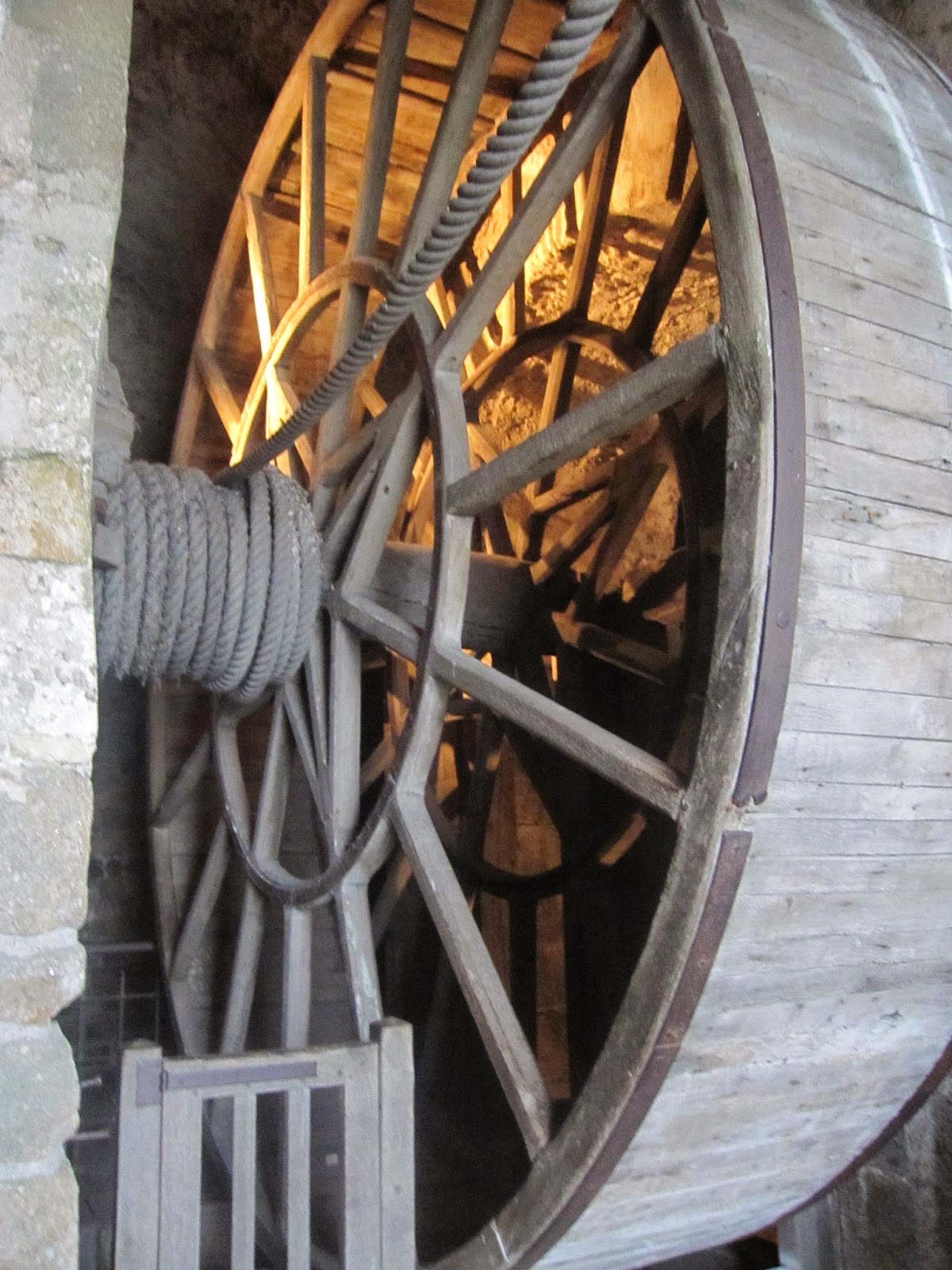
Winch at Mont St. Michel
As you've noticed from my posts about our travels we visit a number of different kinds of attractions. Typical of any travel brochure or other travel advertising art museums, churches and restaurants are featured. It seems to me that those things I consider masculine are usually left out.(The museums are usually art museums.) Now I don't have a problem with fancy restaurants or art museums or cathedrals in moderation. But as a fan of things that move and/or make noise I search for other venues.

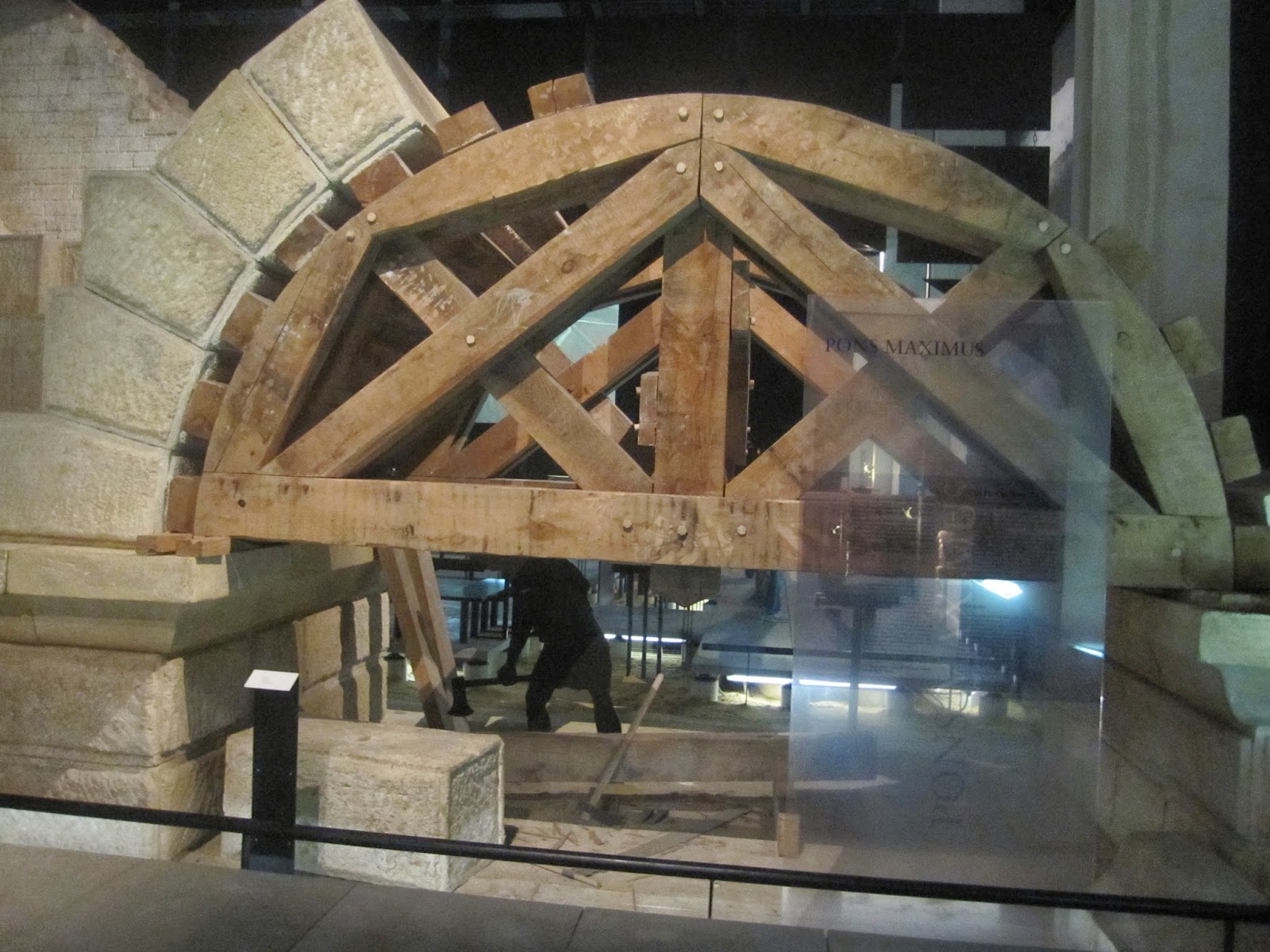
In our travels I've fed my masculine side with quite a few interesting attractions.  At the onset I would like to say in reference to cathedrals I am  in awe of the construction methods used to build these monumental structures. The builders moved tons of stone long before the invention of the giant machines used in modern day. At Mont Saint Michel in France we saw the winch used to raise building stones to the upper levels in this building.  It reminded me of a giant hamster wheel perhaps seventeen feet in diameter. Men would walk inside the wheel as a rope wound around the axle raising building stones to great heights. At El Escorial in Spain there was a great display of building tools used during the middle ages.   In the museum at Pont du Gard, France, you can see the building methods for the giant aqueducts. I never realized until visiting that museum that forms were used to construct
Template for arch at Pont du Gard
the giant arches that are a hallmark of Roman construction. The Romans were fantastic builders and great engineers. Their structures of 2000 years ago still stand today.

I have a fondness of mechanical things and the way they work. Cutaway engines have given me insight to the internal operation of the mechanics that produce the power. One  of the most notable of these is the 28 cylinder Pratt and Whitney 4360 aircraft engine. I saw an animated cutaway version of one of these in the Pima County Museum of Air and Space near Tucson, AZ. I posted a video I made about this engine on YouTube. It has received more than eighty thousand views thus far. The giant steam engine in the British Museum of Science was incredible to observe in operation.  In Nuremberg, Germany, there is a toy museum.  In it are those great mechanical toys of the early twentieth century. This was long before the advent of plastic and battery power. They were made of
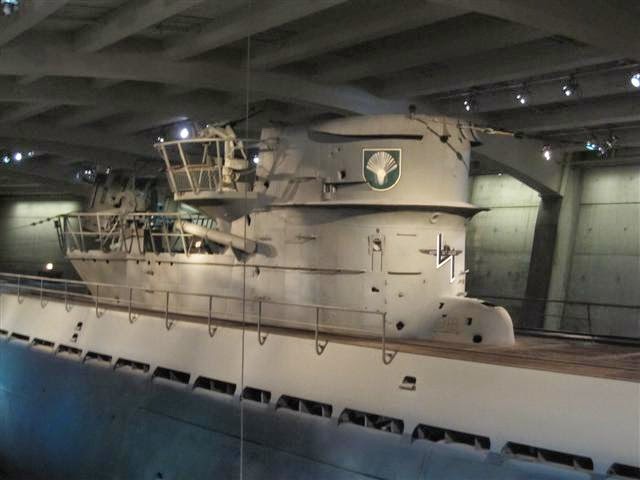
German submarine in Chicago
metal and powered by wound springs and there are videos to show them in operation.   During our travels I have visited submarines, aircraft carriers, battleships and destroyers.  I've enjoyed them all. However, there are times when I think that the exhibitors desire to make an attraction more tourist friendly has destroyed some of the ambiance. For example, on the aircraft carrier, Intrepid,  the "knee knockers" through the bulkheads have  cut down so the tourists won't hit their shins when going through a bulkhead.  And on the German submarine in the Museum of Science and Industry, Chicago, the subfloor has been removed so tourists
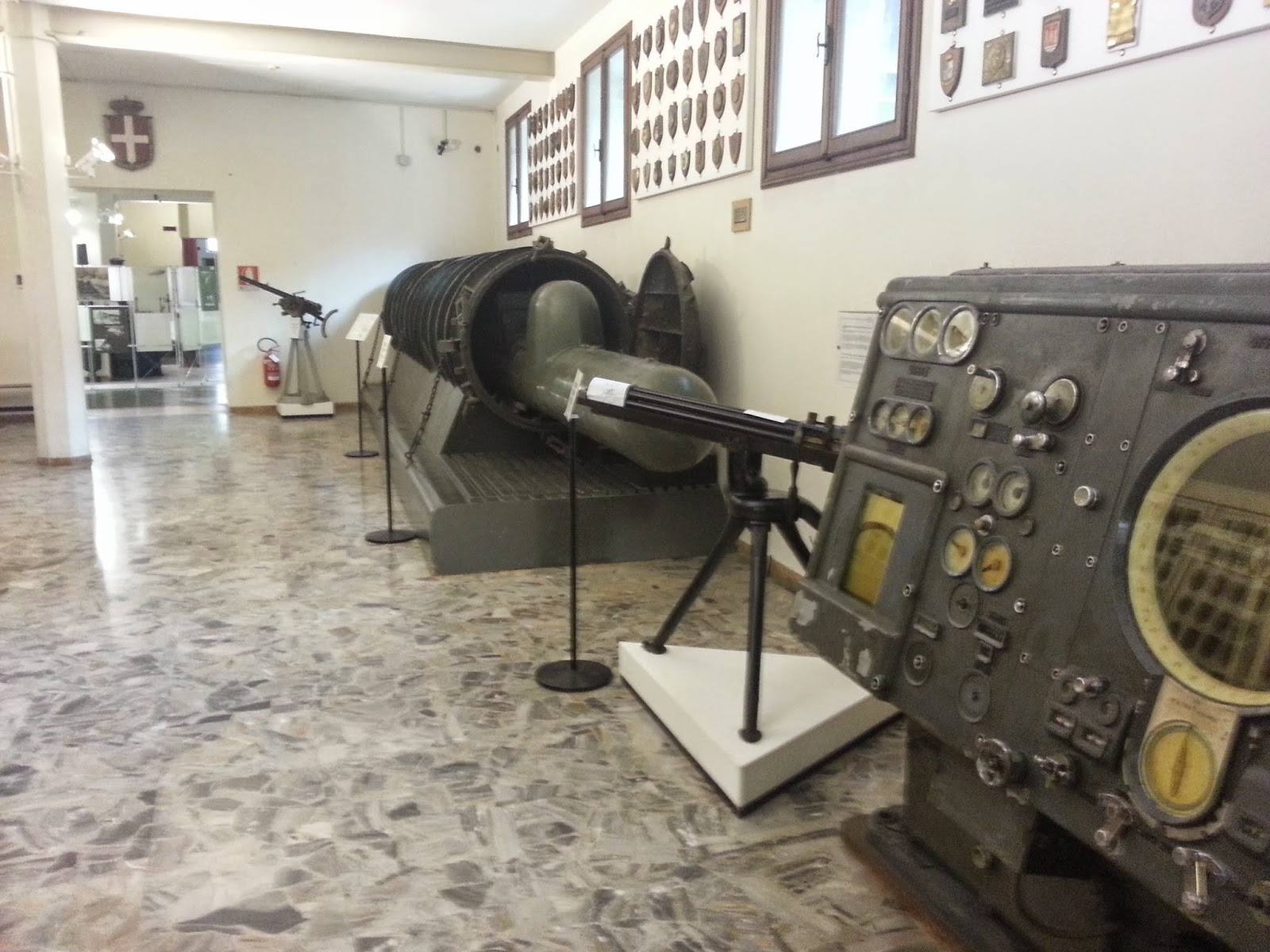
Midget Italian submarine in Venice
will be able to stand up straight when touring the relic. I believe that these modifications prevent a person from experiencing the true effect of being on the vessels. Arms and armor along with the aforementioned ways in which mankind seeks to destroy mankind I find interesting. The mechanical means of destruction is well documented in the Spanish Armory Museum in Segovia where examples of weapons from the spear to rifled cannon are on display. The engraved and ivory inlaid crossbow of a past king is a work of art. One of the most unusual instruments of warfare was the two-man miniature submarine used by the Italian navy during WWII. I'm sure I drooled over it in the Italian Naval Museum in Venice.

Perhaps the item I seek out most on our travels are aircraft displays.  There is just something about these machines that break the bonds of gravity that fascinate me. If I had to pick a favorite it would be the Pima County Museum of Air and Space. The displays are more accessible than the U.S. Air Force Museum or the Museum of Naval Aviation.  In Charleston, SC, the aircraft carrier, Yorktown has a great collection of naval aircraft. It has a much better display than that of the Intrepid in NYC. We've visited at least ten other aircraft museums over the years. When I have the opportunity sit in the cockpit of these flying machines I feel a connection with the men that flew them.  I also realized that the men that flew them were smaller than me.

fighter plane on the USS Yorktown

In the future I look forward to other great museums and attractions.  But without an understanding wife I would never had be able to see the things I have. Of this I am most grateful.