Showing posts sorted by date for query technology. Sort by relevance Show all posts

Sep 15, 2023

What Now for American Education?

What I’m about to talk about is important to all Americans.  About their children or grandchildren. They are the future of our country.


We, in the United States of America, enjoy the highest standard of living in the world.. We have the highest standard for a number of reasons. Abundant natural resources and a multi-ethnic people living under a government that promotes personal freedom. These were the people who placed men on the moon, split the atom and invented the supercomputer. And many other products and services that we enjoy today. 

But one factor behind this success is the education of its children. At the turn of the 20th century emphasis was placed on education. At least eleven years of public education. This was soon increased to twelve years. Out of this system came hundreds of well educated factory workers, tradesmen and professionals. During the 1960s emphasis was placed on mathematics and science in our public schools. This was primarily due to the Space Race the USA had entered with the  USSR. A bold American president said we would put a man on the moon in a decade, and we did.  The result of this goal culminated in tremendous advances in technology and the invention of new materials and processes. 


During the Clinton administration the Department of Education was created.  Later the federal government instituted programs such as the ”No Child Left Behind Program'' in the Geo. W. Bush administration. The intent to improve was a failure.  Later during the Obama administration the American Recovery and Reinvestment Act was passed. Although it was designed to stimulate a poor economy, it provided millions of dollars for education. The “Race For The Top'' initiative provided $4.35 million for certain educational programs. These were normally referred to as “Common Core”. The idea was to have a national standard for education. This program was not endorsed by educators or students’ parents.  This did little to slow the slide to education mediocrity. Perhaps the only positive response to Common Core was the interest sparked among normally disinterested parents 

One of the major factors contributing to a substandard American education system is the lack of interest of parents in their children’s education. During the school shutdown during the COVID-19 pandemic parental interest in education increased considerably. Now such organizations as Moms for Liberty are demanding accountability from local education systems. Although millions of dollars has been funneled from the federal government, state and local governments, very little has found its way into a teacher’s paycheck. Average teacher pay is $62,304. There is a scarcity of qualified teachers. It should be noted that teachers’ unions are all about teacher benefits and not about the quality of instruction. 


There is an interesting fact concerning money for education. It seems that with the more money given to education, the better the letter grades students receive. Interestingly, scores on national tests indicate that as more money is given to education and student grades are higher, the actual learning decreases. According to a Business Insider report in 2018 the U.S. ranked 38th in math and 24th in science. The National Assessment of Educational Progress, commonly referred to as “America’s Report Card”,  measures students' knowledge in key subjects—math, reading, history, science,and more. The NAEP results echoes the same findings. 


But now our education system is deteriorating. There is no longer an emphasis on the curricula that produces mathematicians, scientists and engineers. And our place as a world leader is 

diminishing. But it’s not too late to reverse the trend. 

Feb 26, 2023

Butt First

“You gotta get in butt first,” he said as he entered the automobile.  


“ Okay,” says I as I maneuvered  my seventy-eight-year-old body into the sleek machine. Flexibility is one of those things that fades away with age. 


I settled into the body hugging comfortable seats. It was a four passenger vehicle and I was riding shotgun. Tiny colored icons appeared on the glossy sections of the instrument panel bathing interior with another worldly light. Patrick touched some of these hieroglyphics as the Porsche moved into the street. There was a slight whine and motor sound from the engine. He maneuvered the machine through light traffic in the onset of evening. I felt the gear change which surprised me. He noticed my surprise and said unlike most vehicles of this type the Tayman had a transmission. There was also the sound of an internal combustion engine which I was told was included in the design primarily as a warning device for pedestrians. (Electric vehicles are silent.) The automobile accelerated quietly and moved deftly through light traffic until we turned into a wide street (I think all streets are wide in Phoenix.) and he stopped the car. I looked through the windshield over a slightly sloping hood of which Porsches are famous for a view of the desert sky. It was lit with fiery orange accented with streaks of purple against an advancing darkness. Patrick was tapping icons on the touch screen  putting the car into which I would learn was “launch mode”. “Are you ready?” he asked and added, “I always ask everyone this. They say they are, but usually aren’t. Are you ready?”  I answered in the affirmative and had a mental flashback to an event of nearly sixty years ago. The car seemed to be attempting to move but was being held back. In my youth I would watch Torqueflite equipped Dodges and Plymouths on the starting line at the local drag strip rev up their wedge head and hemi engines. The entire cars would twist due to the tremendous torque of their engines. But I wasn’t at a drag strip in the 1960s, I was on a street in Phoenix, Arizona. And then it happened. I was slammed into my seat as the low profile tires on twenty-one inch rims grabbed the asphalt like a bulldog grabbing a bone. I was one with a projectile shot from the cannon.  It has to do with eight hundred volts of electricity delivered from a battery to an electric motor driving the rear wheels. A perfect system developed and produced by the German company created by Dr. Ferdinand Porsche many years ago. I’m sure this launch had Dr. Porsche turning over in his grave.  Indeed the epitome of German automotive technology. Patrick continued to extol the features of  his electric four door sports car as we drove along. However, no other features compared to what I would call the “blinding acceleration” demonstrated. Patrick’s smile was bathed in the light of the instrument panel .


It was a  sho nuff electric hot rod. 


Jul 5, 2021

Want To Drive a Nuclear Submarine?

270K


Have you ever wanted to stand in the control center of a nuclear submarine? After such movies as The Hunt for Red October  and Crimson Tide  I know  I do. However, I can understand why the Navy doesn’t allow this. But there is a way, sort of…

Let’s check out the Naval Undersea Museum. 


The Naval Undersea Museum is located in Keyport, Washington. 

The modern building, built in 1995, houses the museum. By the entrance is the sail, off the nuclear submarine USS Sturgeon SSN 637. 


The first display area is dedicated to the world in which the submarine operates—the undersea world. Here, water temperature, tides, currents and the ocean floor are explained by way of graphics and objects on display. It is quite colorful and informative. Also aquatic animals are featured and the way man has used them to research the sea. This is the operating environment of the submarine, the sea.


Prior to the invention of the underwater boat or submarine, mines known as torpedoes were the undersea weapon of choice. By the way submariners refer to their craft as a boat. When Commodore David Farragut exclaimed, while sailing into Mobile Bay during the Civil War, “Damn the torpedoes, full speed ahead!” The torpedo he was referring to is what we refer to as a mine today. Initially they were triggered when an object such as ship came in contact with the mine then known as a torpedo. this contact resulting to a flintlock like mechanism ignition the explosive powder.  


Interestingly enough, the motorized and controlled torpedo was invented before the practical submarine. The  Englishman, Robert Whitehead, invented the modern torpedo in 1866. Compressed air fueled the reciprocating engine to provide motivation through the water. The later switch to steam also drove a reciprocating engine prior to replacement by a steam turbine. Electric motors with battery packs were also used. The adaption of the gyroscope in the late 1800s greatly  improved maneuverability. These torpedoes, first used by the Austrian Navy in warfare, were launched from small ships. They would continue to be launched by surface vessels for years to come. 


Although submarines are known to have existed in the 18th century they did not become practical until the late nineteenth century. In 1775 the first military submarine was the Turtle, invented by David Bushnell. According to the museum, the first submarine to sink an enemy vessel, the CSS H.L. Hunley in 1864 was not a true submarine because it did not have apparatus for the crew to breathe underwater. The first mechanically powered submarine used compressed air and a reciprocating engine. Later  steam engines were used. When it became obvious that the submarine would need and internal combustion engine was well as an electric engine the diesel-electric hybrid combination was used. This allowed the submarine to operate on the surface with the diesel engine and charge the batteries for the electric motor simultaneously. With the advent of diesel electric power in the late nineteenth century submarine production increased rapidly.

A number of nations had built practical military submarines by the time of the First World War. Germany was very effective in its use of submarines in warfare. In WWII Germany’s U-Boats wreaked havoc on shipping in the North Atlantic. Between the wars submarine technology increased the speed and range of the underwater boats. Germany depended on its submarine fleet to rule the Atlantic and Mediterranean. The brass headed German G7e torpedo is responsible for sending thousands of tons of ships and ship’s cargo to Dave’s Jones locker. And that’s the US Navy’s Mark 18 torpedo used by the Americans during WWII. Submarine commanders distrusted it due to design flaws. It would frequently circle the target rather than hitting it. However, after the design flaws were addressed the American submarines ruled the Pacific against the Japanese. 


Although technical advances continued in torpedo development, torpedoes were overshadowed by the guided missile as a submarine weapon. Shortly after the nuclear powered submarine was introduced in 1955  the intercontinental ballistic missile was added to the arsenal of the nuclear powered submarine. It followed the deck launched winged missiles such as the Rugulus.The submarine launched missile reached perfection in the SLBM, Submarine Launched Ballistic  Missile. The MIRV, the Multiple Independently targeted Reentry Vehicle, is the ultimate ballistic missile. These large missiles with as many as 14 targetable warheads delivered to high altitude by a missile are dispersed and guided to targets below.  These large missile carrying submarines have the ability to deliver unbelievable destruction, and are called s“boomers”. 


Not all nuclear submarines are this big and powerful. Some such as the USS Greenling  SSN 614, a fast attack submarine,  were smaller with a crew of 12 officers and 95 men. The museum has a command center of a nuclear powered submarine on display  Actually all electronic monitoring, communication and ancillary equipment are from the USS Greenling SSN 614, decommissioned in 1996. And that includes the periscope. The decisions for the submarine’s operation were made here. Notice the lack of chairs which would have been normally in front of the instruments and controls.

Unfortunately, due to COVID-19 restrictions, I was unable to enter the space and stand in the control room of a nuclear powered attack submarine. 


There are other displays of underwater research and rescue vehicles in the museum but pale in comparison to the undersea warfare section. When in Keyport on Puget sound check out the Naval Undersea Museum

Jan 29, 2021

Tony's Motorized Slider (behind the scenes)


This project like many others reiterates the adage that necessity is the mother of invention. I needed to solve a problem.  As a solitary filmmaker, I fill all the roles, director, cinematographer, screenwriter and so on. I am also the talent and that creates a major problem.  It is difficult to control camera movement while on camera!

I particularly like the shots from a camera mounted on a slider, especially reveal shots. For my birthday my wife had given me a very nice slider. I used it with my Samsung S7 and liked how smooth it was and the shots I was able to take with it. BUT, I was not in any of the camera shots because I had been operating the slider.
An easy solution would have been to have purchased a motorized slider for several hundred dollars. The cost was prohibitive for me. 


When I first got the idea to motorize the slider I looked for a motor in my spare parts bin with no luck. An inexpensive rechargeable drill would provide the motor. But I would have to disassemble the power tool to adapt it to a task for which it was not designed. With a hacksaw I cut the plastic case apart. I used a hacksaw because it had fine teeth and cut carefully to avoid cutting any wires. Since the reduction gears used the plastic body for a gear case they fell out and I had to put them back in.  It was sort of like putting together a puzzle. The battery pack, switch, and charging circuitry were cut free of the motor. 

In order for the motor to move the slider I had to mount to the slider track. I had to fabricate a bracket of wood to match the curvature of the drill motor body to the slider rails. Initially I intended mount it with screws to the slider. But I would need to drill and tap holes in the slider. I don't have a drill press or taps.  So...I resorted to wire ties although I would lose 6 inches in slider length. I scrapped the drill  momentary "on"  and reverse rocker switch. A simple continuity check with a multimeter determined where to insert a switch from my junk bin. An old 35mm film canister was used as a switch enclosure. Some old multi conductor phone wire was used to wire the remote switch.  The phone wire also provided the wire needed to locate the battery at the opposite end of the slider. I located the heavy parts of the system at opposite ends of the slider to balance the weight in case it was installed on a tripod. One final item had to be added. I had a problem. How to attach the movable slide to the drill motor. I could have used monofilament fishing line. Or maybe cotton string. The fishing line was too stiff. The string was not durable enough. But dental floss was strong, flat, and waxed.  It was attached to the movable part of the slider and the motor. I have used dental floss in other repair projects. Everything worked as expected and at a price I could afford. One caveat about the operation of the slider: it is extremely noisy!

I am a believer in close enough technology and this is a good example.


Jul 29, 2019

Who's That Knocking At My door


Who's that knocking at my door?

With the new doorbell cameras you‘ll always have the answer to that question.  Once a novelty of electronic hobbyists the doorbell camera is now available for all homeowners. These are sold primarily as security devices. When used with your home wifi you can easily determine who’s at your door from your smartphone, PC, tablet or laptop. Sounds great doesn’t it? You can tell when that pesky neighbor that always wants to borrow something is at the door.  Or maybe a political candidate that you despise is at your door with that insincere smile and a hand full of flyers. You don’t have to confront these people; just ignore them.

However, not all clouds (No pun intended!) have a silver lining. Doorbell security cameras operate with your home’s wifi system. Wifi systems can be hacked. Virtually  any electronic signal , i.e. radio signal, can be hacked. Hacked, meaning it can be received or intercepted, usually with bad consequences. In doing so a hacker will know who your visitors are and, with proper facial recognition software, identify them. He will also know if you have packages  delivered such as UPS. By having a view of your street they will know what happens in front of your house. 

One of the most popular doorbell cameras is the Ring Video Door Bell.  This is sold by Amazon.  The initial product was very easy to hack but the company says that changes have been made that make hacking more difficult. The Ring is accessible via an app for your phone or computer. Ring also suggests that you share the information from your doorbell camera with your neighbors, thereby improving neighborhood security.  Local police departments endorse this. They say it is a deterrent to crime. The Ring camera can be linked to Amazon’s Alexa.  

It is most interesting that Amazon would offer such a product produced by a company owned by, you guessed it, Amazon. Think of it as Amazon’s own private view into your world. If you shop at Amazon, and who doesn’t, the company has quite a comprehensive customer profile according to your shopping preferences and, of course, your credit information.  If they choose to collect data from your doorbell cam, and who says they won’t, your profile will be enhanced. Actually, anyone can hack your wifi and get all this data. This does not mean to imply that hacking is easy. It's not. Hacking requires considerable computer skills and tenacity.  

Recently, an Arizona homeowner received  a phone call from a hacker in Canada.  The hacker informed the homeowner of considerable personal data. He told thenhomeowner how many visitors he had received and described them.  When asked why the phone call, the hacker said he meant no ill harm he only wanted the homeowner to know how vulnerable he was. 

It could have been you.  What can be done? Since all our electronic devices are accessible via wifi it is imperative that  we have proper wifi security.

According to the experts  at the National Institute of Standards and Technology a password containing numbers, letters, and non alphanumeric characters is no longer recommended.  Currently they recommend a passphrase. A simple phrase that is from eight to fifteen characters and is easy to remember is sufficient. And if it is effective, it is unnecessary to constantly change these passphrases.  However, a different passphrase is recommended for each account you have. 

Remember to take proper precautions if you only need to know whose been knocking on your door.  

Jun 10, 2019

A Museum of Civil War at Sea

Main gallery NCWNM

In the city of Columbus, Georgia, on the banks of the Chattahoochee River, lies a very special museum.  Within forty thousand square feet of exhibit space encased by red brick of Georgia clay is the only American museum with artifacts and exhibits commemorating naval warfare of the greatest military struggle within our borders, the American Civil War.

As soon as you arrive at 1002 Victory Drive you realize you are at some place special.  One hint is the full-size reproduction of  a Civil War side-wheeler and a huge selection of naval cannon. As you enter the building, which was completed in 2001, the information booth is on the right adjacent to the gift shop and, of course, the exit.  There is no admission fee, but a volunteer contribution of five dollars is expected. A large exhibition area is visible and the lecture area is flanked by three huge paintings totaling over fifty feet. They depict the ships of the opposing navies. In the distance the ruins of the ironclad C.S.S. Chattahoochee are visible.


The hull of the C.S.S. Jackson


An opening in a wall to the left the size of a garage door leads to the center piece of the museum. It is the one hundred eighty foot long hull of the  C.S.S. Jackson (a.k.a. C.S.S. Muscogee). The ironclad warship was reclaimed from the mud of the nearby Chattahoochee. Ironclads were the very epitome of naval technology in the Civil War. Many small creeks and rivers throughout the south had shipyards producing such vessels. Our tour was self guided, sort of. Throughout the museum  life size cut-outs of "powder monkeys" point the way. Powder monkeys were the names given to the young boys who carried gunpowder to the cannoneers who manned the huge guns. Glass display cases abound filled with weapons, model ships, uniforms and even a surgeon's attire with bloodstains from the aforementioned armed conflict. A big screen monitor has a never ending lecture playing about weapons and weaponry. A life-size reproduction of the U.S.S. Monitor's turret adds to the authenticity of the Monitor exhibit. All captions on ship models and artifacts are easily read and interpreted. A broadside of the U.S.S. Hartford, Admiral David Farragut's flagship in the battle of Mobile Bay is reproduced. An actual small boat from that ship is on display.  The wardroom, berthing deck and the captain's cabin are also reproduced. We had seen similar displays at the Spanish Naval Museum in Madrid and the U.S. Navy Museum at the Navy Yard in Washington, D.C.


C.S.S. Albemarle


Near the Monitor turret is a man-sized opening leading into semi-darkness. As your eyes adjust you find yourself walking on a wooden pier.  On your left are shops with illuminated display windows.  On your right tied up to the pier is a full size replica of the Confederate ironclad Albemarle.  The muzzle of a 6.4 inch Brooke rifle peers from the superstructure. A gangplank leads to the interior of the vessel. It is quite dark inside the vessel but we can see the interior with the huge cannon and the helm from which the ship is steered. We exited through what appears to be the rear of the vessel into another exhibit hall. 


with the guide


We allowed ourselves four hours to bask in the history of the Civil War navies of the North and South.  It was indeed time well spent.  


Nov 21, 2018

Internet Portal


Are you using a patient portal.
If you regularly visit a physician or just get periodic health check-ups, patients portals provide a unique insight into your healthcare. 
What is a patient portal?

A patient portal is a secure online website that gives patients convenient, 24-hour access to personal health information from anywhere with an Internet connection. Using a secure username and password, patients can view health information such as:
  • Recent doctor visits
  • Discharge summaries
  • Medications
  • Immunizations
  • Allergies
  • Lab results
Some patient portals also allow you to:
  • Securely message your doctor
  • Request prescription refills
  • Schedule non-urgent appointments
  • Check benefits and coverage
  • Update contact information
  • Make payments
  • Download and complete forms
  • View educational materials
With your patient portal, you can be in control of your health and care.  Patient portals can also save your time, help you  communicate with your doctor, and support care between visits.
I’m 74 years old and have congestive heart failure. Through my patient portal I can see record of all medications I take and when they were prescribed and income cases removed from my medication schedule. After each doctor visit I log on to my patient portal and check to see the results of the test I was given.  this way I can see trends in my health.  By looking at this data i can determine if any changes in life style have affected my health. My next appointment is also indicated and I can request prescription refills if necessary. The portal also gives me direct access to my doctor via email and I can schedule and appointment if needed.
My general practitioner brought  patient portals to my attention several years ago and I use a portal with each doctor I visit.  It is simply a way modern technology can make our lives better. 
Ask your physician about a patient portal.


Sep 19, 2018

Seeing Is Not Believing Any More.

Someone once told me to "believe only 1/2 of what you hear, 3/4 of what you read and all of what you see", but that is no longer true. The advance of technology continues to destroy the axioms of the past. You can no longer believe 100% of what you see. Nowhere is this more evident than in electronic media. Electronic media has become the lifeblood of modern society. In a cursory view of communication this is obvious.

In personal communication we use the cellphone for verbal conversation and the same device for written conversation via texting.  We send images both static and moving with the same device.  Not only do we communicate person to person on a social level but we also conduct our business this way.  When I was in the sign business the fax machine was an important part of my business.  I could send a client renderings of a proposed project for approval before beginning construction. Recently, when my wife was curious about the appearance of tissue after minor surgery, she used her phone to take a photograph of the suspect area and send it to her doctor.  Upon analysis by a medical professional a prescription was emailed to a local pharmacist for a topical medication.  Within the last year I attended the Citizens Police Academy at our local police department. The officers explained how dash cameras in patrol cars and body cameras worn by officers were used to collect evidence in potential court cases.  Documents in our judicial and banking systems depend on transmission via fax machines.

Imagine, if you will, that you have been stopped by the local police for driving erratically. Your driving skill has been impaired by prescription medication.  You fail the rudimentary tests for sobriety. You fail to touch your nose, walk a straight line, and so on.  All this is recorded by the policeman's body cam and the patrol car's dash cam. You are arrested and released on bond awaiting trial. Later the police write their reports and submit them, along with video evidence, to the proper authorities.  You are upset and feel that you have ben unfairly charged and decide to call an old college classmate for help. When you appear in court at the appointed date you find that all charges have been dropped.  What happened?

Your old college classmate is a hacker. He has penetrated the police department files of video evidence and contaminated them so that they are no longer useful.  The images of you are no longer recognizable, you have a different face. When the written documents were faxed to the proper authorities, he hacked into the fax network and changed the wording in the documents.

The preceding is fiction, but completely possible.

The Department of Homeland Security is well aware of video hacking and its ICS-CERT recently issued warnings concerning a particular brand of security camera.  The Industrial Control Systems-Cyber Emergency Response Team  issued an advisory concerning Hikvision Cameras. These particular cameras, with over 16,000 in use, are easily accessible to hackers. This is but one security camera that can be easily hacked.

It would stand to reason that if hackers have access to the video images they could also alter them. In a recent August Article in Wired, covering the DefCon conference in Las Vegas, a senior policy analyst with the ACLU said, "The fact that some law enforcement evidence-collecting devices can be hacked evokes some true nightmare scenarios". Also in the article a hacker showed how easy it was to hack into a body cam and replace the actual footage recorded. A Fortune, August, 2018, article states that all hackers need is the phone number of a fax machine to hack into it and gain access to faxed documents.  If it is an "all in one" printer connected to the office through wifi, then the hackers have access to any device on the network. In the same vein home security systems are easy targets for hackers and associated malice.  An often overlooked security camera is the nursery cam or baby cam. Parents frequently use these nursery cams to monitor baby's activity. A hacker close by can access this camera corrupt the image, perhaps luring an unsuspecting parent into a precarious situation.

All electronic media can be hacked.  By definition hacking is the unauthorized gaining of access  to a data system via a computer. Secure systems remain secure only as long as no one hacks them. Therefore we can no longer be confident that what we read, hear or see is true, i.e. factual. Government agencies as well as private individuals and businesses must remain vigilant against hackers. Manufacturers must continually improve the security of their products. Perhaps future generations will see security as something of which myths are made.


AFTERTHOUGHT
The entertainment industry has manipulated media for years whether the media is read, heard or seen. In many cases the news industry has followed the same trend but to a lessor degree. Bias in news reporting is not always obvious to the consumer, but Hollywood is in the business of creating illusion. We expect it whether it is creating Brad Pitt's aging face in the Curious Case of Benjamin Button or the enhancement of William Shatner's derrière in the Star Trek movies, but it does not necessarily stop there.

Aug 22, 2016

A Little Bit of Kindness, Please.

credit.jpg


Recently, I was in the checkout line at my local grocery when a somewhat unusual incident occurred.  The line was getting quite long and was not moving. It seems there was an elderly lady having a bit of difficulty scanning her credit card.  The more the cashier tried to help her the more frustrated she became. Customers in line were beginning to get unruly. I overheard some saying such things as: “She ought to be in a home”, “poor old thing”, and “why don’t they do something about her?”  Soon a young man with a necktie joined the cashier.  Slim in stature and with a young-man-on-the-way-up attitude he took over the cashier’s job.   His nametag said he was a management trainee. The young man had an air of condescension toward both cashier and the elderly customer. He quickly took charge by grabbing the plastic card from the elderly woman’s hand and swiping  it.


“See,”  he says, “there’s nothing to it! Now move along!”

I felt a bit of empathy for the elderly lady. It occurred to me that one day we would all be old and much like her and probably have a problem with modern technology. Yes, one day every frustrated person in that line would be having problems too. Growing old is a gradual process and not necessarily one easily adapted to.

I remember when I was a child attending a rural school, one of the treats of the first day of school was a new ruler. It wasn’t very fancy or anything.  Just a wooden ruler with a metal straight edge. The local Coca-Cola bottler would give every student a new 12-inch ruler. On the back of that ruler was printed: “Do Unto Others As You Would Have Them Do Unto You”.  I don’t guess they give them out to students anymore, or maybe that young management trainee just didn’t get one.

Sep 14, 2015

Cosmonautica?

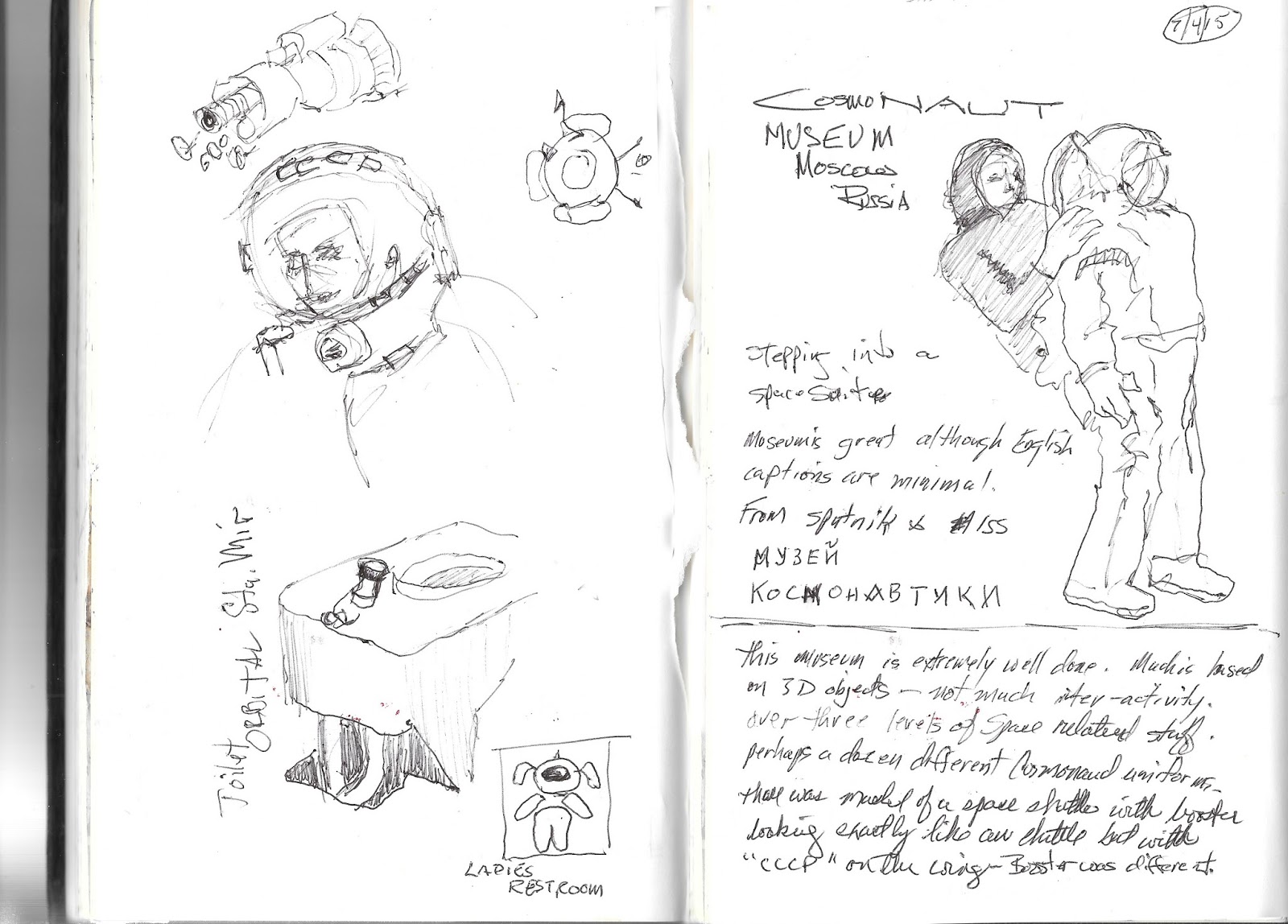
On our recent trip to Russia there was one place that interested me probably more than any other: The Museum of Cosmonautics. I'm sort of at techie at heart.  My wife, Claudette, can attest to this having visited many aircraft, railroad, automobile and naval museums with me.   What better to summarize Russian technology than a museum dedicated to space exploration? It was a "must see" for me in Moscow. The museum is located at 111 Prospekt Mira, VDNKh, and it was easy to find once you learned how to read the Russian metro maps. Like most subway maps the lines are numbered, named, and color coded. Moscow subways are world renowned for their uniqueness. Nearly seven million people a day ride the Moscow subway.  There are two ring lines with a male voice announcing on the clockwise train while the opposite is announced by a female voice.  875 direct current volts move the trains along the tracks at what seems to be extremely fast rate. Published rate of speed is only 25.9 miles per hour. I tend to believe that is an exercise in creative writing. The subway was opened in 1935 and has highly decorative Art Deco waiting platforms with arched ceilings decorated to celebrate the Russian worker. At the end of one of the platforms was a huge hammer and sickle. We queried our guide about it, but she said that was from the old Russia. Russian guides tend not to talk much of the communist ruled Russia or the days of the Union of Soviet Socialist Republics. The columns are connected by archways, many of which have decorative statues. The statues are painted black, but there is a statue of a dog whose nose is shiny bare metal. Thousands of Russians each day rub his nose for good luck.  Claudette and I did too. You can never have too much good luck.

We had to change trains twice to get to our destination.  If you turned left when you exited the train, you were at the museum, but you may not know it.  A man pointed toward a giant monument when I finally got him to understand what we were looking for. This was the Monument to the Conquerors of Space.  It was very impressive.  There is a titanium rocket atop its trail three hundred fifty feet in the air. The base was over fifty feet long and had steps all around. We could see no entrance. I sat on a bench while claudette reconnoitered. While  I sat a few Hare Krishnas came by chanting and beating a drum. The were followed by what appeared to be Russian college students. I guess some things are the same all over. When Claudette returned we decided we would go back to the street and venture further away from the train station.  Sure enough, in less than a block we found the entrance to the museum. We had not turned left when exiting the train.

The Museum of Cosmonautics is sub-terranean beneath the Conquerors of Space monument.We paid an  entrance fee  of 200 rubles, or $2.95.  They wanted an extra 200 for the right to take pictures, and even more if you wanted to shoot video. I thought this was ridiculous.  Instead, I did drawings. Fortunately, I had my Moleskine sketchbook with me. Don't get me wrong, I love to draw, but it An Astronaut's Guide to Life on Earth, all spacemen, whether astronauts or cosmonauts, must perform a specific act to insure a safe flight. When the vehicle which transports them to the spacecraft stops midway, they must get off the bus and urinate on the back tires to ensure good luck. This fact may or may not be listed on a caption in the museum.  My Russian is very poor.  
slows you down when visiting a large museum.   The museum is fascinating and had recently undergone a renovation. It traces Russian space exploration from its humble beginnings to the present day.  I remember when the Russians launched the first artificial satellite. It was called Sputnik.  It was only about the size of a volleyball with some antennae sticking out. People would go outside and look into the night sky and claim they saw it. In cartoons it always made a "beep-beep" sound. The U.S. was caught dreaming about space while the Russians were going there. As a result, American education systems placed renewed emphasis on science and mathematics. Soon the Americans caught up with the Russians and probably surpassed them in space exploration. Yuri Gagarin was the first man to orbit the earth, and his space capsule is on display.  Once he had entered the earth's atmosphere and was at a fairly low altitude he ejected from his capsule and parachuted to earth. The Russians, unlike Americans, always recovered their cosmonauts and their craft on land rather than sea. Gagarin, now deceased, started a pre-launch tradition the is still observed today. According to Chris Hadfield's book,
There are many space capsules and models of spacecraft to be seen. A model of a space shuttle very similar to ours as well as robotic moon rovers which were placed on the moon in 1971 were on display.  The moon rover was actual size.  All displays are extremely well executed. One diorama shows cosmonauts having landed in mountainous terrain during winter. It is a full size rendering of the event. Very realistic. There were two stuffed dogs representing the dogs that flew into space atop huge solid fueled rockets early in the space race. They looked like Jack Russell terriers. It was very interesting to walk through a mock-up of a section of the Mir space station.  It was a reminder of the space station at the Museum of Space and Aeronautics in Washington, D.C. My biggest criticism of the museum is the lack of English captions on displays. Unfortunately, I could not use the translator in my phone because it involves using the camera and I stupidly did not pay the extra 200 rubles for camera use. Also, there were very few direction signs in the multilevel facility.
Did I like it? You better believe it! Would I like to visit the Museum of Cosmonautics again?^ Absolutely!


Nov 14, 2014

Musty Odors and Ancient Objects

"Lady, you need to get you son out of there!" the docent said to my mother. When I was a young boy
California Automotive Museum
(about five-years-old) my mom took me to the oldest museum in the United States, the Charleston Museum. Although only the classical Greek columns of the building remain today, I can still remember that musty smell of antiquity. I also remember being apprehended by museum personnel that day.  It seems I had managed to get inside some ancient piece of armor. Was this a detriment to my quest of old stuff? Not a bit!

Museums are of all kinds, and many specialize.  As an artist I find art museums extremely interesting. The Mona Lisa, Sunflowers, Guernica, or The Third of May.  Just to be so close to the genius of da Vinci, Van Gogh, Picasso or Goya is inspiring. The  photographs in art books don't do them justice.
The Tate Modern, London.
Reproductions of art somehow always miss something. Perhaps it's the dimensional aspect of the art. With oil paintings you can see the dimensional quality of brushstrokes better and just maybe smell the hint of oil in the air. There is something awe inspiring about seeing the actual works.

Aviation museums are no doubt my favorite.  There is something about these machines that break the bounds of gravity and join the realm of birds that have always fascinated me.  In our travels I
have seen many types of aircraft, some famous and some infamous. Of course the most common historic aircraft is the Wright Flyer, or rather a replica.  The original first American airplane to make controlled powered flight was destroyed. The Spirit of St. Louis, which first was flown solo across the Atlantic, and the huge NC4 flying boat of the U.S. Navy, which was the first to fly across the Atlantic, claim aviation fame. The Messerschmitt Me-262 was the first jet aircraft flown in combat and was a marvel of German technology.  The Glamorous Glynnis was the X-15 rocket plane which Chuck Yeager flew faster than the speed of sound. Actually, Gen. Yeager named all the planes he flew after his wife. The Enola Gay dropped the first atomic bomb, which ushered in the nuclear age, and the fastest airplane to ever fly was the SR-71, Blackbird. I've been fortunate enough to see these famous aircraft and many more.

The Chicago Museum of Science and Industry

To me, the British Museum is the creme de la creme of museums.  There you will find the Rosetta Stone. Discovered in 1801, this seventeen hundred pound piece of black granite has inscriptions in three languages.  These inscriptions in three languages allow linguists to translate the hieroglyphics of the ancient Egyptians. Also in this museum are many Egyptian mummies and the mummified remains of one of the first humans.  There are the ruins from Greek temples on display as well as Roman artifacts.  It was said that the sun never set on British soil.  During this period treasures of many civilizations were collected by the British Museum.
The Museum of Anatolian Civilizations, Ankara, Turkey

Once upon a time I was an enlisted man in the U. S. Navy and therefore have an affinity for things naval other than oranges. I must say that the Spanish Naval Museum in Madrid is another favorite of mine, although I've been aboard a number of the American warships which are now museums. The Spanish National Naval Museum houses a map produced by the cartographer who sailed with Christopher Columbus to the Americas. A map shows some of the coastline of the new world. The museum follows Spanish naval history from early colonial days through World War One.  It was interesting to see a scale model of the battleship U.S.S. Maine, the ship whose sinking started the Spanish-American War and whose capstan is in White Point Gardens in Charleston, South Carolina. Another Spanish museum I favor is the museum at the Spanish Artillery School in Segovia. Spanish weaponry is traced from the crossbow and spear to the rifled and breech loading cannon. Chicago's Museum of Science and Industry, The British Museum of Science, and the Museo della Scienza e della Tecnologia Leonardo da Vinci in Milan are great science and technology museums as well. One of the most popular exhibits in Chicago is the German submarine captured during WWII. The Milan museum does a great job tracing technology from Leonardo da Vinci's machines to modern computers. The mammoth steam engines are unforgettable in the British Science museum.
The National WWII Museum, New Orleans, 

As a childhood fan of B-Western movies, I would be remiss not to mention my fondness for cowboys. The one museum that depicts cowboy life well is the Buffalo Bill Historical Center in Cody, Wyoming. There is a reason your ticket will allow you entrance for two days.  It's that big! And, to appease the artist in me, it has Frederic Remington's studio reproduced. Remington is one of my all-time favorite painters and sculptors. Throughout this country museums abound on almost any subject.  Whether it is a museum about teapots or Winchester rifles I'm sure everyone can find one that suits their fancy. That includes the Crawford W. Long Museum in Jefferson, GA, which commemorates the birthplace of anesthesia.

Perhaps one of the greatest advantages of visiting museums is the opportunity to learn. Sometimes just to see an object as opposed to reading about it or seeing pictures of it can offer a completely
The Heard Museum, Phoenix, AZ
different explanation to its operation.  Nowhere is this more evident than in  science and industry museums. They show how stuff works. And musical instruments, which are machines of a different nature, are better understood when held in your hand. The Musical Instrument Museum in Phoenix, AZ, is great for this.  How do you play a gong anyway?

I will continue to immerse myself in the next museum I find, but I don't think I can get my torso into a piece of Greek armor anymore.


The Spanish Naval Museum, Madrid

Jul 5, 2014

Abbey on the Danube.


We disembarked from our river cruise ship for Melk and its grand abbey. From the Danube it appears as a fortress high on a rocky outcropping complete with turrets. After a short bus ride through local farm land we reached the abbey and its surrounding village. I found it amusing that we walked down a stairway from the bus parking lot to an abbey which had appeared to be on the top of the mountain when viewed from below. It was founded by the Benedictine monks in 1089, and the current structure was built beginning in 1702.  It has been a school for many centuries and currently serves as a school for local children.  As you would imagine, the massive structure has over one thousand rooms with chapels  and a baroque style cathedral.  Through the halls and rooms you learn the history of the Abbey. There is a scale model of the entire complex which allows you to become more oriented. 


The displays in some of the rooms are of the old artifacts presented with new technology. The Kaisergang, Emperors' Gallery, was a 658 foot long hallway with, of course, portraits of rulers.  A personal favorite room of mine was the library.  As we stepped into the library of the Melk Abbey I said.


"Can't you almost hear the sheep bleating?"

"What in the world are you talking about?" she queried.

"Look around. There are hundreds of bound manuscripts here," I responded, indicating with my raised arm walls over twenty feet high full of books.

"It's the monks' library. Of course there are a lot of books.  The guide said there were about one hundred thousand. But she did not say anything about sheep," she said.

"Sheepskin, dear. Books were first made of vellum, sheepskin. Only about four pages could be made from one sheep's skin. Look around, many of these old books have vellum pages, and that was a lot of sheep!" said I.

"I thought vellum meant 'calf skin'?" she asked.

"Well...it does, literally.  You got me on that one. But when someone graduates from college we say 'They got their sheepskin', not calf skin!  Did you know that vellum is more permanent than paper?" I was still trying to impress her.

"Look at these book shelves.  They must be twenty feet tall, and the gilded wood carvings are awesome. I can't believe that this library is still in use," she mused.

"I wish I could take some pictures in here," I commented.

"You know they are forbidden! You shouldn't have taken those in Nuremberg where the sign said: 'No Photos'."
Wikipedia photo

There was a sculpture in the center of the library representing wisdom. Also, there were antique globes representing the earth that were true works of art.   The largest was over four feet tall. There was a spiral staircase to the other floors of the library which were off limits to tourists.  We did not see a scriptorium, which is where the monks would have copied manuscripts by hand. However, we had seen one at Mont Saint Michel, France.


Another favorite room for visitors is the Marble Hall.  This hall, that was originally used for meetings and dining, was empty during our visit. It was a thing of beauty with sunlight streaming in illuminating the interior. The floor is parquet style marble with colored stone in various colors. You can detect the wear of centuries in its unevenness. But the center is dominated by a huge ornamental iron grate which allows for heating of the large hall. The ceiling was spectacular not only because of the fresco by Troger but because of the design. Following the idea  trompe-l'oeil  the artist created the illusion of a domed ceiling.  Another bit of visual trickery is in the wall decor.  Some of the wall treatments are actually painted on to represent carved marble. (see photo above) However, the Marble Hall at Melk Abbey was definitely worth our time and shouldn't be missed by a traveler in that part of Austria.


We exited the building through the church. Since mass was in progress we did not tarry, but did take a few photographs of this beautifully decorated church.  Built in the baroque style, ornamentation is lavish. This style was encouraged by the Catholic Church in rebellion against the Reformation. Much of the ornamental stone work was covered with gold leaf.  Having done some gilding as a signmaker, I particularly enjoy good examples of the gilders craft.

Once back aboard ship, we sailed for Krems. Some of our shipmates went to a wine tasting tour of a local winery. But, Claudette and I did some window shopping, because most of the stores were closed. There was a street entertainer, a one-man band, rendering American folk songs. He was good.  We dropped a few euros in his cup.  I did a few sketches, and we enjoyed ice cream at a sidewalk cafe. Soon we were back aboard the Kara and enjoying hearing of our friends' visit to a local winery at dinner.

I am fast becoming a fan of Viking River Cruises.